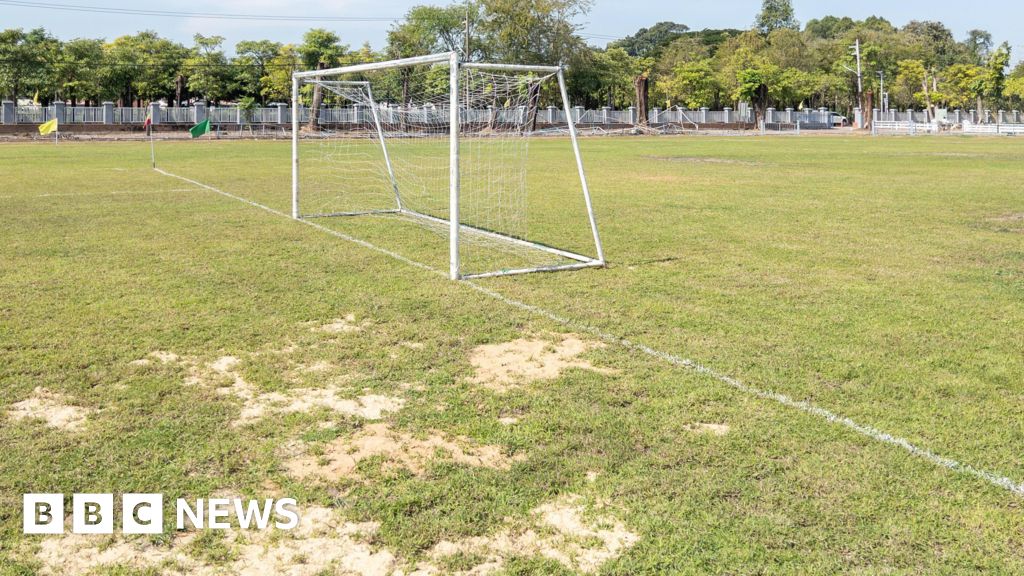
Dry weather conditions are leaving football pitches "like concrete" – and could put players at increased risk of injury, Yorkshire clubs have warned.
They said pitches were left waterlogged in winter and then baked hard in summer, and called for more support from sports bodies.
A report by non-profit group Round Our Way, which examines the impact of climate change, said the cost of making pitches safer was putting "significant financial pressure" on grassroots clubs.
Tadcaster Albion FC chairman Andy Charlesworth said: "Last year we ran sprinklers 24 hours a day for six weeks, costing around £2,000 in water alone, yet the pitches were still rock hard. It's like playing football on concrete."
Charlesworth said clubs were paying a rising price to keep pitches playable.
"We're getting no support from the FA or the Football League Foundation," he said.
"We're just starting our pre-season and we're struggling.
"Some of our grass is dying – we're not in a good situation.
"We've got a rota for trying to water the areas of the pitch that are affected to try and get the grass to grow, and that will give the players slightly more protection if they go down onto the hard surface but there's not much more we can do.
"We've just got to muddle through like every other non-league club."
Local clubs argue that while considerable investment has gone into improving grassroots facilities, there is a growing need to help them adapt to the changing climate.
"It's getting harder and harder with every year that goes by," said Charlesworth.
"We don't have a big pot of money and there's only so much you can currently ask for.
"There are no special schemes available. We need more investment in better drainage and irrigation systems from the governing bodies."
Last year, Pocklington Town AFC was forced to postpone part of an annual tournament after pitches became so hard and grass cover so sparse that club officials considered them unsafe.
One player suffered a serious elbow injury during the event.
Richard Bower, secretary of Pocklington Town AFC, said: "We've invested years and thousands of pounds improving our pitches, but two extremely hot summers virtually wiped out much of that progress."
Recent years have seen record-breaking temperatures, longer dry spells and growing concerns about the resilience of community sports infrastructure.
The problem is expected to become more common as climate change increases the frequency and intensity of extreme heat events in the UK.
Lindsay Stringer, Professor in Environment and Development at the University of York, said the effects of climate change on sports pitches depended on the type of soil they had.
She said: "Football pitches suffer from a lot of soil compaction as players run around but normally the pitch has a good degree of in-built elasticity due to both the grasses and the soil pores which add a bit of bounce.
"If you have heavy clay content, it expands a lot when it gets wet and shrinks when it is dry so this can open up surface cracks as well as becoming really hard.
"If the grasses have died as well due to insufficient water, you end up with large areas of bare ground as the dead biomass is easily eroded.
"Hard bare soils mean that if the players fall over, they are at higher risk of injuries like concussion, as well as the fact that the hard surface puts extra stress on their joints as they run around on it."
Dr Jamie Salter, Senior Lecturer in Sports Science & Injury at York St John University, said the change in pitch conditions may lead to an increase in bone stress injury.
"In grass-based sports we wear football boots which are not specifically designed to absorb that force in the same way that running shoes or basketball shoes would be," he said.
"If people are participating on these hard surfaces multiple times per week over a prolonged period, they're more likely to see bone injuries like shin splints – particularly in younger people who haven't got fully established bones – and stress fractures, typically around the fifth metatarsal in the foot or in the tibia bone."
Campaigners are calling for greater support for clubs adapting to changing weather conditions.
Round Our Way co-founder Roger Harding said: "Clubs shouldn't be left to navigate this alone, with some having to find thousands of pounds to make pitches playable.
"Government and sports bodies need to come together and develop an easy-to-navigate support system so clubs can get the advice and funding they need."
Harding said the inequality across elite and grassroots teams meant that local clubs were suffering.
"It is a good moment to ask whether enough money is flowing down from elite levels to help pay for this, especially with Premier League clubs harnessing the technology that makes them more inoculated from weather extremes," he said.
Adaptations could be made by clubs to lower the risks for players, but these come at a cost, according to Stringer.
"Players may need to adapt their footwear, making sure they are wearing boots suitable for harder ground, with shorter studs," she said.
"Using machines that mechanically de-compact the soil, and making sure the turf comprises more drought-resistant grass cultivars can also help.
"It's tricky though as some of these adaptations require re-engineering the pitch altogether, and then of course, the costs rise."
Salter said that governing bodies could subsidise a switch to artificial pitches, designed with rubber or cork surfaces to absorb shock.
"Artificial pictures do get warm but it doesn't affect the interaction with the ground in terms of the shock absorption," he said.
"It's about increasing accessibility to those facilities for teams who can't afford these adaptations."
The Department for Culture, Media and Sport has been contacted for comment.
Listen to highlights from North Yorkshire on BBC Sounds, catch up with the latest episode of Look North.
Researchers say more frequent heatwaves and floods will affect Londoners' health and finances.
After a year of storms, heatwaves and record rainfall, communities are grappling with climate change.
Just weeks after a June temperature record was set in Merryfield, Somerset, the hot weather is set to return.
A childhood fascination with bogs led one Welsh scientist to try and help save the planet.
The Great Big Climate Circus is a four-year youth-led project funded by the National Lottery.
Copyright 2026 BBC. All rights reserved. The BBC is not responsible for the content of external sites. Read about our approach to external linking.
About the Author