Read more 'America at 250' content
Sponsored By
ADVERTISEMENT
ADVERTISEMENT
ADVERTISEMENT
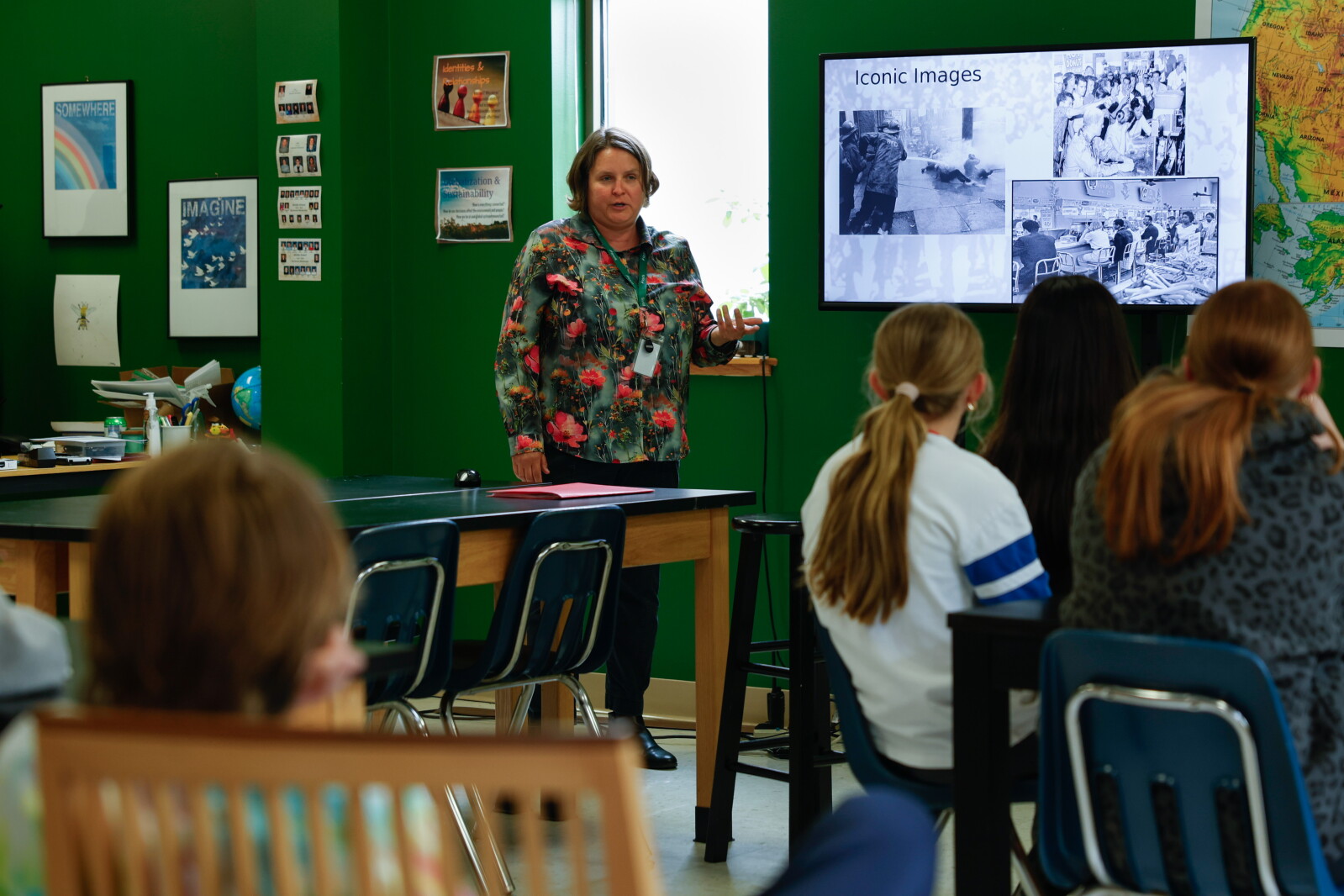
ROCHESTER — In her classroom at Rochester Montessori near the end of the school year, Nancy Richardson had her students stand up and move to one side of the room or the other in response to different statements she gave them.
“The government is always right,” she said at the beginning of the exercise.
ADVERTISEMENT
Most of the students moved to the side of the room that indicated they didn’t agree with the statement. A couple of others moved to the opposite side to indicate they did.
Then Richardson started pressing them on their stances, trying to make them think through the positions they had just taken.
Then she gave them another statement: “The government treats everyone fairly.”
And then another: “War is always just.”
Again and again, the students shifted to one side of the room or the other, and — again — Richardson began making them justify the side of the room their feet had taken them to.
Once everyone returned to their seats, the class went on to talk about the America of the 1960s and 1970s — about protests and counterprotests and the struggle over who gets to tell the story of the country.
In the span of a class period, Richardson was trying not just to teach her students a particular set of facts from an era of the country’s past, but also to tie that history into the students’ understanding of the world they are living in in 2026.
ADVERTISEMENT
It was a momentous occasion for those kinds of lessons. That’s because this year, after all, marks the 250th anniversary of the signing of the Declaration of Independence, also known as the “semiquincentennial” — a word that takes almost as long to say as the time period it describes.
As it turns out, that milestone also coincides with an era when the historical record — the country’s resume, as it were — is a source of contention in the national discourse. In recent years, politicians and advocacy groups have begun raging back and forth about the lens through which history should be taught.
And to varying degrees, that’s something Rochester’s teachers have felt in their classrooms. But at the same time, they’ve been trying to teach the historical record for what it is and help their students interpret it with an open mind.
The battle over the way schools have been teaching history has reached a fever pitch in recent years, with headlines in national news outlets describing how politics on either end of the spectrum is seeping into America’s classrooms.
In 2022, the Harvard Graduate School of Education released a story headlined “The Greatest Battle in History: America is once again asking the question: who gets to decide how we teach the history of our country’s past.”
Then in March 2025, President Donald Trump signed an executive order aimed at “restoring truth in American history,” and another under the banner “Ending radical indoctrination in K-12 Schooling.”
ADVERTISEMENT
Later in 2025, the New York Times published a story under the headline “How politics is changing the way history is taught.”
From teachers unions to advocacy groups to pundits to politicians — there’s no shortage of opinions on how students should learn about the country’s shared past and about how current events follow in the wake of what has come before.
For some teachers, however, that has led to history lessons that are more dynamic than ever.
For example, Century High School social studies teacher Kathryn Gardner said she can’t remember a time in recent memory when anyone was talking about the Voting Rights Act until it recently entered the news cycle.
There have also been plenty of debates related to the U.S. Constitution, such as whether the president could run for a third term. And when the United States invaded Iran in late February, Gardner brought that into the classroom with a segment called “the continuity of change.”
“A lot of people have said, ‘Isn’t it hard to teach history right now? ’ ” Gardner said. “And I’m like, ‘Nope — it’s the easiest time ever.’ … There are just so many things that are relevant to the news today.”
For each subject area that schools teach, the Minnesota Department of Education lays out a set of standards that have to be met. Those standards set a goal for what students should be able to know by each grade level.
ADVERTISEMENT
The state reviews those standards every 10 years, and 2026-27 will be the first year teachers will have to teach their students based on the newly-released standards.
So what do students learn about in history class anyway?
At the Rochester Arts and Sciences Academy, another classroom of sixth-grade students was learning specifically about Minnesota history. The class’s teacher, Dorothy Jorgenson, described how the school uses the topic of state history in the sixth grade as a prelude to the U.S. history that students learn about in the seventh grade.
In Jorgenson’s class, they reached back all the way into the Ice Age to talk about the geography we live in now. Jumping forward, they learn about Indigenous peoples, including the Dakota and the Ojibwe, about the fur traders and the settlers, about how Minnesota came to be known as “the New England of the West” and about how Minnesota was the first state to volunteer troops for the Civil War.
Even at the state level, they touch on how current events factor into the story, such as the recent Congressional vote to open an area near the Boundary Waters to mining.
On one of the last days of school before summer break began, they were looking not back on the past, but toward the future by trying to imagine what the city of Rochester would look like in 100 years.
In Gardner’s AP U.S. History class, a test from the early period of the country’s history includes questions about the early battles of the American Revolutionary War, the Constitutional Convention and what the hindrance was to establishing a peaceful settlement with Great Britain.
ADVERTISEMENT
In one question, students are asked whether “the idea that all men are created equal and have natural rights” is found in the Declaration of Independence, the Articles of Confederation, the Constitution or the Bill of Rights.
In Richardson’s class at Rochester Montessori, one of the test questions on the topic of the Mississippi asked students to “explain the connection between the Mississippi River, King Cotton and the Slave Trade in New Orleans.”
Another asked students to “explain the significance of the Louisiana Purchase” and explain “what it accomplished and why it was so important and yet also controversial?”
And from time to time in class, the teachers are struck with the harsh reality that what may have seemed obvious to them is no longer among the younger generation’s warehouse of common knowledge.
“Who’s LBJ?” Richardson asked the class.
“Lebron?” one of the students responded.
When teaching, Gardner said she tries to engage students in such a way that allows them to step outside their own opinions, such as following the 2025 assassination of the political activist Charlie Kirk.
ADVERTISEMENT
“Why did his message resonate with college students?” she said, as an example. “A student would be able to respond to it and not feel like they were necessarily speaking for themself. And I think that’s a safety net for 15- and 16-year-olds who don’t want to feel that way.”
Several of the students spoke about how learning about history in class is a way to get a more rational perspective on the topic compared to what they hear through social media platforms where influencers push information — accurate or not — with a heavy coating of opinion.
One day near the end of the school year, her students were huddled together in groups, trying to work on projects they had begun. Two of the students, Joanna Richard and Loujane Omar, were creating a YouTube channel to talk about the different eras the country has gone through.
Omar pointed out how a line can be drawn connecting moments from history to things that are still relevant today.
“I think history kind of affects everything,” she said, explaining that they get to learn “the why” behind everything.
Later in their class, Richardson and her class at Rochester Montessori were going through a series of iconic photos from the Civil Rights era. One showed a police officer turning a water hose on a protester. Another showed a woman putting a flower into the barrel of a soldier’s rifle.
Then she pulled up YouTube and played snippets of protest songs that came around during the Vietnam War. One of them was “Where Have All the Flowers Gone” by Pete Seeger, which prompted one of the students to suggest it would have sounded better as a heavy metal song.
Then Richardson played “Lyndon Johnson Told the Nation” by Tom Paxton and “For What It’s Worth” by Buffalo Springfield.
Once again connecting history to the present, Richardson asked the class what they would feel strong enough about to protest.
“Iran,” one of the students replied.
ADVERTISEMENT
ADVERTISEMENT
ADVERTISEMENT
About the Author