Israel and Hezbollah Agree To Ceasefire
BBC News
This video can not be played
This live coverage has closed – read our latest article
Israel and armed Lebanese group Hezbollah have agreed to a ceasefire, a senior US official confirms to the BBC
The agreement follows concerns that continued fighting in Lebanon could undermine the deal between the US and Iran, which called for an end to military operations on all fronts, including Lebanon
According to local emergency services, strikes have continued in Lebanon since the ceasefire deadline
In recent days, the relationship between the Trump administration and Israel has appeared strained
The deadly escalation in southern Lebanon is another sign that Trump is not necessarily in control of the fate of his deal with Iran, writes our State Department correspondent Tom Bateman
Lebanon's health ministry says Israeli strikes since midnight have killed at least 47 people, while Israel says four of its soldiers were killed by Iran-backed Hezbollah
Edited by Andrew Humphrey Katie Williams
Live reporter
Israel and Hezbollah have agreed to a ceasefire in Lebanon after overnight strikes killed at least 47 people, according to the health ministry.
Israel said the strikes were in response to repeated violations by Hezbollah, including an attack overnight which killed four IDF soldiers.
The ceasefire came into effect at 16:00 local time (14:00 BST) but our reporters on the ground say strikes has continued.
It is an early test of the US-Iran deal signed earlier this week, which requires an "immediate and permanent" termination of military operations on all fronts including Lebanon – here's a closer look at the details of the agreement.
The IDF has vowed to "continue to remove immediate threats" and to "respond to Hezbollah's violations".
Meanwhile, Iran's Foreign Minister Abbas Araghchi has said any breach of commitments "will be attributed to the US".
Donald Trump has expressed growing frustration with Israeli PM Benjamin Netanyahu in recent days, saying: "You don't have to knock down a building every time someone walks into it that's from Hezbollah."
Trump is desperate to avoid a derailing of the Iran deal, while Netanyahu is under pressure to placate both Trump and the Israeli public, our correspondents write.
We're now bringing our live coverage to a close, but you can read our article with the latest or read more analysis about the US-Iran deal from Jeremy Bowen.
In a call with Lebanon's president today, US Secretary of State Marco Rubio said negotiations with Israel were "the only feasible path to reconstruction, economic recovery, and ending recurrent cycles of violence", according to State Department spokesman Tommy Pigott.
Rubio also reiterated the need to disarm Hezbollah, and expressed US support for a fully sovereign Lebanese state at peace with its neighbours.
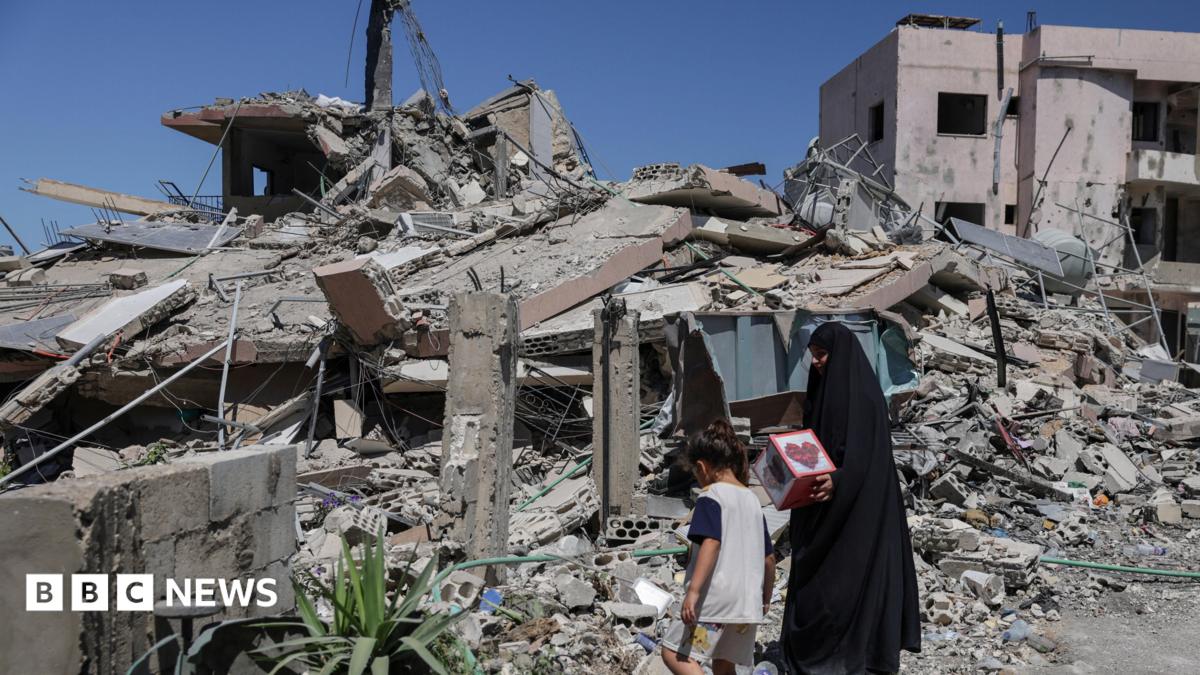
Lebanese people living in Tyre, a city in southern Lebanon which has been left in a state of ruin from the war between Israel and Hezbollah, have been giving their thoughts on the ceasefire announced today.
Speaking to Reuters news agency, one resident, Rida Hijazi, called on Israel to "restrain itself" and respect its borders, claiming "they are the ones who always aggress us and the Arab countries".
Hijazi said he hopes "peace will prevail" and both countries can "live in the coexistence that we have shared for a long time, and still do to this day".
Another local, Mohammed Zeidan, was less hopeful and doesn't think Israel will commit to the ceasefire because "Hezbollah is not letting them stop this".
He added the fighting will only stop when Israel withdraw from Lebanon, adding: "As long as Hezbollah is on the border, we are with them and standing firm."
A view of a house and a shop which were damaged by an Israeli strike in the Tyre district of southern Lebanon Hugo Bachega
Middle East correspondent in Nabatieh, southern Lebanon
In Lebanon's south, the past 24 hours has been one of the most intense periods of Israeli air strikes.
The bombing was in response to the killing of four Israeli soldiers by Hezbollah in southern Lebanon. Israel said it carried out more than a hundred and fifty strikes on what it described as Hezbollah targets.
Recent promises of peace in Lebanon have often ended in more war.
There's now a new ceasefire – but a lasting truce remains elusive.
Israel says it has no intention of pulling its troops out of Lebanon, saying it wants to create a security zone along the border, free of Hezbollah.
The group says it will abide by the deal if it's respected by Israel.
Today's ceasefire in Lebanon fulfils a part of the wider Memorandum of Understanding between the US and Iran, signed on Wednesday, which aims to bring an end to the war in the Middle East.
But since the details of that agreement has been published it has been criticised by some American politicians, most notably, Barack Obama, who has given his thoughts on the deal for the first time since it was signed.
The former US President said he was "very happy" to see a ceasefire and is "hopeful" that it will hold.
But he also questioned the rationale for the war on Iran, noting the US has spent "billions of dollars" and "a lot of people have died".
"It feels like we’re back where we were before we started the war, except maybe a little bit worse off,” he told NBC News.
Obama has received significant criticism from Trump in the last few days over the 2015 nuclear agreement that was agreed with Iran under his presidency.
The deal, known as the Joint Comprehensive Plan of Action, took several years to negotiate and was in force between 2016 and 2018 until being scrapped by Trump in his first term.
Obama speaking in Illinois on Thursday Charlotte Gallagher
Reporting from Jerusalem
Benjamin Netanyahu is under serious pressure from two very different camps.
President Trump wants the fighting in Lebanon to stop before it derails negotiations with Iran. But many Israelis – both politicians and members of the public – want the offensive push in southern Lebanon to continue, believing Hezbollah is an existential threat.
Earlier today, Itamar Ben-Gvir, Israel’s far-right security minister, said: “All of Lebanon must burn”.
It’s hard to see how Benjamin Netanyahu placates both his most powerful international ally and people in his own country.
He has already said he will not withdraw troops from Lebanon while Hezbollah is still operating, in order – he says – to protect Israelis living in the border region. Hezbollah has previously said it will not disarm while Israeli troops remain in Lebanon.
It’s not hard to see why the ceasefire is already faltering just hours in – many would argue it never even began.
The IDF has vowed to "continue to remove immediate threats" posed by Hezbollah despite the announcement of a ceasefire with the terror group, in a statement posted on Telegram.
IDF Spokesperson, Brigadier General Effie Defrin, said Hezbollah has launched "hundreds" of attacks targeting its civilians, including an attack overnight which killed four IDF soldiers.
"These attacks by Hezbollah are violations of the ceasefire. They prove that Hezbollah’s goals remain the same: to remain on Israel’s borders and to plan and carry out attacks on our civilians," he added.
Defrin said the IDF continues to operate in southern Lebanon, adding its soldiers "must stand between Hezbollah and Israeli civilians".
He added the Israeli military will continue to "remove immediate threats, respond to Hezbollah’s violations, and do whatever is necessary to protect our civilians".
Iranian Foreign Minister Abbas Araghchi claims that any breach in the commitments set out in the memorandum of understanding "will be attributed to the US", according to a post on his Telegram.
Araghchi told his Pakistani counterpart in a phone call this afternoon that the deal agreed to "end the war on all fronts" – including in Lebanon – and that America would be responsible for any "violation" of this. Joe Inwood
World news correspondent
Given that the fighting has already killed thousands, with around a million forced from their homes, maintaining a genuine ceasefire between Israel and Hezbollah will clearly have an immediate and important impact for the people of Lebanon.
But it will also have consequences for the wider region – including the prospects for peace between the US and Iran.
For Iran, the deal it did with the US covered the entire Middle East, including its ally Hezbollah. The fact that Israel has continued its offensive was seen by many as a key factor in the failure of talks with the US to take place today.
Indeed, President Trump also agreed that the fighting in Lebanon should end, accusing his Israeli allies of being disproportionate in their responses to Hezbollah provocations.
It is clear he knows that what is taking place in Lebanon has the capacity to derail his prized "Memorandum of Understanding" with Iran – something he is desperate to avoid. Samantha Granville
Reporting from Nabatieh, southern Lebanon
The 16:00 ceasefire appears to be a ceasefire in name only.
We spent the day at a hospital in Nabatieh, southern Lebanon, perched on a hilltop with a 360° view of the town and surrounding villages.
Our team counted more than a dozen Israeli air strikes in our time there.
As we were leaving, the ceasefire was announced. But our contacts at the hospital told us the booms kept coming.
According to the Nabatieh ambulance service, there’s been at least 12 strikes since the ceasefire deadline.
People in the city have little hope that it will be respected.
Iran's foreign ministry spokesman Esmail Baghaei says there is "no basis" behind reports that Iran has re-closed the Strait of Hormuz, according to comments shared by Tasnim news agency.
Some outlets reported earlier that the Islamic Revolutionary Guard Corps (IRGC) had announced the closure of the vital shipping passage. The New York Post pointed to an IRGC statement read over maritime radio channels, which blamed the closure on Israel's refusal to pull forces out of southern Lebanon.
The US and Iran's 14-point memorandum of understanding – signed earlier this week – states that the shipping channel should be reopened toll-free for 60 days, with discussions taking place about the longer-term future.
In return, the US has dropped its naval blockade on Iranian ports, although some vessels remain "in the general area", US Central Command has said.
Here's a reminder of the US and Iran's initial agreement to end the war, which was signed by both parties on Wednesday and centres around 14 points:
1. "The immediate and permanent termination of military operations on all fronts, including in Lebanon"
2. US and Iran to "respect each other’s sovereignty and territorial integrity and to refrain from interfering in each other’s internal affairs"
3. They "commit to negotiating and achieving the final deal in maximum 60 days, extendable with mutual consent"
4. Immediately, the US "will begin the removal of its naval blockade… and will fully end the naval blockade within 30 days"
5. In the Strait of Hormuz, Iran "will make arrangements using its best efforts for the safe passage of commercial vessels with no charge, for 60 days"
6. The US undertakes "with regional partners to develop a definitive, mutually agreed plan with at least USD $300 billion for the reconstruction and economic development of" Iran
7. US to "terminate all types of sanctions against" Iran
8. Iran "reaffirms that it shall not procure or develop nuclear weapons", but other parts of the programme are still to be negotiated. The two parties "agreed to discuss the issue of enrichment and other mutually agreed matters related to the Islamic Republic of Iran’s nuclear needs"
9. Pending the final deal, the US and Iran "agree to maintain the status quo"
10. Upon signing, and until the termination of sanctions, US Treasury will "issue waivers for the export of Iranian crude oil, petroleum products, and derivatives, and all associated services"
11. US undertakes "to make fully available for use the frozen or restricted funds and assets" of Iran
12. "An executive mechanism will be established to monitor the successful implementation" of this memorandum
13. After signing – subject to implementation of points 1, 4, 5, 10 and 11 – the US and Iran "will start negotiations regarding the final deal exclusively on the other paragraphs"
14. "The final deal will be endorsed by a binding UNSC (United Nations Security Council) resolution" Tom Bateman
US State Department correspondent
The deadly escalation in southern Lebanon last night is another sign that Trump is not necessarily in control of the fate of his much-needed deal with Iran – a reality which has got him increasingly angry and frustrated this week.
The agreement – or memorandum of understanding (MoU) – declared a ceasefire in Lebanon as well as between the US and Iran. But that has not been the reality on the ground, seeing Tehran accuse Trump of failing to rein in Israel.
Trump himself has actually given fuel to this argument in an unprecedented set of angry accusations against his ally, Israeli Prime Minister Benjamin Netanyahu, suggesting he has been senselessly killing civilians in his fight against Hezbollah.
Last night’s flare-up in southern Lebanon poses more problems for Trump.
Hezbollah said Israeli forces were trying to infiltrate an area when the group targeted Israeli forces with anti-tank missiles.
Israel’s strikes killed some 18 people in southern Lebanon; Hezbollah killed four Israeli troops including a battalion commander.
While the White House insists there’s now a ceasefire, Israel’s far-right ultra-nationalists are demanding "all of Lebanon must burn" as Tehran calls those ministers a "genocidal death cult".
The survivability of the deal for Trump rests on each side reining in hardliners and showing restraint – and there are few signs of that.
BBC Arabic’s Carine Torbey has been reporting from Tyre, in southern Lebanon, just before the latest ceasefire was announced.
Watch her report below explaining how the city and its residents have been impacted by the conflict.
This video can not be played
Israeli air strikes leave ruins across Lebanon's historical city Tyre
In recent days, the relationship between Donald Trump and the Israeli Prime Minister Benjamin Netanyahu has appeared strained following the signing of the US-Iran deal.
Israel had continued its strikes on Lebanon, as recently as last night, despite the memorandum of understanding stating that military operations in the country would cease.
Speaking at the G7 summit in France on Wednesday, Trump said Netanyahu was a "good man" but he gets "a little excited sometimes".
He said the PM could do with "a little softer touch", adding: "You don't have to knock down a building every time someone walks into it that's from Hezbollah."
But yesterday, Vice-President JD Vance went even further, telling reporters that he did not appreciate criticism of the deal and of Trump by Israeli cabinet members.
He claimed Trump "is the only head of state in the entire world who is sympathetic" towards Israel at this time.
"The problem for Israel is not Donald J Trump; and anybody in Israel who thinks their biggest problem is the president of the United States needs to wake up and smell the reality of the situation that the country is in," he said.
Trump and Netanyahu at the White House in September last year
At least 47 people have been killed and 97 others wounded in Israeli air strikes in the country today, according to Lebanon's health ministry.
A statement by the ministry says the deaths took place between midnight and this afternoon, when a ceasefire between Israel and Hezbollah was announced.
Israel said earlier today that it had struck two Hezbollah command centres in the Beqaa Valley, eastern Lebanon, before confirming the ceasefire.
Images released by Reuters news agency which were photographed prior to the ceasefire agreement show smoke billowing over southern Lebanon after Israeli strikes.
At least 18 people were killed in southern Lebanon following air strikes overnight. The Israel Defense Forces (IDF) said earlier it had struck 80 targets linked to Hezbollah.
Smoke billows following an Israeli strike on southern Lebanon, as seen from the town of Marjayoun
A woman returns to her village in the Tyre district
A house and shop in the Tyre district are reduced to rubble
The Israeli military has been operating in southern Lebanon since March
Lebanon was drawn into the war between Israel, the US and Iran at the beginning of March, with Hezbollah launching rockets into Israel in retaliation for an Israeli strike that killed Iran's supreme leader.
Israel responded by launching a bombing campaign across Lebanon and invading a significant part of the country's south, with the aim of driving back Hezbollah fighters from its northern border.
At least 3,912 people have been killed, among them women and children, and a further 11,699 others wounded since the latest conflict began, according to Lebanon's health ministry.
About a million people remain displaced, while dozens of communities in the south have been completely destroyed.
Hezbollah has vowed to continue with its attacks as long as the invasion persists.
The IDF has confirmed that there is a ceasefire in place between Lebanon's Hezbollah and Israel.
IDF Spokesperson, Brigadier General Effie Defrin, says in a statement: "We are in a ceasefire. The IDF is prepared to continue fighting if called upon to do so."
The first point in the US-Iran deal declares an "immediate and permanent" termination of military operations on "all fronts", including Lebanon.
It also commits all sides to ensuring Lebanon's "territorial integrity and sovereignty".
Centred around 14 points, the memorandum of understanding also includes reopening the Strait of Hormuz, a requirement that Iran will never have a nuclear weapon, a $300bn (£224bn) plan for Iran's "reconstruction", and the US terminating "all types of sanctions" on Iran.
US officials have previously said that while Lebanon was covered by the ceasefire framework, the withdrawal of Israeli forces from Lebanese territory was not a condition of the deal and that Israel would retain the right to self-defence.
To watch and listen, you need to enable JavaScript in your browser.
Israel and Hezbollah Agree To Ceasefire. BBC News. Video
BBC News
Copyright © 2026 BBC. The BBC is not responsible for the content of external sites. Read about our approach to external linking.
About the Author