Industry
[DigitalToday reporter Jinju Hong (홍진주)] Researchers have developed a small humanoid robot that uses a low-cost Android smartphone as the robot’s eyes, sensors and computing device. A key feature is lower build costs by using older, readily available smartphones instead of dedicated high-priced cameras and computers.
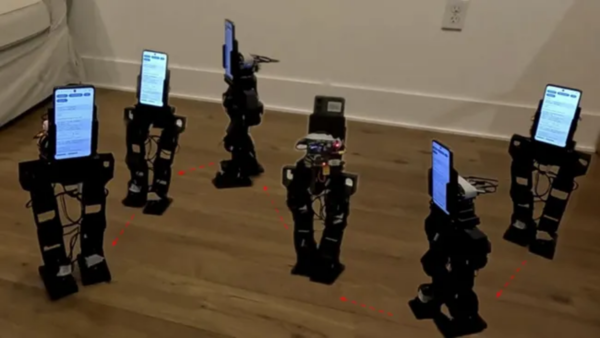
On Oct. 18 (local time), IT outlet TechRadar reported that a research team at the University of California, Los Angeles (UCLA) developed an open-source robot platform called PhoneBot that uses a smartphone as a core device. Hardware costs excluding the smartphone are about $400 (about 530,000 won), and it is designed to be built more cheaply than existing small humanoid research systems.
PhoneBot is a small robot about 48.3 cm tall and weighing 1.8 kg. It uses 13 servo motors to control its legs and a rotating torso. The researchers reduced the cost burden by rebuilding a system that relied on separate high-performance computers and dedicated sensors into a smartphone-centred setup.
The key to PhoneBot is using components built into the smartphone for robot control. The camera is used to detect and track people, while the inertial measurement unit (IMU) provides information on the robot’s movements. This allows the robot to understand its posture and motion and control walking.
The smartphone sends control commands via WiFi. A separate computer inside the robot converts commands into movements for each motor and manages communication between motors. The system is set up so major computations such as walking control and visual recognition are processed on the smartphone.
Each leg has 6 actuated joints on each side, including the hip, knee and ankle. It also adds a joint that rotates the torso and smartphone together. This lets the robot point the smartphone camera toward a person without continuously moving its feet to turn its entire body.
The researchers tested the platform with 4 Android smartphones, including the Honor 9 released in 2017. The smartphones used in the tests cost about $50 to $80. While detailed features differed by device, all supported core functions such as motion sensing and walking control, visual recognition and interaction with people.
The researchers trained the robot’s walking controller with reinforcement learning in a simulation environment. The method rewarded desired movements and imposed penalties for unstable posture or excessive motor load. The trained controller ran on the smartphone through TensorFlow Lite.
Early experiments showed problems such as uneven walking patterns or excessive reliance on one leg. To improve this, the researchers introduced mirrored training samples that match left and right movements. This enabled symmetrical learning of both legs without adding additional physics simulation stages.
In evaluations, left-right symmetry error in joint angles fell to 0.003 radians from 0.254 radians across 5 independent training runs. Left-right torque imbalance fell to 0.034 from 0.205, and mechanical power imbalance decreased to 0.040 from 0.339.
In demonstrations on the real robot, it was shown walking, standing back up after falling, and rotating its camera toward a person. It combined the low-cost smartphone’s camera, sensors and computing performance to implement basic humanoid movements and vision-based interaction.
PhoneBot lowers build costs, but challenges remain. Using low-power servo motors means it can carry only a small load, and it has limits in performing fast and dynamic movements stably.
The walking controller was also trained on a flat floor. Further verification is needed on whether it can move stably on uneven terrain. Its armless design also does not provide manipulation functions such as picking up or moving objects.
The researchers released the PhoneBot project as open source so other researchers can reproduce the hardware, change parts or expand smartphone-based robotics research. The results were published on the preprint repository arXiv.
The project shows it may be possible to build a robot without expensive dedicated computers and sensors by using cameras, inertial sensors and computing functions already built into a smartphone. It adds that for the robot to develop into a general-purpose humanoid usable in industrial sites or homes, it will likely need further improvements in mobility stability, strength and object manipulation capabilities.
This content was produced with the assistance of AI and reviewed by our editorial team. You can read the original version in Korean here.
About the Author