e-Edition
Get the latest news in your inbox!
Get the latest news in your inbox!
e-Edition
Trending:
Two years before San Diego rejected the Chargers’ final stadium proposal, the team had already heard a verdict from its own pollsters.
A survey commissioned in late 2014 found more than 70% of likely voters opposed public financing for a new stadium. After respondents heard arguments against public funding, opposition approached 80%.
An internal Chargers draft prepared to make the team’s case to the NFL for relocation, obtained by the Union-Tribune, drew a stark conclusion: “In short, there is simply no way to achieve the two-thirds majority required by the California Constitution.”
Less than two years later, the Chargers asked voters for that majority anyway.
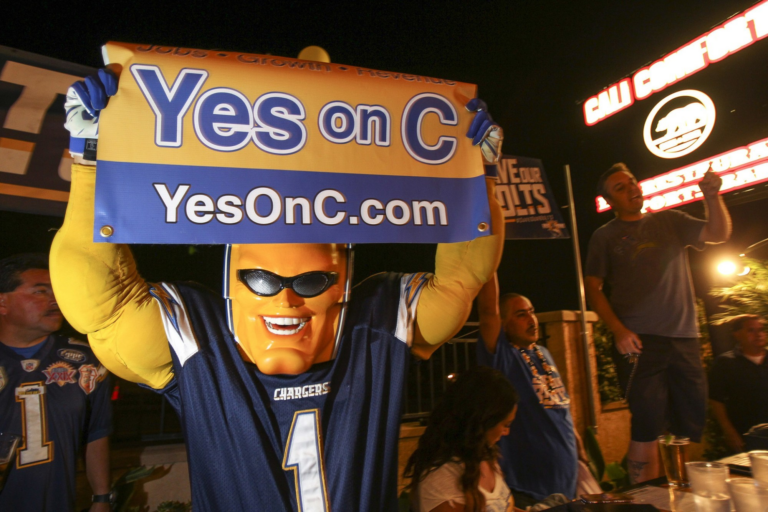
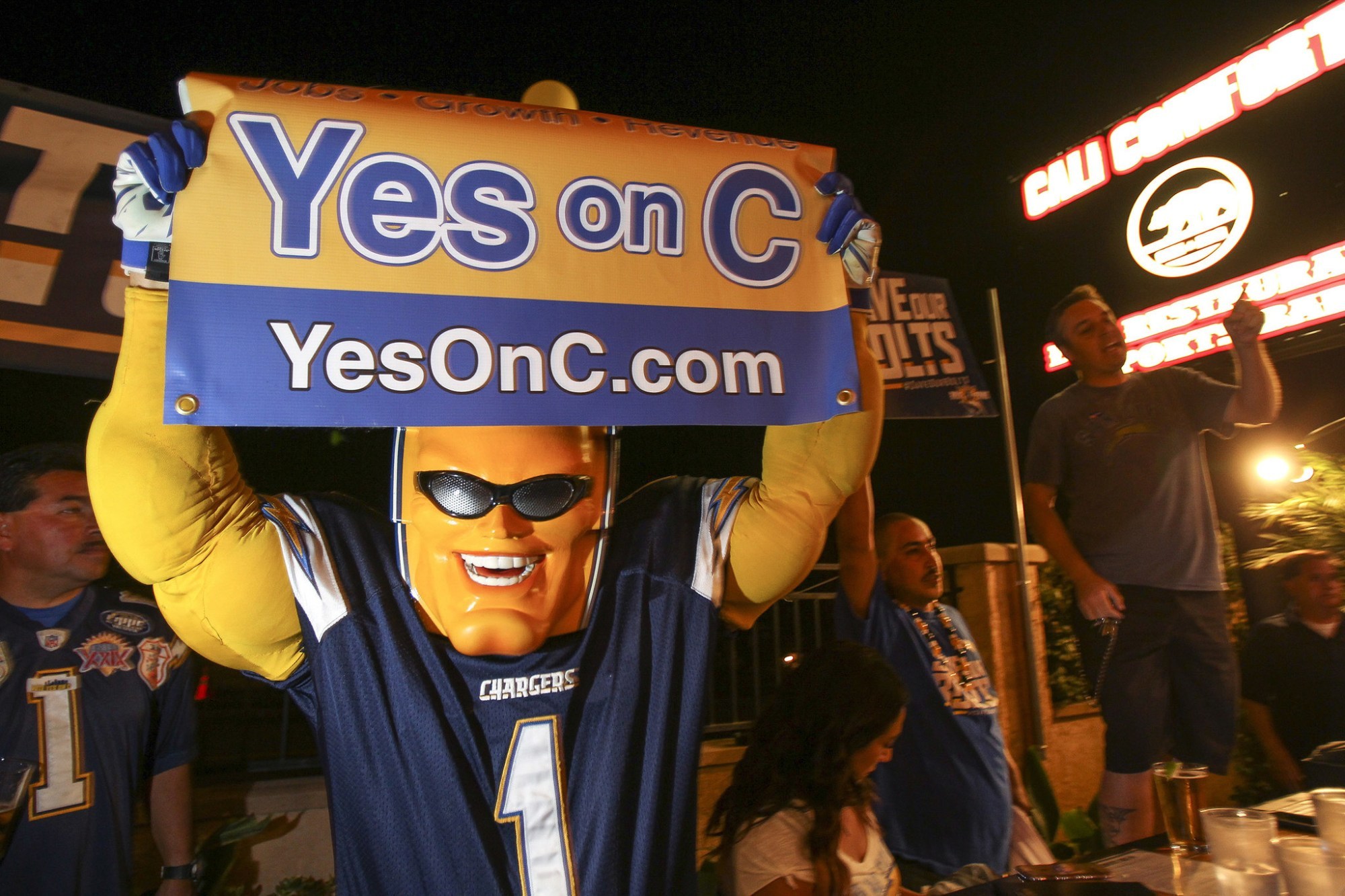
They spent millions gathering signatures and campaigning for Measure C, a $1.8 billion stadium and convention-related development downtown. On Nov. 8, 2016, the proposal received just 43.64% of the vote — more than 23 percentage points short of the required two-thirds majority.
It would have taken another 125,393 voters switching from no to yes for the measure to pass.
Sunday is the 10th anniversary of that election, arriving days after San Diego County voters again weighed a tax increase in Tuesday’s midterms.
County Measure B, a proposed half-cent sales tax for health and safety services, needed only a simple majority — unlike Measure C’s two-thirds requirement — and held a narrow lead in returns that remained unofficial Friday.
Different projects, different electorates, the same unavoidable question: What will voters agree to finance?
Measure C’s failure was not merely a casualty of California’s two-thirds requirement.
It was the final expression of a political problem that had defeated stadium proposals for roughly 15 years: San Diego had plenty of Chargers supporters, but its leaders, taxpayers and business interests never coalesced around the price of keeping the team.
The team’s own document had recognized the danger long before the 2016 vote. The 2014 survey examined attitudes toward public stadium funding, not the later Measure C plan; the draft was the Chargers’ account of those findings. But the resistance it described was difficult to miss.
In January 2016, NFL owners gave Dean Spanos the option to move to Los Angeles alongside the Rams. He stayed for another season and chose a final attempt: a citizens’ initiative proposing a stadium in East Village, funded principally through higher city hotel taxes. A petition drive could put the plan on the ballot without first completing the environmental process that had bogged down other negotiations.
Mark Fabiani, the team’s longtime stadium adviser who no longer works for the franchise, remembers the vote as a desperate possibility, not a confident bet.
“We always knew it was going to be a long shot,” Fabiani said. “That’s no secret.”
Why go ahead? The relocation option existed, and another negotiated San Diego plan did not.
Looking back, Fabiani pointed to the surprise result of the presidential election held that same day.
“In elections, you never know,” he said. “Donald Trump got elected President of the United States … And no one ever thought that was happening.”
Public polling delivered another October warning. A SurveyUSA poll found 36% certain to vote yes, 41% certain to vote no and 23% unsure. Even a sweep of the undecided voters would have fallen short of two-thirds.
The stadium proposal combined $350 million from the Chargers and approximately $300 million in NFL financing with a substantial city-backed share. Measure C would raise San Diego’s hotel occupancy tax from 10.5% to 16.5% while eliminating a separate 2% Tourism Marketing District assessment at larger hotels. The new tax revenue would support bonds for the development and tourism-related activities.
Supporters promised a stadium, convention space and economic activity, largely paid for by visitors rather than the city’s General Fund.
The city’s Independent Budget Analyst, however, warned that construction costs could be higher than projected and that insufficient hotel-tax revenue could expose the General Fund to future obligations. It was a question of risk, not a forecast of certain losses.
The hotel industry objected to losing its established tourism-marketing mechanism and questioned the project’s convention center value. Taxpayer advocates opposed the financing. Councilmembers David Alvarez and Chris Cate signed the ballot argument against the measure.
Mayor Kevin Faulconer endorsed it Oct. 3, just five weeks before Election Day, after receiving written assurances from Spanos about overruns and city finances. For Fabiani, the late endorsement was evidence of political support arriving too late.
The campaign’s financial advantage was immense, but not quite what it appeared. A review of campaign-finance filings and completed city audits shows the principal Yes on C committee spent $6.18 million, compared with $77,252 by the main No on C committee — about 80 to 1.
Yet $1.88 million of the supporters’ spending, more than 30%, went directly to Arno Petition Consultants in the first half of 2016. That money merely helped secure the ballot, not just persuade the electorate. The formal No committee’s modest budget also understated the influence of organized hotel and civic opposition.
The deeper story emerges in the precinct returns.
A Union-Tribune analysis found eight named geographic reporting areas where Measure C won more than half the vote. San Ysidro led at 56.16%, followed by Otay at 54.91% and Nestor at 54.88%. Encanto East, Paradise Hills, Southeast San Diego East and Encanto West also voted yes. Centre City, encompassing downtown precincts near the proposed project, supported it with 52.11% of the vote.
Elsewhere the map was unforgiving. Mission Valley, where the Chargers played at Qualcomm Stadium, registered 47.01%. La Jolla gave Measure C 39.55%; North Park, 34.32%; Hillcrest, 32.16%; Adams North, 29.61%. Even populous Rancho Peñasquitos rejected it, with 23,215 no votes to 20,734 yes.
Not one named neighborhood, and not one geographically identified precinct, reached two-thirds support. The strongest geographic precinct, in Centre City, registered 64.3%.
In 2019, researchers Candon Johnson and Joshua Hall gave the returns a further dimension. Writing in the journal Economies, they found that ZIP-code areas with higher turnout in the presidential election were significantly less likely to support either Measure C or the competing Measure D.
Areas with larger shares of Trump voters were more favorable toward C, but less favorable toward D, which proposed higher hotel taxes while restricting stadium subsidies.
The researchers argued that a presidential election’s broader turnout diluted the influence of a concentrated constituency, such as committed Chargers fans.
The study also echoed a finding explored in the third and fourth installments of our series, “Bolting San Diego”: New professional stadiums generally fail to generate meaningful net regional economic growth.
Their findings help explain why concentrated support from Chargers fans wasn’t enough to carry the stadium tax proposal.
Then there is the question that still shadows the loss: What if everyone in San Diego County had voted?
A persistent belief among those involved in the stadium fight and Chargers fans alike is that a countywide vote, including fans in cities and suburbs outside San Diego, would have given the team a better chance.
Adam Day, chairman of the city’s 2015 stadium advisory group, said he would “probably agree” that county voters would have been more favorable to the plan. Fabiani believed those voters could have helped, too.
But a countywide Measure C was never on the table. It proposed a downtown facility, financed with a City of San Diego hotel tax. Residents of Chula Vista, La Mesa, Poway and other cities had no legal vote on that municipal tax.
“It’s a City of San Diego location,” Fabiani said. “It’s a City of San Diego hotel tax and therefore it’s a City of San Diego ballot measure.”
A regional referendum would have required a different financing proposal, an actual county role, agreements over who paid and who benefited, and more political cooperation than the parties had managed to muster. Time and trust were already exhausted.
Day’s advisory group had tried to avoid a new-tax vote altogether with a separate Mission Valley plan.
“We knew we weren’t going to get two-thirds of the vote,” he recalled.
The Chargers instead chose the downtown initiative. A regional election may be the great San Diego what-if, but it wasn’t a workable substitute for the proposal that reached the ballot.
Measure D proposed a competing hotel-tax and convention-center plan that barred the new tax proceeds from financing a Chargers stadium. It also lost, with only 41.12% support.
In November 2016, the Chargers possessed the resources to force a decision, but not the coalition to win one. The San Diego they hoped would rally behind them was divided over the stadium’s location, the use of public money and whether its benefits justified the risks. Even their strongest neighborhoods fell short of the required two-thirds majority.
The Chargers spent 15 years searching San Diego for a stadium site and a way to pay for it. They found land, cycled through financing plans and, when negotiations with the city collapsed, gathered enough signatures to force an election.
What they never found was the political will to make any of it happen.
Editor’s note: Almost 10 years have passed since the Chargers ended their 56-year run in San Diego and moved to Los Angeles. Over the course of this NFL season, this series will trace the stadium fight and decisions that led to the move, revisit the fans and community left behind, assess the Chargers’ decade in Los Angeles and San Diego’s life without them, and explore whether the NFL could ever return.
Part 1: Nearly 10 years after the Chargers, one fan has no team — and no regrets
Part 2: ‘We’re still here’: Die-hard Chargers fans root for team from San Diego
Part 3: What happens after the NFL leaves?
Part 4: How San Diego’s economy moved on from the Chargers
Part 5: Ten years after Chargers’ departure, their old stadium site is being transformed
Part 6: Why 9 stadium possibilities failed to keep the Chargers in San Diego
Part 7: 15 Years to Nowhere: How San Diego’s Chargers stadium talks unraveled
Part 8: Rams host Chargers at SoFi, where the home-field advantage extends beyond football
Copyright 2026 San Diego Union-Tribune. All rights reserved. The use of any content on this website for the purpose of training artificial intelligence systems, algorithms, machine learning models, text and data mining, or similar use is strictly prohibited without explicit written consent.
About the Author