Artificial intelligence company OpenAI has officially confirmed it will develop humanoid robots in-house. CEO Sam Altman disclosed the plan on the podcast Sources, making clear that the project’s core focus is the intelligent “brain” that drives robot operation, rather than hardware appearance.
Altman explained the logic behind choosing the humanoid form factor. He noted that real-world infrastructure and tools—doors, keyboards, common equipment—are all designed around the human body. A robot that needs to move freely in the same spaces would reasonably adopt a similar shape. “Matching that form factor is a good idea,” he said.
When asked whether OpenAI would actually build humanoid robots itself, Altman’s answer was succinct: “We will.” However, he does not believe the robot’s appearance is something worth agonizing over at this stage. He added that these details “matter far less than actually developing the ‘brain’ that drives the robot.” Even if you give a machine two arms and two legs, if it doesn’t know how to use its limbs, the hardware is of little practical use.
2027 Demo Prototype, Commercialization Still Years Away
According to Altman’s timeline, OpenAI could deliver an impressive demo prototype by 2027, but humanoid robots reaching real-world public deployment will take several more years. He told Fortune: “I expect we’ll have a compelling demo prototype by 2027… but robots on the streets will take a few more years.”
As of now, OpenAI has not disclosed what the demo will entail, what the robot will look like, or when outsiders might get a close look at the device. The project remains a considerable distance from a formal commercial product.
Technical Challenges Go Far Beyond the Word “Brain”
Calling a robot’s intelligence system a “brain” makes the problem sound straightforward, but the actual difficulty is far greater. A high-performance humanoid robot needs multiple integrated capabilities: understanding environmental data from cameras and sensors, interpreting human commands, planning execution strategies, coordinating its body to complete actions, and autonomously correcting movements when unexpected situations arise in the real world.
Take grabbing a coffee mug, for example. The robot must identify the object, locate the handle, estimate the grip posture, and control grasping force—all in sequence. If any step goes wrong, spilled coffee and floor cleanup are inevitable. The entire pipeline demands an extremely high level of software-hardware coordination.
To tackle these technical challenges, OpenAI has already begun recruiting talent across motion control, state estimation, actuator control, full-body behavior development, and machine learning infrastructure for training embodied AI systems.
Lessons from the Dactyl Project
OpenAI is not starting from zero in robotics. Its earlier Dactyl research project trained a robotic hand to manipulate real objects entirely in simulation, and the company later applied the technology to solving a Rubik’s Cube. The project also exposed a common challenge plaguing the entire robotics industry: models can learn expected actions in software, but real-world physics is the ultimate arbiter. The gap between simulation and reality remains a challenge every robotics company must confront.
Hardware Is Not an Afterthought
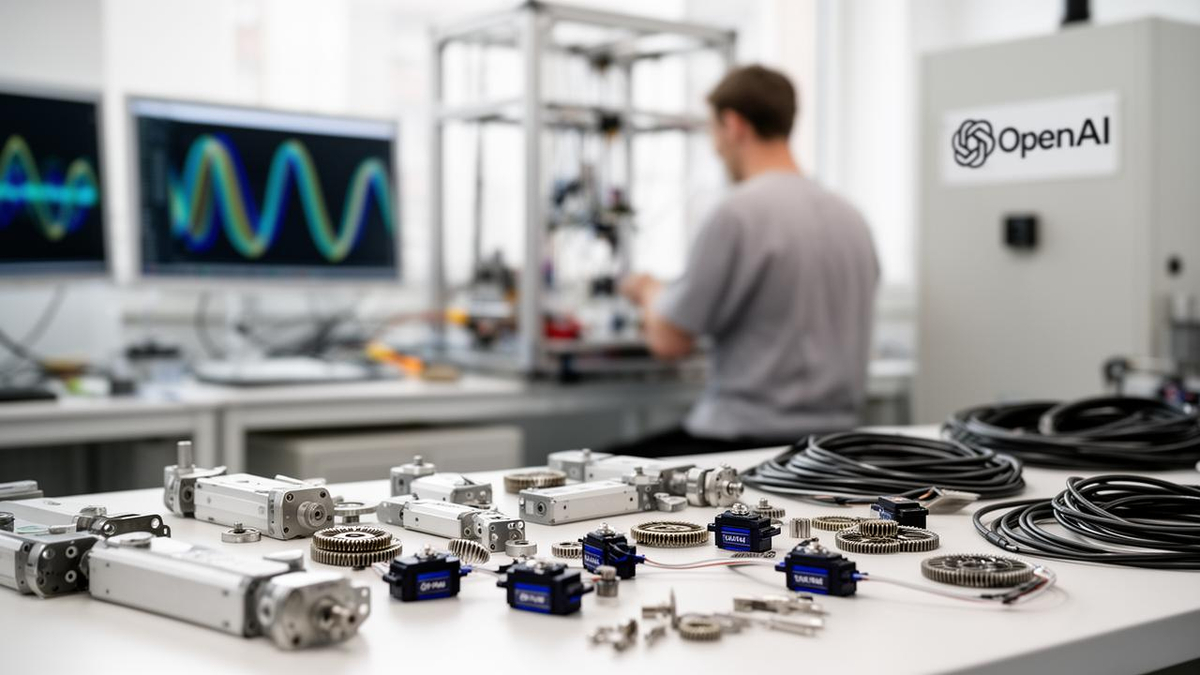
Altman’s emphasis on intelligence does not mean OpenAI treats hardware as a secondary accessory. Job postings show the company’s robotics team is developing in-house mechatronic actuators that integrate motors, transmission mechanisms, sensing, and thermal management systems. Other positions cover manufacturing and supply chain work needed for scaled hardware production. For this supposedly “less important” half, the actual workload is substantial.
Industry Competitive Landscape
OpenAI is not entering uncharted territory. Tesla has spent years developing its Optimus humanoid robot, and XPeng (9868.HK) recently achieved a milestone with its IRON humanoid robot walking off the production line autonomously after assembly. Both validate an industry consensus: even with sufficiently intelligent software, you still need to drive an extraordinarily complex system of motors and joints to execute movements.
A Pragmatic Path to Deployment
In terms of rollout planning, OpenAI has adopted a relatively pragmatic strategy. One robotics job posting states that the company’s near-term goal is to build general-purpose robots that assist skilled workers with infrastructure construction tasks; the long-term goal is to develop robot products for personal use, expanding into more diverse task scenarios.
As of press time, OpenAI has not officially released a physical humanoid robot product. Consumer pricing, subscription models, launch timing, and robot-specific privacy protection standards all remain undisclosed. However, its public careers page still lists 27 open positions in robotics, indicating the project is accelerating.
It is worth noting that if OpenAI’s robots eventually enter homes equipped with cameras and microphones, privacy concerns will become far more immediate and pressing. For now, however, these questions have not yet entered public discussion.
The news and data on this website are for reference only and do not constitute investment advice or an offer to buy or sell. Information is sourced from exchanges and public sources, and may be delayed, interrupted, or updated. While we strive for accuracy, we do not guarantee timeliness, correctness, or completeness. Content may include external links for which we are not responsible. By using this site, you agree that we and our partners are not liable for any losses. Investment carries full responsibility; please carefully assess risks and consult professionals. If there are errors in the content, please contact us for correction.
About the Author