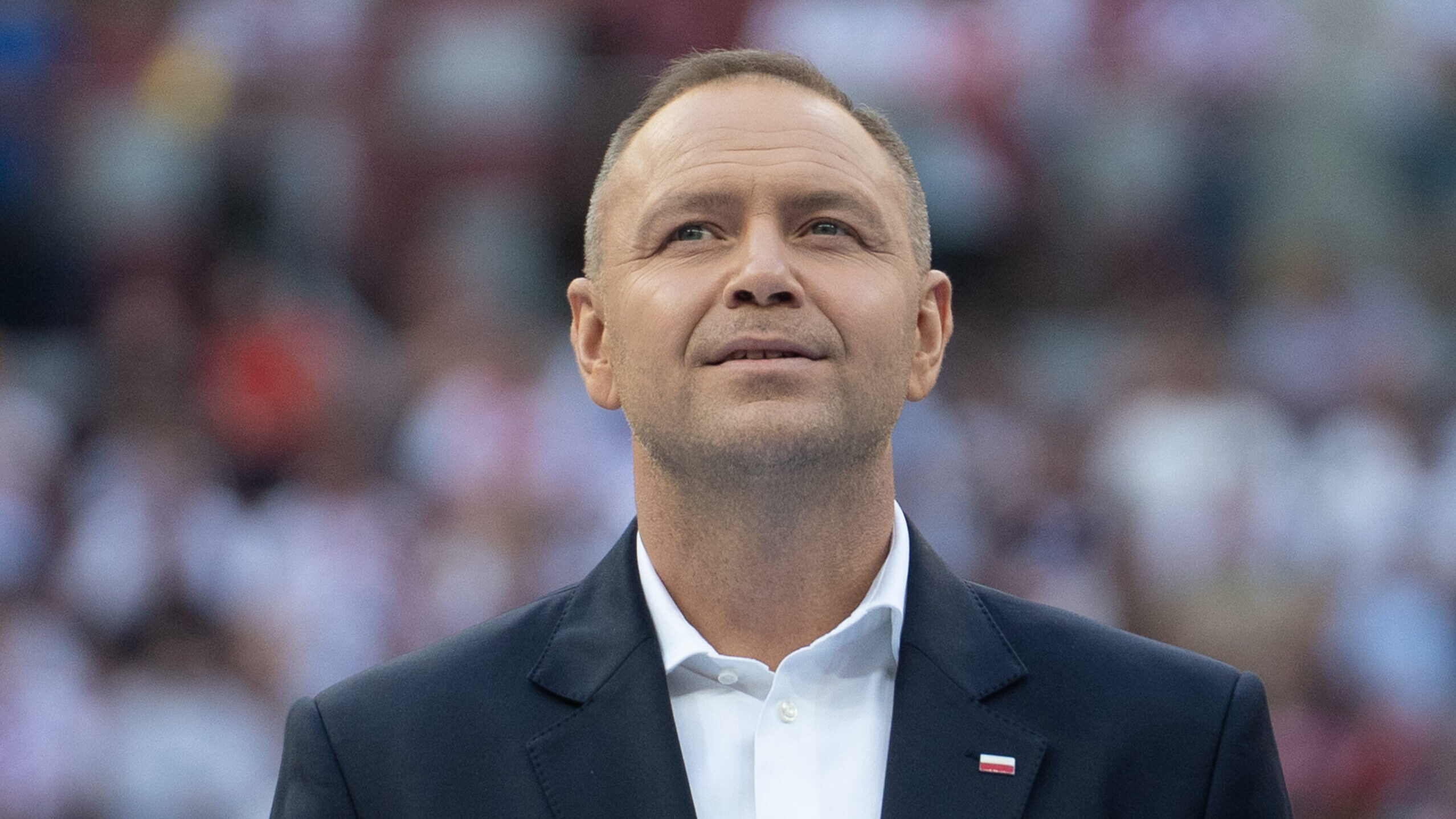
Polish President Karol Nawrocki confronted Prime Minister Donald Tusk face-to-face on Tuesday, 3 November, accusing him of personal responsibility for Friday’s attempted judicial coup at the Constitutional Tribunal. Addressing Tusk during the televised opening of the National Security Council, Nawrocki demanded an end to the unlawful takeover before Poland’s Independence Day on 11 November and vowed to use his constitutional powers to stop it.
‘Full responsibility for every police officer outside the Tribunal, for all the illegal actions, such as the suspension of judges, illegal orders and entry into the Tribunal from the Prime Minister’s Chancellery, rests with one man—a man who is present in this room, at whom I am smiling, although I do not understand or accept his actions and oppose them. That man is Prime Minister Donald Tusk,’ Nawrocki declared. He also accused the government of exploiting his absence abroad to carry out the takeover.
O matulu! Ależ prezydent Nawrocki podczas RBNu zrugał Donalda Tuska za zamach na Trybunał Konstytucyjny.Pozostało Tuskowi się tylko głupio śmiać, bo wie, że już definitywnie przegrał.Wow. pic.twitter.com/E6jViQWp64
Nawrocki warned that internal disorder threatened Poland’s security and demanded that Tusk reverse the disputed measures. The prime minister did not respond during the televised opening. Following the almost four-hour meeting, he described the president’s approach as confrontational and called for dialogue, without withdrawing his defence of the newly elected Tribunal judges.
The crisis erupted on Friday when Judge Anna Korwin-Piotrowska suspended Tribunal President Bogdan Święczkowski and his deputy, Bartłomiej Sochański, claiming control as riot police secured the premises. Nawrocki and the previous leadership denounced the move as an unlawful takeover, while Tusk defended the operation as necessary to allow parliament’s judges to take office.
On Tuesday, two parallel judicial meetings were held over the constitutional conflict. At the Supreme Court, an extraordinary assembly convened by First President Zbigniew Kapiński failed to adopt a resolution after 28 judges boycotted it, leaving the gathering without a quorum. Nevertheless, all 55 judges in attendance supported a statement by the Supreme Court’s governing college opposing the suspension of the Tribunal leadership.
Kapiński warned on Monday that the Supreme Court itself could be the government’s next target.
At the Constitutional Tribunal, eight judges supporting Korwin-Piotrowska declared themselves a sufficient quorum by excluding Święczkowski, Sochański and another disputed judge. They approved the institution’s 2027 budget plan and selected disciplinary panels for the suspended leaders. Święczkowski rejected the assembly’s authority.
A recently published document appears to strengthen that position. Dated 28 April and released on Monday by Święczkowski’s spokeswoman, it designates Judge Stanisław Piotrowicz to direct the Tribunal when both its president and vice-president are absent. Citing Article 12(3) of a 2016 law, it authorizes him to manage the court, represent it externally and oversee its administration. Święczkowski’s camp argues that this prior designation prevents Korwin-Piotrowska from assuming leadership under the statutory fallback procedure.
Piotrowicz, in yet another extraordinary twist in the story, was himself selected as disciplinary prosecutor in proceedings against Święczkowski.
Related articles:
At a time when public debate is increasingly polarized and superficial, Hungarian Conservative remains committed to depth, intellectual honesty, and independent conservative thought.
Producing high-quality journalism requires resources. Your contribution helps us expand our coverage, reach new audiences, and keep our content accessible.
Please consider supporting our mission.
Hungarian Conservative is a quarterly magazine on contemporary political, philosophical and cultural issues from a conservative perspective.
At a time when public debate is increasingly polarized and superficial, Hungarian Conservative remains committed to depth and independent thought.
Please consider supporting our mission.
To provide the best experiences, we and our partners use technologies like cookies to store and/or access device information. Consenting to these technologies will allow us and our partners to process personal data such as browsing behavior or unique IDs on this site and show (non-) personalized ads. Not consenting or withdrawing consent, may adversely affect certain features and functions.
Click below to consent to the above or make granular choices. Your choices will be applied to this site only. You can change your settings at any time, including withdrawing your consent, by using the toggles on the Cookie Policy, or by clicking on the manage consent button at the bottom of the screen.
About the Author