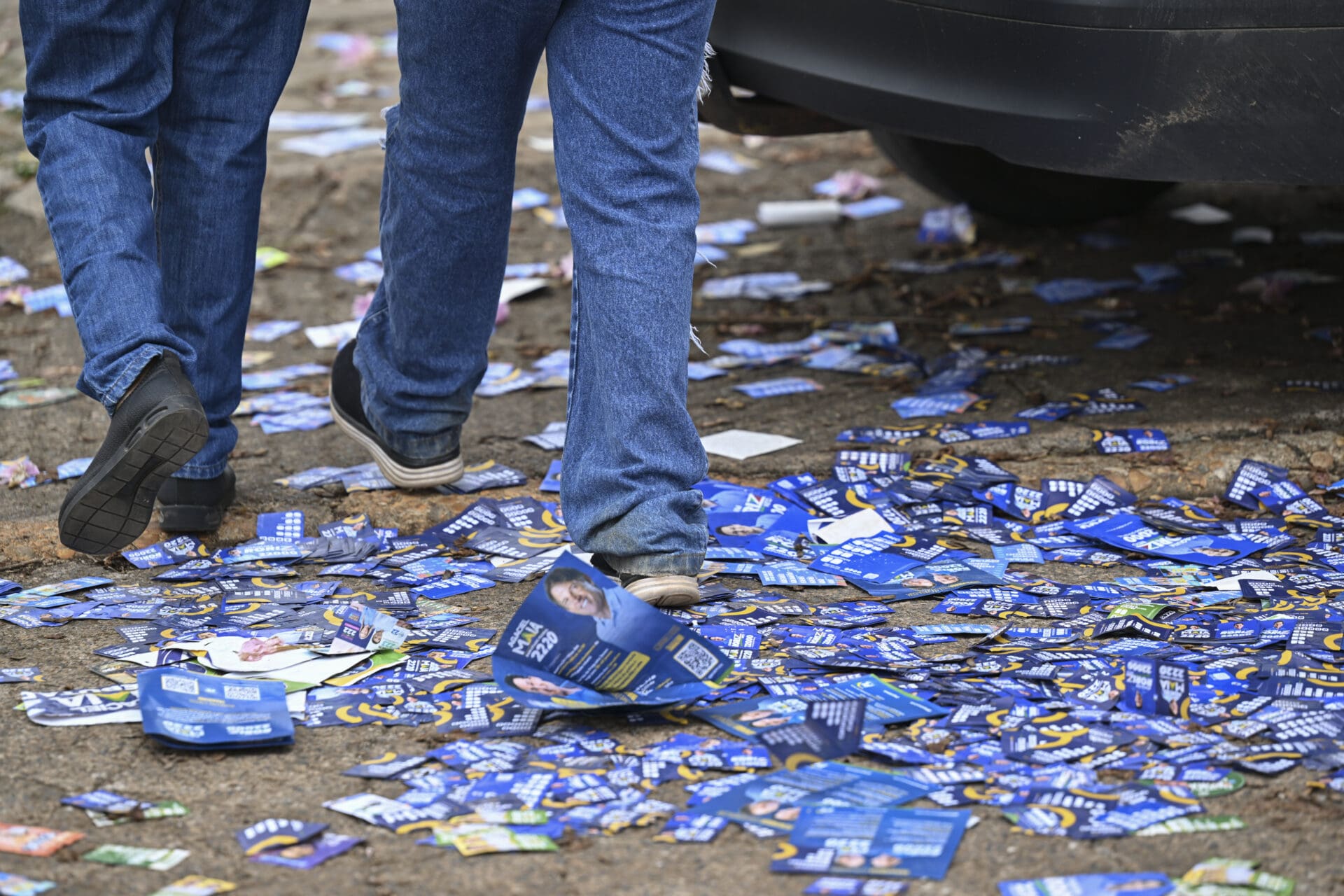
On October 4th, reactionary Flávio Bolsonaro took the lead in the first round of voting over incumbent Lula, buoyed by the growing strength of Brazil’s right-wing evangelicals and despite Lula overseeing a growing economy. To help get a sense of what this means for the international community in advance of the second round election on October 24th, where Bolsonaro appears favored to win, International Policy Journal editor Kelsey D. Atherton sat down with Senior Non Resident Fellow Michael Ahn Paarlberg.
The following interview has been edited for length and clarity.
Kelsey D. Atherton: As a foreign observer familiar with the region, how expected was this result?
Michael Paarlberg: Flavio Bolsonaro’s lead in the first round was a surprise. It was predictable that the election would go to a runoff, since there were multiple candidates in the race. However because those candidates were on the right, splitting Flavio’s vote, and because of positive economic indicators for Lula, it was expected that Lula would come out ahead and be in a slightly stronger position than Flavio for the runoff. The polls clearly underestimated Flavio, but none predicted a decisive Lula victory; the consensus was it was essentially a tossup. Only now has the consensus shifted to a probable, though not entirely certain, Flavio victory in the second round.
KDA: In the last Brazilian presidential election, Flávio’s father Jair attempted to cling to power, in a pattern that to my eye at least resembles J6. Do you think there’s any likelihood of an extralegal effort here, a move to more legally in-bounds action on the election, or a clean and free process?
MP: It’s quite likely that Flavio wins outright, so there would be no need for him to attempt the kind of coup that his father actively planned, and nearly carried out. The degree to which Brazil came close to an outright coup in 2022/23 became clear in the police investigation that followed the J8 insurrection. Incidentally, it did indeed resemble J6 – there was even a Brazilian Q Anon shaman – although it was poorly planned for an insurrection, given that Congress wasn’t in session and the president was out of town. But in retrospect, the warnings by the Biden administration, and by senators Kaine and Sanders, for the Brazilian military to respect the democratic process, were crucial.
The most likely case for there to be extralegal actions were if Lula were to win in the second round. If that were to happen, it is likely that the Bolsonaristas would refuse to recognize the result, and would create a constitutional crisis. Were that to happen, I would not count on the Trump administration to play a helpful role.
KDA: Are there any down-ballot signals?
MP: The more decisive result from the first round is that, no matter who wins, the legislature will be controlled by the right. Bolsonaro’s Liberal Party won the plurality of seats up for election in both chambers of Congress. And while there are divisions between the more far-right Bolsonarista wing and the more traditionally conservative and clientelist Centrão, it is more likely that the two would come together around a shared neoliberal agenda under Flavio than make a deal with the PT under Lula. Thus it is hard to see a viable path for the kind of ambitious social democratic reforms under a fourth Lula term that he pursued under his first.
KDA: Under Lula’ Brazil has achieved many of the robust material conditions that could once be expected to deliver reelection for an incumbent. What’s the story there?
MP: By all pocketbook measures, Lula should have had this election in the bag. He certainly thought so, and it seems these results have stunned his campaign. For those who say “it’s the economy, stupid,” these results don’t make sense. Brazil’s unemployment rate is at a historic low. Extreme poverty has been nearly halved under the current Lula administration alone. This is to say nothing of his first term, when the commodities export boom spurred GDP growth and financed social spending programs like Fome Zero and Bolsa Familia that lifted millions out of poverty and reshaped Brazil’s political map. Even crime, which was a big issue in this election, is actually dropping: including violent crime, down 8% year to year and nearly 40% since its peak a decade ago. It is true that inflation is a problem for voters, as it is across the world, but this is largely out of the government’s hands, and has much to do with global oil prices surging from Trump’s war with Iran.
There are many non-material factors that have set the tone and issues of the election: a media environment which is strongly in favor of Flavio, the role of the evangelical mega-churches, corruption scandals which implicate Flavio but has turned out to be a liability for Lula too, and Trump’s own intervention in the election.
KDA: One enduring factor is the change in ideological composition of the Brazilian electorate. The rise of evangelicalism in the country has been blamed for everything from poor performance in the World Cup to the success of reactionary politics despite material conditions. What’s your read?
MP: A lot of observers outside the region miss this trend, because historically they associate Brazil, and Latin America as a whole, with Catholicism. In fact, Protestantism, in the form of evangelical Christianity, is fast growing throughout the region, and in some countries in Central America, evangelicals outnumber Catholics. In Brazil, they are about a third of the population, but if trends continue, they could overtake Catholics within a few decades. This has had tremendous consequences for Brazil’s politics. First, what in Brazil is often termed Pentecostalism has shifted a focus of politics more toward religiously defined issues. Brazil is becoming more conservative, but this is a social conservatism, rather than a traditional libertarianism of the business elite.
Second, it has stolen a significant part of Lula’s and the PT’s base. Lula’s first win shifted the left’s base from the urban factory workers of Sao Paulo to the rural poor of the northeast, where Lula is from. And these voters, many of whom are Afro-Brazilian, some of whom stay in the northeast and others who move to the cities, have reliably voted for the PT for a generation. It is within these communities where we see the fastest growth of the Pentecostal churches, and thus see a major shift of poor and Afro-Brazilian voters toward the right. The largest of these churches oversee vast media and business empires, can set the tone of political discourse, and serve as massive voter turnout machines for the Bolsonaristas.
KDA: Lots of presidential systems in the Americas have seen recurring backlash to incumbents; Chile, Colombia, and Brazil are all set to elect reactionaries after having incumbents on the left, a pattern one could argue extends as far north as the United States. Do you see this reactionary wave as distinct from anti-incumbency, part of it, or something else?
MP: It’s not just anti-incumbency, but a broader kind of anti-establishment politics: a selective one, because both Flavio and his father Jair have benefited from this sentiment (along with other right-wing figures such as Kast in Chile and Fujimori in Peru) despite being career politicians. It helps him that his opponent, Lula, is 80 years old, and is the most consequential politician of his era. Thus anyone dissatisfied with the direction of government, and with the political elite, will more likely associate their grievances with him – a great irony for someone who came from the anti-government labor movement of the 1980s.
Elsewhere, incumbents have won reelection: Abinader in the Dominican Republic, MORENA in Mexico. But the social issues that have come to define many elections in the region, including in the US, crime, migration, gender and sexual issues, have driven a particular anti-establishment message that benefits populists of the right, as opposed to economic issues which tend to benefit populists of the left.
KDA: What would a second Bolsonaro on the world stage mean, especially for causes like preservation and climate change mitigation championed by progressives internationally that depend a great deal on limiting the exploitation of the Amazon?
MP: It certainly would reverse the gains made under Lula’s current term to combat deforestation. This is the policy reversal we can anticipate will have the most devastating consequences for the rest of the world. It should be understood that Lula’s push to preserve the Amazon is remarkable, and came with political cost, because Brazil has long bristled at efforts by the international community to limit its exploitation of the Amazon, seeing it as a matter of national sovereignty.
To Brazil, the Amazon is roughly analogous to the West for the US in the Manifest Destiny era: an area of great promise and vast untapped wealth, with indigenous communities who unhelpfully live there standing in the way. Cutting down the rainforest to start a ranch has long been the path to economic independence for poor Brazilians unable to make a living elsewhere, serving as a pressure valve for urban labor markets. And many Brazilians consider it hypocritical to deny them the chance to grow rich by exploiting their resources, when it comes from countries like the US or Norway which did the same thing. Nevertheless, Brazilians are also seeing, and researching, the impacts of deforestation, and there is support for preservation. This comes into conflict with the political demands of ranchers and the agribusiness industry, which is the engine of Brazil’s economy.
KDA: Anything the rest of the world should read into it cautiously?
MP: I’d caution against reading that a Flavio Bolsonaro victory in the runoff is a reflection of a reversal in material living conditions in Brazil. As I mentioned: unemployment is down, poverty is down, crime is down. We can see this in other countries that shifted to a hard right turn, such as Chile, where Kast won on an anti-crime and anti-immigration platform despite both crime and migration dropping.
It’s also important not to read this as a reflection of corruption in a simple sense: the Banco Master scandal touches Flavio directly, and Lula only indirectly, through a Supreme Court justice who is seen as allied with him. Yet that scandal has not hurt Flavio. Instead, it contributes to a general sense of cynicism that “they’re all corrupt” which favors a right-wing anti-establishment message. The left’s response, essentially: “we’re not as corrupt as our opponents,” is not a winning message. Even if it’s technically true. Nor is it helping them to point out that the social issues in this election, such as crime and education, are not really federal issues: policing and schools are administered at the state and local levels. The left’s reputational loss has less to do with its performance in office than with media narratives, which they do not control.
Call it a vibes-based election. But these vibes come from institutions: media conglomerates, mega-churches, Silicon Valley, Trump, none of whom are friendly to Lula.
For media availability and comment, contact Michael Paarlberg.
Subscribe for the newsletter.
1050 Connecticut Avenue,
NW, Washington, DC
20036
Suite 500
(202) 232-3317
Copyright © 2026. All rights reserved.
Powered by Design in DC
About the Author