news Alerts
There are no new alerts at this time
Welcome to From the Politics Desk, a daily newsletter that brings you the NBC News Politics team’s latest reporting and analysis from the White House, Capitol Hill and the campaign trail.
Subscribe to read this story ad-free
Get unlimited access to ad-free articles and exclusive content.
In today’s edition, Adam Edelman dives into the next stage of the redistricting fight for Democrats as they look to make up ground on Republicans. Plus, Andrea Mitchell previews the U.S.-China summit.
Sign up to receive this newsletter in your inbox every weekday here.
— Adam Wollner
After a series of court rulings gave Republicans a decisive advantage in the national redistricting fight, Democrats’ options for a counterpunch before this year’s midterms are limited.
So they are shifting their attention to battles for control of legislatures in key states this fall to help lay the groundwork for new congressional maps for the 2028 election cycle.
Given that Democrats have full control of state government in fewer places than Republicans — and that in several of those states, commissions, not lawmakers, are in charge of drawing maps — the party faces a lack of alternatives and time to launch new redistricting efforts before November, when control of the narrowly divided House is at stake.
But 2028 could bring a series of new opportunities for Democrats, particularly if they make significant inroads at the state level this year.
There are a handful of battleground states where Democrats have their sights set on defending the governorship while flipping at least one legislative chamber this fall: Arizona, Michigan, Minnesota, Pennsylvania and Wisconsin.
And in deep-blue Oregon and Washington, Democrats are looking to secure legislative supermajorities.
Of course, Democrats would likely encounter obstacles even if they were successful at the state legislative level in the 2026 elections. States like Arizona, Michigan and Washington have redistricting commissions that would need to be circumvented to enact partisan gerrymanders. And not every Democratic-led state may be eager to pursue an aggressive redraw, much like Illinois and Maryland this year. But there will be pressure for Democrats to act as Republicans continue to forge ahead with new maps.
Louisiana lawmakers have advanced a proposal for this year’s election that would carve up one of the state’s two majority-Black districts. Local outlets are reporting that South Carolina Gov. Henry McMaster is now expected to call a special session on the issue after the state Senate rejected an initial redistricting effort yesterday.Looking ahead to the next cycle, Georgia Gov. Brian Kemp today called for a special legislative session in June for lawmakers to take up a new congressional map for the 2028 election. And in Mississippi, Gov. Tate Reeves has said he expects the Legislature to redraw lines between now and 2027.
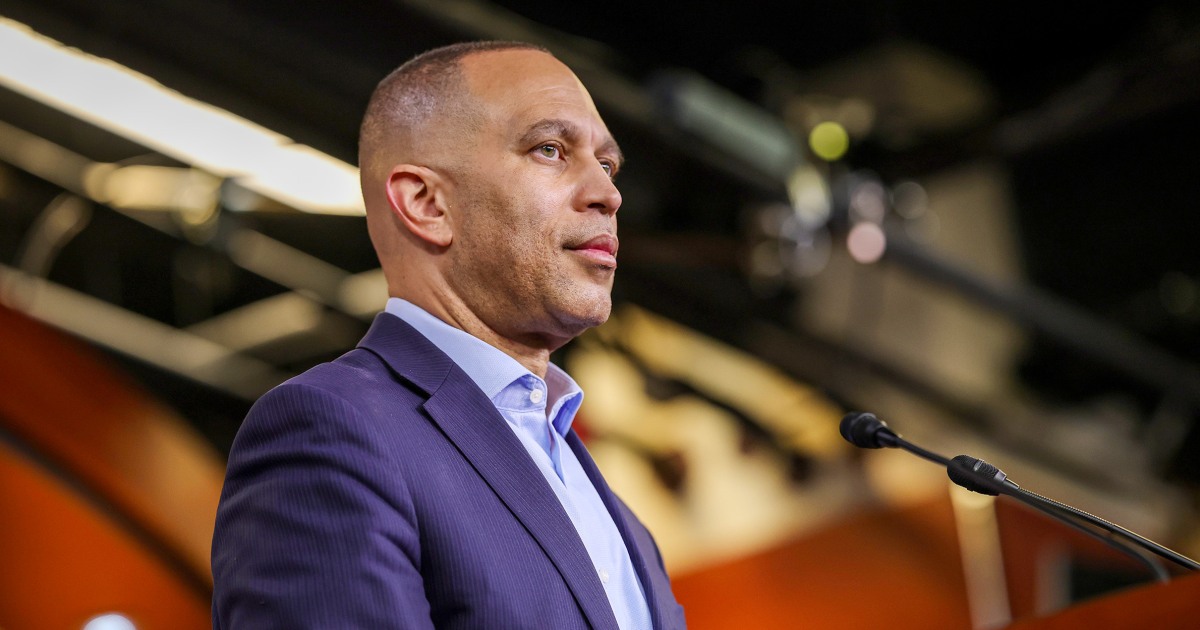
“We’re not going to unilaterally disarm,” House Minority Leader Hakeem Jeffries, D-N.Y., said during a news conference on Capitol Hill today. “Not now, not ever, and this redistricting war is just getting started.”
Read more →
CBC fallout: Rep. Yvette Clarke, D-N.Y., the chair of the Congressional Black Caucus, is warning that as many as 19 of their members could be affected by the redistricting fight in a worst-case scenario, Scott Wong and Melanie Zanona report. That would be one-third of the CBC’s 58 members, a number that reached an all-time high this Congress.
SCOTUS fallout: The Supreme Court has frequently admonished judges not to interfere in election cases when the process is already underway. But justices are now being accused of doing exactly that in recent redistricting decisions favoring Republicans, Lawrence Hurley writes.
When President Donald Trump stepped off Air Force One in Beijing today, Elon Musk was only a few steps behind — symbolizing not only that the tech billionaire is back in the president’s good graces, but that the business of this summit is business. And in China, Musk is first among equals among the business leaders Trump brought with him.
Trump arrives considerably weaker than originally envisioned for his first visit to China in nine years. The trip was initially scheduled for the end of March but postponed until now because the White House thought the Iran war would be over. Trump’s optimistic timeline even suggested the summit could have turned into a victory lap of sorts.
Now, it is anything but. Iran is now asserting control over the Strait of Hormuz, potentially a long-term threat to the global economy. It still has near-weapons-grade enriched uranium and is rebuilding bombed-out missile sites. Although suffering economically, the assassination of the supreme leader and many top political figures has strengthened the Islamic Revolutionary Guard Corps’ grip on a more radicalized regime.
The U.S. has been pressing Chinese President Xi Jinping, Iran’s close ally and source for sanctioned oil, to help reopen the Strait of Hormuz. In advance of his talks with Xi, Trump said “we’re going to have a long talk about it.”
But he sounded like he was lowering expectations, when asked 30 seconds later, “Do you think he can help in any way?” Trump answered, “No, I don’t think we need any help with Iran. We’ll win it one way or the other.” And speaking about his goals for the trip, Trump said, “We have a lot of things to discuss. I wouldn’t say Iran is one of them, to be honest with you, because we have Iran very much under control.”
Trump’s major focus at the summit will be trade, with Treasury Secretary Scott Bessent the lead Cabinet official. It’s the first time since the U.S. and China began holding summits more than a half-century ago that the top American officials won’t be the secretary of state and the national security adviser — both jobs now held by Marco Rubio. Likely deals will include increasing China’s purchases of soybeans, beef and Boeing jets.
Competition between the two nations is also escalating over artificial intelligence, further weaponizing cyberattacks. In Trump’s first term, the two leaders agreed not to attack each other, a truce that didn’t hold up. The U.S. has still not solved how China penetrated sensitive U.S. government and corporate telephone networks two years ago. Now, China has asked the administration and been denied access to Anthropic’s new Mythos AI model, which has revolutionary and potentially dangerous abilities to penetrate systems.
Chinese officials have said their “core” interest this week is Taiwan, the self-governing democracy that Beijing claims as part of China and the U.S. has pledged to defend. Here, language is important. Since 1984, U.S. presidents have always said they do not “support” independence for Taiwan. Xi would like Trump to say he “opposes” independence for Taiwan, a nuance China could then exploit to increase pressure on the island. Trump already alarmed congressional China hawks this week by saying he would discuss Xi’s concerns about future weapons sales to Taiwan.
The summit will last only two days — time enough for pageantry, and potential pitfalls.
🇨🇳 Related: A judge told Musk he wasn’t excused from trial. He went to China with Trump anyway, by David Ingram
That’s all From the Politics Desk for now. Today’s newsletter was compiled by Adam Wollner.
If you have feedback — likes or dislikes — email us at politicsnewsletter@nbcuni.com
And if you’re a fan, please share with everyone and anyone. They can sign up here.
© 2026 NBCUniversal Media, LLC
About the Author