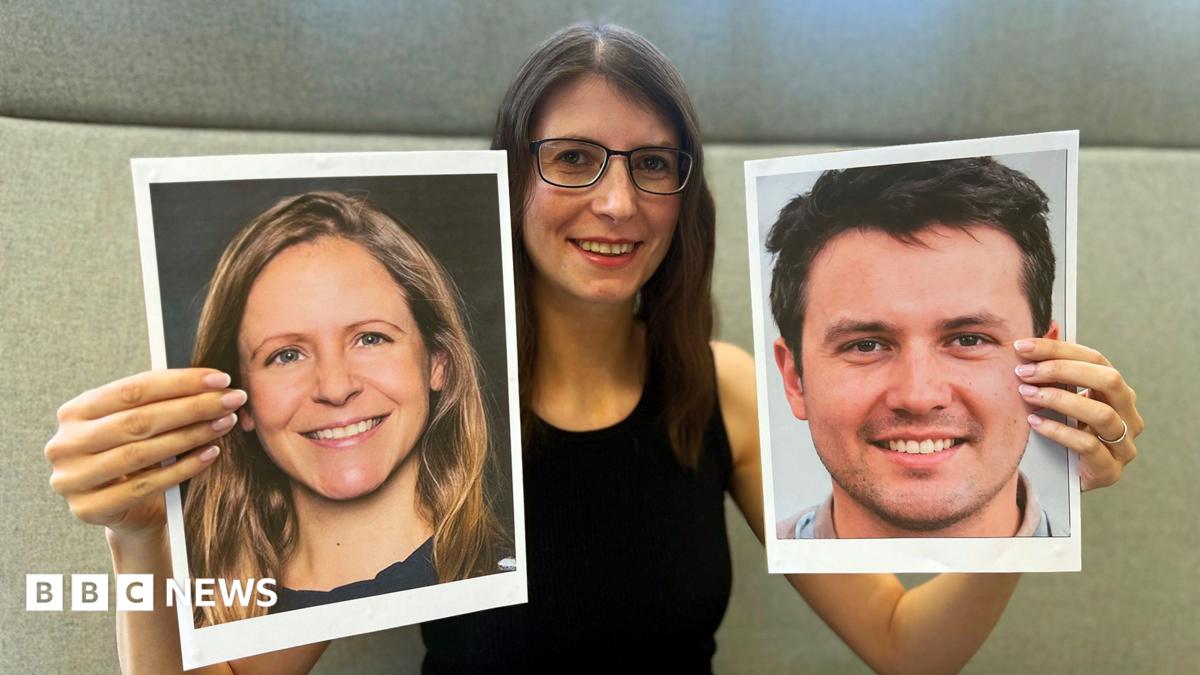
One of these photos, being held by Dr Clare Sutherland, is an AI-generated deepfake
Psychologist Dr Clare Sutherland is holding up two large photos. One shows the face of an Australian academic leading an international research study; the other is an AI-generated deepfake.
Artificial intelligence has become so adept at creating realistic images, it is increasingly hard to figure out what is real or not.
But can people be trained to spot an image of a human that has actually been created by a machine?
That's a question Sutherland, from the University of Aberdeen, and her Australian colleague have been examining.
But before we reveal the answer, have a go at this test – and note down your score.
If you found that tough, you are not alone.
It used to be far easier to spot computer-generated visual creations – often used by fraudsters – because AI would make blunders, like adding an extra finger or something else that was obviously weird.
But AI learns from its mistakes.
"Training on visual artifacts, like looking for a sixth finger or odd earrings, has had limited success, partly because the AI is getting too good, and fraudsters may avoid using pictures with obvious flaws anyway," explained Prof Amy Dawel.
She is the woman with shoulder-length hair in the picture being held by Sutherland. The man's image is the fake.
Dawel is the director of the Australian National University Emotions and Faces Lab.
She has been leading a team of researchers in Australia, Canada and the UK to find out if people can be trained to rumble the AI imposters.
The answer, for now at least, is yes – but learning to spot an AI fake requires a more subtle approach.
Sutherland is leading the UK-based research at the University of Aberdeen., external
She said they had noticed they were getting a feel for which faces were real or AI just by looking at them.
"So we thought, OK, it would be really interesting to see if we could teach other people this too," she said.
For the experiments a pool of thousands of AI-generated faces was created using an AI image tool called StyleGAN3, one of the most realistic face generators available.
Participants were tested before and after being given training
The researchers trained participants in the studies by drawing their attention to six perceptual qualities:
Symmetry – AI often fails to recreate the quirks that make us human – a slightly drooping eyelid or a lop-sided smile. "If it's too good to be true, it probably isn't."
Proportionality – A similar concept. Very large noses or protruding ears are not typical of deepfake images.
Attractiveness – "AI faces tend to look more attractive," explains Sutherland. "That one is more subjective, an aesthetic judgement, but AI often creates faces that are pleasant looking."
Distinctiveness – "That could be something like 'what would make a face stand out in a crowd?' AI faces do tend to cluster towards the average. So they look a bit more generic."
Expressiveness – "AI faces tend to look less emotionally expressive", says Sutherland. "They tend to show less emotion."
Memorability – "They often look less memorable – they're difficult to remember."
AI also tends to be less proficient at recreating non-white, older or younger faces because more of its training involves young white people.
Some of these tips might sound quite similar and "fuzzy" – but that's the point.
Rarely will you encounter a surefire "tell" that will unmask an AI fake. Rather, it is about becoming attuned to their characteristics and developing a gut feeling.
Researchers found that by exposing people to images, both AI and real, then telling them which was which, they can get significantly better at it – even in the space of an hour or so.
The researchers found the participants would typically increase their accuracy score from about 40% to 80%.
A few individuals achieved close to 100% accuracy.
Researchers found that training could help people spot AI deepfakes, like this one
Ironically, what the human brain is doing here is similar to the way that generative AI models work.
Give them enough data to train on and, over time, their accuracy improves – even though we may not totally understand how they are doing it.
The studies also looked at how confident the participants were at identifying the AI images.
Previous research had indicated people were overconfident that they could spot AI faces, with the most confident people making the most errors.
After training, participants were found to have increased their confidence in spotting the deepfakes.
"That's helpful right?" says Sutherland. "Because if you don't know when you're correct or not, you can't really do anything with that information."
OK, so are you ready to take another test?
How did you do? Feeling more confident?
If the answer is no, don't beat yourself up over it. In both the human world and that of generative AI, practice makes perfect – or at least a bit closer to perfect.
There are many websites out there where, if you so desire, you can hone your skills. You can also volunteer to take part in the research yourself. , external
The obvious danger is fraud.
Global consultancy firm Deloitte has predicted that losses from AI deepfake scams, external in the US alone could rise to £40bn next year, up from £12bn in 2023.
The report cited the example of a scam where an employee at a Hong Kong-based firm transferred £25m to fraudsters after a video call with a deepfake recreation of their boss.
Another sinister use of deepfake technology is political espionage.
As long ago as 2019, an Associated Press investigation, external found that a LinkedIn profile – including a photo – belonging to a woman called Katie Jones appeared to be fictitious.
Jones purported to be a Russia and Eurasia specialist with links to prominent Washington think tanks and policy circles.
The AP report claimed she was actually a deepfake produced by Russian intelligence who had successfully connected with top US political aides and national security officials.
An investigation by Associated Press claimed Katie Jones was a deepfake
In Australia, a politician is currently proposing a requirement to disclose and "watermark", external AI-generated political content.
To be fair to AI, Sutherland also sees some positive uses of the technology – such as the ability to quickly and cheaply show how a long-missing child might look at various ages.
She says that if people are "engaging with it in good faith and people know that AI has been used, it could potentially be very useful for creative acts".
So the good news is that we're yet not living in a dystopian world where it's impossible to tell what's real and what's computer-generated.
The bad news is that AI models may have already "read" the published academic research papers. And it's learning.
Parents warned not to publicly share children’s images amid AI abuse risks
Tinder and Zoom offer 'proof of humanity' eye-scans to combat AI
Police go nationwide with anti-deepfake campaign
Watch our pick of standout clips from across the BBC
Ann Widdecombe was attacked 24 hours before she was found dead, police believe
TV presenter Dermot Murnaghan dies aged 68
Reeves tells BBC: Burnham needs worked-through plan to govern from the start
Dating can be hard in South Korea – so the monks stepped in
See if you can spot an AI deepfake with our test
Twenty years of Chasing Cars: 'It's the song that took us to the whole world'
Pioneering treatment saves identical twins from rare pregnancy condition
Catherine cheers on William at charity polo match
All the best looks from Paris Haute Couture Week 2026
The Papers: 'Widdecombe murder inquiry' and 'Strike Norse'
Royal Watch: Get the latest royal stories and analysis with Sean Coughlan’s weekly newsletter
The youth clubs fighting to stay relevant in the social media age
The rebels, rockstars and revolutionaries of tennis
The return of the thrilling, award-winning drama about the CIA
A new mystery starring Nikki Amuka‑Bird and John Simm
Jackie Kennedy's guided tour of the renovated White House in 1962
TV presenter Dermot Murnaghan dies aged 68
Reeves tells BBC: Burnham needs worked-through plan to govern from the start
Pubs can stay open for full Norway game – even if kick-off delayed
Meet the crypto billionaires building a world where money buys you a vote
See if you can spot an AI deepfake with our test
I asked Bonnie Tyler for an autograph at 15 – then spent Christmas with her for 30 years
US wants Iran to pledge to stop shooting at ships in Strait of Hormuz
Killer's final police interview footage released
Chaos and confusion reign as Harry loses media battle
Ann Widdecombe murder probe: What we know so far
Copyright © 2026 BBC. The BBC is not responsible for the content of external sites. Read about our approach to external linking.
About the Author