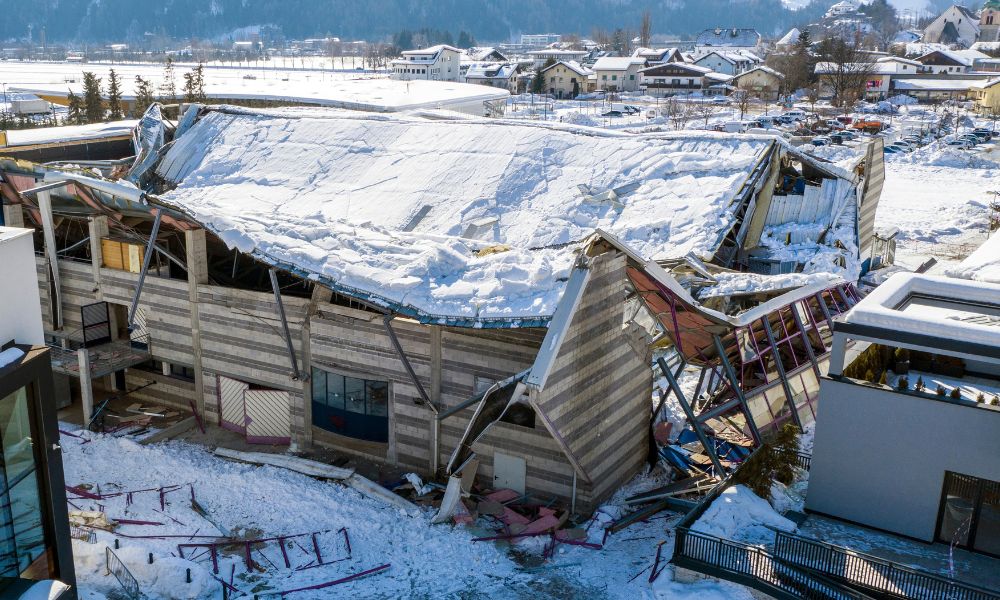
What happened: Idaho's Supreme Court affirmed summary judgment for State Farm after policyholders failed to document losses from a collapsed barndominium
Who's involved: State Farm Fire and Casualty Company and two Idaho policyholders
What's at stake: Additional claims beyond the $120,000-plus State Farm already paid, including a $272,300 rebuild estimate
Why it matters: The decision shows how undocumented claims fail at summary judgment – directly relevant to claims handling and SIU
Where it stands: Final – unanimous Idaho Supreme Court decision issued October 6, 2026
Two Idaho policyholders claimed $10,000 for frozen meat and $12,000 for a flatbed trailer – on a handwritten list with no receipts.
State Farm had already paid more than $120,000 after their half-built barndominium collapsed under heavy snow the day after Christmas 2022. The couple wanted $272,300. On October 6, Idaho's Supreme Court unanimously said no.
The couple purchased a homeowners policy in May 2022 for a Sandpoint, Idaho property where they were building a barndominium while living in an RV on the grounds with their children and farm animals. When the partially framed structure gave way under snow on December 26, 2022, the RV survived but lost its water, power, and sewer connections.
State Farm paid $7,500 in January 2023, then $115,966.47 for dwelling repairs less than two months later.
The couple hired a public adjuster, who submitted a new personal property inventory five months after the loss. Twenty-five new items had appeared. Values climbed sharply. Every entry was marked "Total Loss Contents." No bills or receipts followed. The couple sent photographs labelled only with item names.
Their rebuild estimate fared no better. The contractor's one-page bid included a $70,000 foundation upgrade their own engineer confirmed was not storm damage but "an upgrade to International Building Code requirements." A $5,300 custom staircase had not been shown to exist in the original structure.
For additional living expenses, the couple pointed to a house leased at $4,500 a month. The husband testified the family never moved in, never spent a night there, and never paid rent or the deposit. The lease was mutually terminated.
The court corrected the lower court on one point – "residence premises" includes the grounds where the insured resides, not just the dwelling. But the correction changed nothing. The couple never claimed expenses for maintaining the RV.
The court found the claims "clearly fairly debatable" and noted State Farm had "legitimate grounds to question the inflated demands."
The strength of a claim lives or dies in the documentation file – not in the size of the demand.
The issues in this matter were addressed by the Idaho Supreme Court in a final ruling issued October 6, 2026. The decision is unanimous.
We’ll keep you up-to-date with the latest breaking news, cutting edge opinion, and expert analysis affecting both your business and the industry as whole.
Our daily newsletter is FREE and keeps you up – to – date with the world of Insurance. Please complete the form below and click on subscribe for daily newsletters from IB US.
About the Author