Saturday
November 07, 2026
7 November, 1975. Around midnight, I woke to gunfire and cries of “Zindabad” echoing through Dhaka Cantonment. Everyone in the house was frightened.
From the rear veranda, overlooking the cantonment’s main road, I saw military vehicles packed with soldiers moving through the darkness, shouting slogans. Several tanks sped southwards, while tracer rounds from anti-aircraft guns near Tejgaon Airport lit the night sky.
I could not understand what had happened. Recalling the leaflets distributed that evening and the rumours in the cantonment, I initially suspected fighting between units involved in the 15 August coup and those supporting Khaled Mosharraf.
Lieutenant Colonel Mashahed Chowdhury, commander of an anti-aircraft unit, lived downstairs. One of his batteries had been deployed at Tejgaon Airport without his authorisation to block access to the airfield. He invited us into his drawing room, where we discussed the deployment and the leaflets, but couldn’t determine what was unfolding outside.
Gunfire continued all night. By dawn, I put on my uniform and set out for brigade headquarters with my neighbour Major Harun of station headquarters.
On the main road, we met Major Mashuk Ahmed Chowdhury and Lieutenant Colonel Sharif, a director at Army Headquarters, on a motorcycle. They told us Major General Ziaur Rahman had just been released from detention and taken to the 2nd Field Regiment, where several officers had reportedly gathered, and urged us to go there.
Before we could ask more, a military truck carrying armed soldiers and young civilians sped past, its occupants firing into the air.
“Sepoy, sepoy, brother to brother; we want the blood of officers,” they shouted, followed by “Long live the soldiers’ revolution” and “Long live General Zia”.
Harun and I quickened our pace. More trucks passed, carrying soldiers alongside armed civilians. I later learnt that the civilians belonged to the Gono Bahini, the armed wing of the Jatiya Samajtantrik Dal (JSD), whose members had been trained under Colonel Abu Taher.
Some young officers accompanied the soldiers, but their uniforms carried no insignia of rank. When I questioned one, he replied that from that day there would be no distinction between soldiers and officers and no hierarchy in the armed forces. That, he said, was the essence of their revolution.
Had Taher’s Biplobi Sainik Sangstha, or Revolutionary Soldiers’ Organisation, finally launched its uprising?
Whatever remained of the army’s chain of command seemed to have collapsed. Soldiers moved through the cantonment firing weapons and celebrating wildly. The deterioration in discipline I had witnessed over the preceding days seemed insignificant by comparison.
Zia’s release and the 2nd Field Regiment
At the headquarters of the 2nd Field Regiment, Subedar Major Anis greeted me. He said no one could be found at brigade headquarters. General Zia, he added, had been looking for us.
Anis said the soldiers’ uprising had begun around midnight. Major Mohiuddin arrived at Zia’s residence with a battery from his unit to free him. The 1st East Bengal Regiment soldiers guarding Zia, apparently fearing that a countercoup had begun, joined Mohiuddin’s group without resistance. Zia was then taken to the 2nd Field Regiment.
Zia was in the commanding officer’s office with several officers, including Brigadier Mir Shawkat Ali, commander of the 55 Brigade in Jessore. The regiment had become the centre of power in Bangladesh. Ironically, it was also one of two units that had joined the 15 August coup under Rashid.
Only 10 to 15 officers were at the regiment when we arrived. Several familiar officers, including Lieutenant Colonel Bahar, a senior freedom fighter, had been placed in the quarter guard’s detention cells.
Anis said revolutionary soldiers had prepared lists of officers against whom they held grievances and had attacked their residences. Some officers had fled, abandoning their families. Those located by the regiment had been placed in protective custody to prevent their murder.
Inside, Ziaur Rahman sat in the commander’s chair, with Mir Shawkat Ali beside him. After I saluted, Zia told me to return to brigade headquarters and bring the soldiers under control. He said he had spoken to my brigade commander, Shafaat Jamil, who was safe, and that AJM Aminul Haque had been appointed the new brigade commander.
As I left, I met Aminul Haque. He advised me to stay for a while, observe the situation and then return to headquarters. With most of the brigade staff missing and his own unit needing him, he asked me to assume responsibility for brigade operations.
The whereabouts of Khaled Mosharraf and his closest associates remained uncertain.
The collapse of the 3 November coup
The soldiers’ uprising had overturned the arrangements established by Khaled’s coup on 3 November.
When it began, Khaled, Colonel KN Huda and Lieutenant Colonel Haider left Bangabhaban together. Shafaat Jamil initially remained, unaware of the extent of the developments in the cantonment. After reaching the 2nd Field Regiment, Zia tried to contact Khaled at Bangabhaban but spoke to Shafaat instead.
“Forget and forgive. You come back,” Zia reportedly told him.
Shafaat’s response was roughly: “I am a rebel and will remain so.”
At that stage, Shafaat may not have realised that Taher, the Gono Bahini and the Revolutionary Soldiers’ Organisation, rather than Zia himself, were driving the uprising.
When he learnt that armed soldiers were searching for him at Bangabhaban’s main gate, he handed his car keys to his driver and tried to escape over the rear boundary wall, breaking a leg. With Major Didar Ataur, a company commander of the 4th East Bengal Regiment, he travelled towards the Meghna ferry terminal on the Dhaka–Chattogram road.
Unable to continue because of his injury, he met the sub-divisional officer of Narayanganj, who took the two men aboard a launch. After arranging treatment, the official handed them over to Bandar police station. From there, Shafaat spoke to Zia by telephone on the morning of 7 November. He was later admitted to the Combined Military Hospital, and the injury left him with a limp for life.
Taher’s arrival and the struggle for control
From the veranda of the 2nd Field Regiment, I saw Taher arrive with soldiers and Gono Bahini members. He entered Zia’s room, where the two initially embraced.
Taher urged Zia to go to the radio station and address the nation. But Zia, on the advice of other officers, had already recorded a speech and sent it for broadcast. Taher also presented a list of demands on behalf of the soldiers. Zia accepted the document but said he would consider the demands later.
Taher appeared dissatisfied. After a private discussion with Zia, he left the room agitated. The details of their conversation remain uncertain.
From the beginning of the uprising, the radio station had been under the control of the Revolutionary Soldiers’ Organisation and the Gono Bahini, and remained so for a considerable period. Zia had been prevented from going there in person to deliver his address. Taher wanted Zia to announce the soldiers’ demands and outline a new political and military structure.
According to unverified accounts, Taher also planned to take Zia from the radio station to the Central Shaheed Minar to address revolutionary soldiers and Gono Bahini members, and Zia would be assassinated on the way back, allowing the revolutionaries to seize power. Brigadier Mir Shawkat Ali later referred to such a possibility. These claims, however, were not supported by documentary evidence.
What was evident was that Taher’s political objectives and Zia’s immediate priorities were becoming incompatible.
Taher had sought to mobilise ordinary soldiers with promises of better conditions and the abolition of what he portrayed as the armed forces’ class hierarchy. His organisation had built networks particularly among army service corps personnel, military clerks and members of the air force, and the Gono Bahini was mobilised alongside them.
During Khaled’s coup, propaganda portraying him and his associates as pro-Indian and pro-Awami League had turned sections of the rank and file against them. Zia, by contrast, was presented as a figure around whom the disaffected could unite.
Taher apparently expected the Revolutionary Soldiers’ Organisation and Gono Bahini members to release Zia and take him to Taher, allowing the wider revolutionary programme to proceed. But Subedar Major Anis did not come under Taher’s influence. Instead, Anis and Major Mohiuddin secured Zia’s release and brought him to their own regiment. With Zia surrounded by loyal officers and soldiers, Taher’s chance of controlling the uprising had diminished.
The killing of Khaled Mosharraf
Amid the confusion, news arrived that Khaled, Huda and Haider had been killed by soldiers of the 10th East Bengal Regiment near the MP Hostel in Sher-e-Bangla Nagar. Until then, I had not appreciated the brutality the uprising had unleashed. The deaths of three senior officers, including men distinguished by their Liberation War service, brought home its gravity. Zia ordered their bodies brought to the cantonment so he could see them.
A week later, Lieutenant Colonel Nawazish Ahmed, commanding officer of the 10th East Bengal Regiment and a coursemate of mine, described what had happened.
After the uprising began, Khaled, Huda and Haider left Bangabhaban as soldiers began targeting those associated with the 3 November coup. Khaled contacted Nawazish through Huda, and Nawazish invited them to take shelter at his unit.
Accounts later circulated that the three had tried to travel towards northern Bangladesh, that their car had broken down near Asad Gate, and that they had changed clothes at a private clinic before walking to the regiment. Nawazish did not confirm this. He acknowledged receiving a telephone call from Khaled but could not establish where it originated. All three reached his office on foot.
Zia learnt of Khaled’s location early that morning and spoke to him by telephone. Their conversation reportedly became heated. Zia then instructed Nawazish to ensure the safety of Khaled and his companions.
Nawazish arranged breakfast. By his account, Khaled remained composed, while Huda and Haider grew apprehensive.
By then, members of the Revolutionary Soldiers’ Organisation had entered the regiment’s lines, encouraging its soldiers to join the uprising and demanding that Nawazish hand over the three officers. Zia telephoned again, repeating his instructions to protect them. But the atmosphere deteriorated, and Nawazish could not restrain the agitated soldiers.
Realising that death was becoming inevitable, Khaled reportedly lit a cigarette. When Huda and Haider kept asking Nawazish to guarantee their safety, Khaled told them not to plead for their lives.
“Take it easy. You should have known your fate by now,” he reportedly said.
These were Nawazish’s recollections, and the precise wording may have differed.
Shortly afterwards, soldiers forced their way into the commanding officer’s office, took the three men to the garage below and shot them dead. Two officers, Captain Asad and Captain Jalil, both company commanders in the 10th East Bengal Regiment, also took part in the killings. Why they joined the soldiers remains unknown.
A revolution without command
By about 10am, I was in the adjutant’s office at the 2nd Field Regiment with Lieutenant Colonel Nuruddin Khan, who was helping coordinate the military response, collecting reports from different parts of the cantonment and directing officers back to their posts.
The soldiers’ demands were presented to Zia. The original document contained 22 points, later reduced to 12. They included abolition of the batman system, under which soldiers performed personal duties for officers; higher pay for ordinary soldiers; reduced salary disparities between ranks; medical and transport allowances; an end to entry into officer posts directly from the ranks, as well as to direct commissioning; punishment of those responsible for the 3 November coup; declaration of 7 November as a public holiday; and a mess facility for ordinary soldiers, like the one available to officers.
Some grievances reflected longstanding resentment over officers’ privileges and the treatment of ordinary personnel. But legitimate service-related grievances had become entangled with an armed political movement that threatened the military’s institutional structure.
Zia’s recorded radio address, broadcast earlier that morning, made no commitment to accept the demands. Opening with “Bismillahir Rahmanir Rahim” and closing with “Bangladesh Zindabad”, he called on soldiers to remain calm, maintain discipline and return to their duties, and urged civilians to continue their normal activities so that government administration could function.
Around 11am, the bodies arrived at the 2nd Field Regiment in a civilian truck. A crowd gathered to see them before they were transferred to the Combined Military Hospital.
Around midday, officers and soldiers from brigade headquarters arrived at the regiment to take me back. I hesitated. Given the attacks on officers, I could not be certain whether the armed men accompanying the vehicle included members of the Revolutionary Soldiers’ Organisation. Nuruddin advised me to go, since they had come for me.
I had previously commanded the brigade headquarters company during another officer’s absence and had grown close to its personnel. Seeing their confusion, I felt responsible for returning to lead them.
“Khoda Hafez,” Nuruddin said.
The violence continues
On 8 November, Zia returned to Army Headquarters as army chief, while Brigadier Mir Shawkat Ali was appointed chief of general staff in place of Khaled. But the restoration of senior command did not immediately end the violence.
Further officers were killed. Among the dead were a woman doctor named Hamida and dental surgeon Karim, apparently over personal grievances. Captain Anwar and Lieutenant Mostafiz, who had been training with the Bangladesh hockey camp, were chased and killed near the television station. Major Azim was killed near the airport while preparing to travel to Chattogram.
As news of the killings spread, enthusiasm for the uprising gave way to anxiety. Disillusionment grew among ordinary soldiers who had joined what was called the soldiers’ and people’s revolution. Many had taken part spontaneously, believing it would address their grievances. But the indiscriminate targeting of officers and the absence of coherent leadership exposed its dangers. Ordinary soldiers distanced themselves from the Revolutionary Soldiers’ Organisation.
Not all formations took part in the violence. Of the four infantry battalions of the 46 Brigade in Dhaka, two stayed outside the organisation’s activities on 7 and 8 November. The killer group Taher had formed within the Revolutionary Soldiers’ Organisation consisted mostly of soldiers from the army’s service corps and the air force. The organisation’s influence, though enough to destabilise the cantonment, was far from universal.
Zia appeared to recognise that Taher’s attempt to direct the uprising had failed, and officers, soldiers and commanders in Dhaka and elsewhere looked to him to restore order.
Zia moves to restore military discipline
From 8 November, Zia moved through military installations, addressing soldiers and insisting on the restoration of the chain of command.
That afternoon, he assembled soldiers near the lines of the 4th East Bengal Regiment in Dhaka Cantonment. Only 40 to 50 officers were present in the cantonment, while virtually everyone else was armed. Zia instructed the soldiers to surrender their weapons and return to their barracks, promising that their legitimate demands would be examined and addressed.
Although Justice Abu Sadat Mohammad Sayem had been asked to continue as president, Zia made the announcement on behalf of the government. The previous afternoon, during a visit to the radio station with Mir Shawkat Ali, he had agreed in principle to the revised demands under pressure from Taher and the soldiers supporting him. He now reiterated that commitment while making clear that discipline had to be restored.
During the gathering, one soldier accidentally shot himself with his own rifle and died. The assembled soldiers nonetheless agreed to surrender their weapons. The immediate crisis appeared to be moving towards containment.
Yet the threat had not disappeared. At around 9pm on 8 November, while I was at brigade headquarters, a signals operator told me that the Revolutionary Soldiers’ Organisation had prepared further lists of officers to be killed, and that it intended to continue its struggle unless the demands were fully accepted.
He also suggested that only a small group, particularly from the signals units, lancers and military clerical staff, had been directly involved in the murders. This reinforced my belief that an organised minority, rather than the armed forces as a whole, was driving the violence.
The failure of Taher’s revolution
Looking back, I believe Taher’s objective extended well beyond improving conditions for ordinary soldiers. His movement sought to dismantle the armed forces’ command structure by exploiting resentment towards officers and their perceived class privileges. Had his plan succeeded, the army’s command structure would have collapsed that night or within the following few days; Zia would have been killed, and state power seized.
Taher drew ordinary soldiers into the movement by promising to secure their demands and portraying officers as feudal in their behaviour. After dismantling the army’s structure, I believe the revolutionaries would have turned against the civilian bureaucracy in the same way, plunging the country into chaos and endangering its sovereignty and independence.
The conflict between Taher’s revolutionary programme and Zia’s determination to restore military command was unmistakable.
The decisive development was that Zia’s release had not placed him under Taher’s control. The intervention of Subedar Major Anis, Major Mohiuddin and the soldiers of the 2nd Field Regiment gave him a position from which he could assemble loyal officers, communicate with commanders and reassert authority.
Once he understood Taher’s intentions, he distanced himself from the revolutionary leadership and acted quickly to restore discipline. His popularity among soldiers, personal authority and rapid decisions brought the situation under control within days.
The events of 7 November exposed not only the political divisions within the armed forces but also the destructive consequences of a military losing its command structure, for those of us who witnessed that night and its aftermath, the gunfire, the slogans, the frightened officers and the bodies of murdered comrades remain unforgettable.
What began as a soldiers’ uprising became another bloody chapter in Bangladesh’s history.
Source: Brigadier General (retd) M Sakhawat Hossain, Roktakto Dingulo 1975–81: Obhyutthan-Palta Obhyutthan, Protyokkodorshir Obhiggota, Prothoma Prokashan. Translated, condensed and edited from the original Bengali .
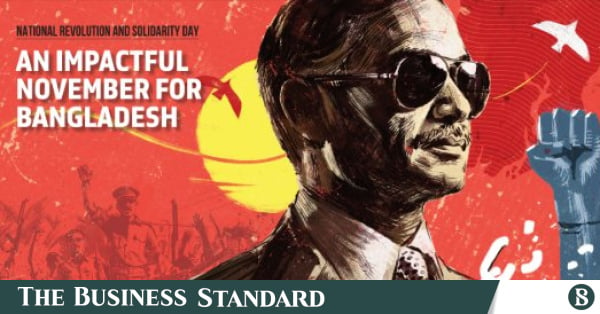
National Revolution and Solidarity Day / BNP
While most comments will be posted if they are on-topic and not abusive, moderation decisions are subjective. Published comments are readers’ own views and The Business Standard does not endorse any of the readers’ comments.
The Business Standard
Main Office -4/A, Eskaton Garden, Dhaka- 1000
Phone: +8801847 416158 – 59
Send Opinion articles to – [email protected]
For advertisement- [email protected]
About the Author