More than 500,000 gather in Paris and other cities for protests uniting students, teachers, unions and ‘yellow vests’.
Save
Share
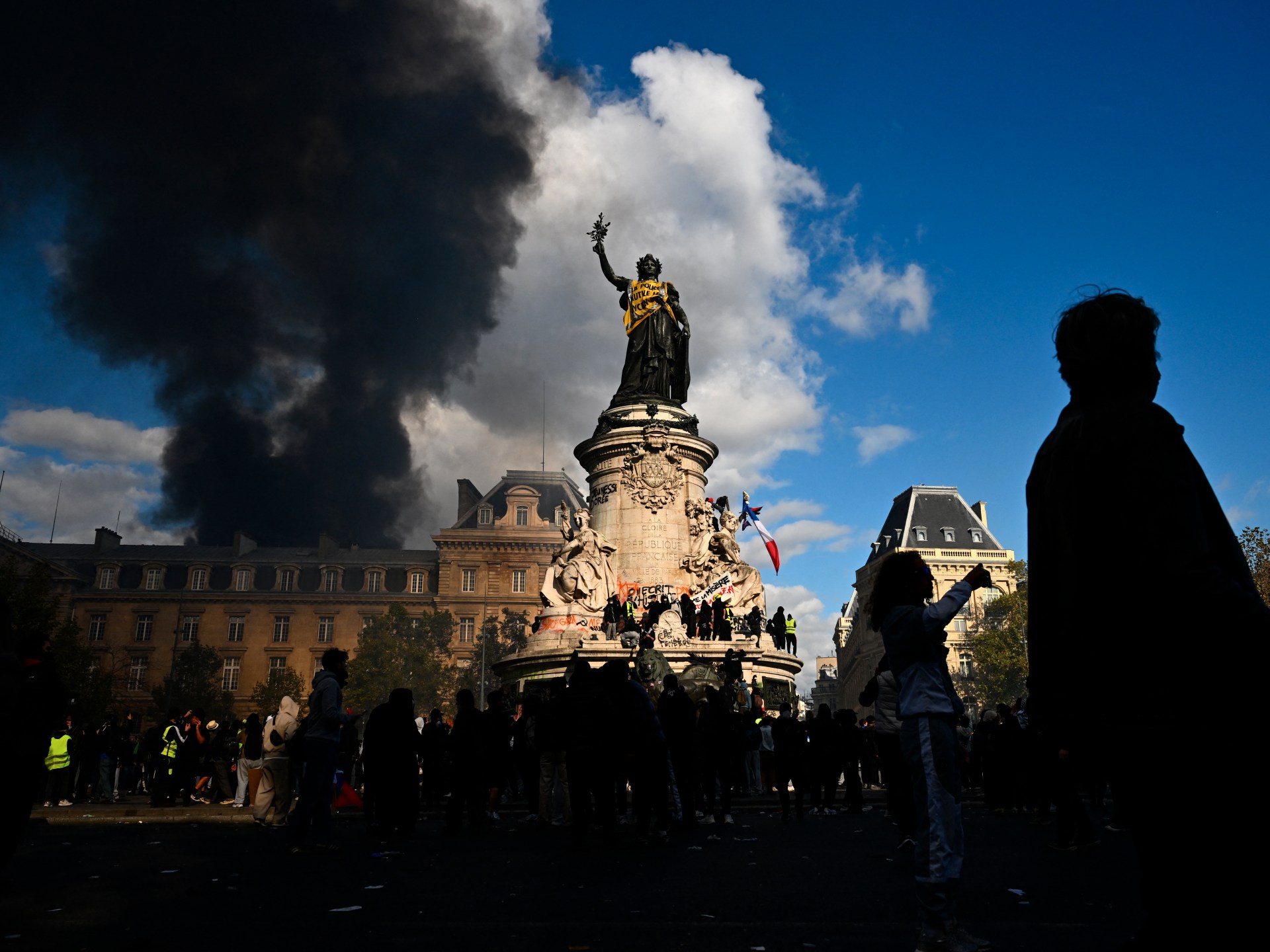
Paris, France – Marianne, the statue personifying the French Republic, towers over Place de la Republique in Paris, wearing a yellow vest.
At the base of the monument, the faces of the three allegorical figures representing Liberty, Equality and Fraternity are streaked with black tears. Above them, tear gas canisters arc through the air, filling the square with smoke.
This was the scene as tens of thousands of protesters, mostly young people, rallied at the heart of the French capital on Saturday in the latest act of a movement that has been rocking France to the core for more than a month now.
The demonstrations were spearheaded by students demanding education reforms but quickly swelled to channel mounting anger over failing public services, rising living costs and a future that feels increasingly out of reach.
“Everybody has come together asking the government for a final time to hear us loud and clear because it is not OK what is happening,” said a high school student who asked not to be identified, her fist raised in the air.
“We are here because we want to take back our rights,” she said.
The social movement, hailed by some as historical, has gained cross-class, cross-working sector support, uniting groups including remnants of the “yellow vests” – the grassroots cost-of-living protests that shook France in 2018.
The presence of nurses, human rights lawyers, firefighters, parents, teachers and some remnants of the “yellow vests” on Saturday was a testament to how pupils have catalysed a social discontent running deep across French society.
The CGT, one of France’s major labour unions, also backed the protests, calling for “higher wages and pensions, lower prices and the protection of public services that meet people’s needs”.
Authorities said 550,000 people protested across the country on Saturday, including 110,000 in the capital.
A recurring theme among protesters interviewed by Al Jazeera was that the system has failed them, violence is used too casually, and that any prospect of a better future looks bleak.
Anxiety was a recurring word.
“Young people are anxious about their futures and their failing schools; the yellow vests are distressed by the cost of living, which is literally exploding; and there are existential anxieties regarding the geopolitical situation,” said Jean Pierre, a member of the French Human Rights League. “That is why there are so many people out there; it is the result of a whole host of anxieties that people are feeling today,”
Parents were also present. Amelie, a mother of three, did not want to provide her last name. With eyes tickling over the smell of tear gas, she said it was important for her to support them.
“We will keep up the pressure to make sure someone is taking care of our children’s future,” she said, while standing next to her teen daughter.
At each corner of the square, there was a heavy police presence of large numbers of riot police officers dressed in full gear.
Gas canisters were launched in the early hours of the protest at noon despite a scarce presence of people. Yet, from 2pm onwards (12:00 GMT), the square was packed, and it became tense.
Clashes broke out between the police and some of the protesters, who threw firework mortars at officers and set one car and a newspaper stand on fire, sending a thick cloud of black smoke up into the sky.
The smell of tear gas could be felt from streets away, as well as the sound of what seemed like stun grenades that became more frequent as the day progressed.
Coffee shops and boutiques closed for the day as firefighters’ sirens crossed the city. Still, the vast majority of the protesters peacefully joined the march that started moving towards northwestern Paris.
Elsewhere in France, in the southern city of Marseille, demonstrators breached the town hall and looted shops; in Lyon media reports said a tourism office was set ablaze.
France’s Ministry of the Interior said that at least 400 people had been arrested after violent incidents involving hooded individuals, including in Paris, Marseille in the south, Rennes in the northwest, Toulouse in the southwest and Angers in the west.
“Such actions include attempted looting, confrontations with law enforcement, the setting of fires to street furniture and the targeting of seats of power and media outlets,” it said, blaming the unrest on what it described as the “ultra-left”.
Bruno Cautres, a researcher at the Paris-based Center for Political Research, told Al Jazeera that Saturday’s events are the “culmination of different mobilisations” that emerged out of frustrations about high taxes combined with a significant national debt and deficit that is preventing the government from satisfying public demands.
“The French are asking themselves where are we going as a country? How are we going to get out of this budget crisis?” Cautres said.
The protests began in mid-September at a high school in the Paris suburb of Creteil, where students took to the streets over dilapidated buildings, overcrowded classrooms, teacher shortages and what they see as a deeply unequal education system.
Saturday’s mobilisation followed calls on social media to revive the “yellow vests” movement, which emerged in 2018 against diesel prices but quickly morphed into a movement against President Emmanuel Macron’s perceived bias in favour of the elite.
It is also taking place in the last stretch of Macron’s presidency amid a highly polarising political landscape before crucial elections next year, which could pave the way for Europe’s second-largest economy to be led by a far-right party, the National Rally.
Macron appealed for calm on Friday, the eve of the protests. “There is a constitutional right to protest and to express oneself. But this right comes with the need to respect. Respect for people, respect for property, and therefore a commitment not to insult or destroy,” he said in Brussels.
But the government has no easy way out. France has been trying to reduce its ballooning public debt but has failed so far to reassure investors, pushing the government borrowing costs to their highest levels in more than 20 years.
Follow Al Jazeera English:
About the Author