Home
/
Global Taiwan Brief
/
/
Taiwan’s most holy temple to the Daoist medicine god, Baosheng Dadi (保生大帝), is found in Xuejia, Tainan. The temple is managed by a powerful local figure named Wang Wen-tsung (王文宗), a name that means “eminent writer” in literary Chinese. Wang’s name, as well as the therapeutic role of Baosheng Dadi, contrast with Wang’s personal history. In 2022, Wang allegedly orchestrated a shooting during which a gunman unloaded 88 bullets into two properties owned by politicians aligned with Taiwan’s Democratic Progressive Party (民進黨). Wang was the reputed mastermind behind the plot, paying for expenses related to the gunman and an accomplice’s escape to Fujian Province, in the People’s Republic of China (PRC). Wang even travelled twice to meet the accomplice in China, paying for the latter’s hotel rooms and allowing the man to use his identity for Chinese payment apps. Wang was arrested in March 2023, and prosecutors laid out the evidence for his involvement with the crime. Yet in December 2023, eight months after Wang had been arrested trying to flee the country, he was re-elected as chairman of Ciji Temple (慈濟宮), the Xuejia shrine dedicated to the god of healing.
This case raises curious questions about Taiwan’s temple governance and grassroots society: How can a man who arranged for a submachine gun attack on two politicians’ properties remain the leader of an eminent temple in Taiwan? In February 2024, Wang Wen-tsung was convicted of harboring a criminal and sentenced to six months in prison. As of October 2026, he was still leading temple events in Xuejia, distributing cash gifts to worshippers, and leading processions in celebration of Baosheng Dadi. Why would someone capable of organizing such a sensational crime take an interest in managing a Daoist temple in the first place?
Temples are deeply influential institutions within Taiwan’s grassroots, traditional society—the kind of communities found widely outside of urbanized, highly-educated locations such as Taipei or Hsinchu. Because temples serve as a community meeting point for residents, and are permissible channels through which patronage can be distributed to local citizens, there is a strong incentive for criminal actors seeking political power to take over management of them. The majority of Taiwanese temples are most likely not gang controlled; however, there are a number of highly prominent temples in Taiwan that are run by alleged organized crime leaders.
Temples are attractive targets for control by gang leaders, as there are few to no regulations requiring detailed financial reporting to the Taiwanese government. The financial and personnel management of temples is governed by a set of internal rules, the robustness of which determines how easily criminal actors can establish control over the temples in question. Temples are also effective conduits through which criminal figures can establish relationships with local and national politicians, as elected officials are drawn to the well-attended events thrown by temples and the subsequent opportunities to connect with local voters.
Based on interviews with Taiwanese government officials, scholars, and temple managers, this article unpacks the system that has produced a conspicuous degree of overlap between alleged gang leaders and temple managers.
Government Regulation in Name Only
Because Taiwanese temples predate the development of Taiwan’s modern legal system, the institutions are afforded a special place in Taiwanese regulation. In an interview, Howard Wu (吳浩遠) of the Tainan City Civil Affairs Bureau (民政局)—the local government department that oversees temples—shared with me that unlike Christian churches, temples are not required to establish foundations to operate. Indeed, there are few direct regulations that can compel a temple operator to register their temple at all. In other words, an individual can start a Daoist temple or shrine in their home, accept cash donations, and spend those cash donations in any way they see fit without breaking the law. [1] In a separate interview, a senior official in Taiwan’s Ministry of the Interior (內政部) shared that as long as the operator of the shrine restricted individual transactions to under NTD 500,000 (USD 15,650), they could conceivably funnel cash donations to their personal accounts and escape the notice of banks’ anti-money laundering systems. [2]
Yet even if a temple registers with its local civil affairs bureau, the requirements for financial reporting are extremely lax. Wu pointed out that a temple must submit a biannual financial report that shares topline figures for the money received in donations, and the money spent by the temple. The financial administrator of the temple need not provide any proof for the reported figures, nor must they itemize revenues or expenses. Over a banquet dinner (辦桌), the financial administrator of a Tainan temple dedicated to the City God (城隍爺) cheerfully told me that “it is a very simple system.” [3]
Wu, the Tainan City official, admitted that the government cannot impose penalties on temples even for non-compliance with these simple financial reporting requirements. Instead, local governments rely on inducements to encourage temple managers to adhere to rules. Wu outlined that any temple with an ambition to attract substantial donations will register with local authorities, as registration confers a sense of legitimacy that worshippers reward with cash contributions. Registered temples are also able to issue receipts through which donors can apply for tax deductions. Yet in order to incentivize temples to comply with even the meager reporting requirements conferred by Taiwanese law, local authorities dole out subsidies for temple events—and, in the case of particularly historical temples, money for building improvements.
Perhaps more importantly than the superficial financial reporting requirements, temple registration calls for managers to disclose the institution’s organizational chart, which may change at each temple election. This is important for local officials, as it allows them to understand whether a temple is adhering to its own bylaws for managing leadership, or whether a few individuals have established corrupt control over the temple’s administration. Local governments will occasionally raise objections if they find that a temple has not adhered to its personnel management bylaws.
Ultimately, however, whether or not temple managers abuse the political and financial power of temples is less a product of government regulation, and more the outcome of the internal governance systems of each institution. Indeed, as the financial administrator of the City God temple in Tainan conceded to me: “[T]he temple manager has the power to decide most of what we do.”
The Internal Governance Systems of Temples
No two temples operate identical internal governance systems. These systems generally reflect decisions made at the time of the temple’s founding, and the communities around the temple. Most temples are organized by a committee (委員會), and occasionally by “boards” (董事會)—if they have established foundations or simply wish to adopt that nomenclature to present a more official image. Committees and boards will include individuals that have taken on specific roles, such as chair (主委, 董事長), vice chair (副主委, 副董事長), supervisor (常務監事), and financial administrator (財務委員).
Internal practices, such as accounting, are determined by committee members—and may be concentrated under the authority of the chair, or shared among multiple officials. The City God temple financial administrator described a robust system to me. Boxes containing cash donations are opened monthly by a group of no fewer than three people. Donations are counted collectively and deposited to an account held under the names of two officials. Meanwhile, any expense over NTD 1000 (approximately USD 31) must be reported to the temple committee. (The itemized expenses were not shared with the local government.) However, the financial administrator pointed out that in other temples, bookkeeping may be purely executed by the temple chair, who is often the only full-time official in the institution.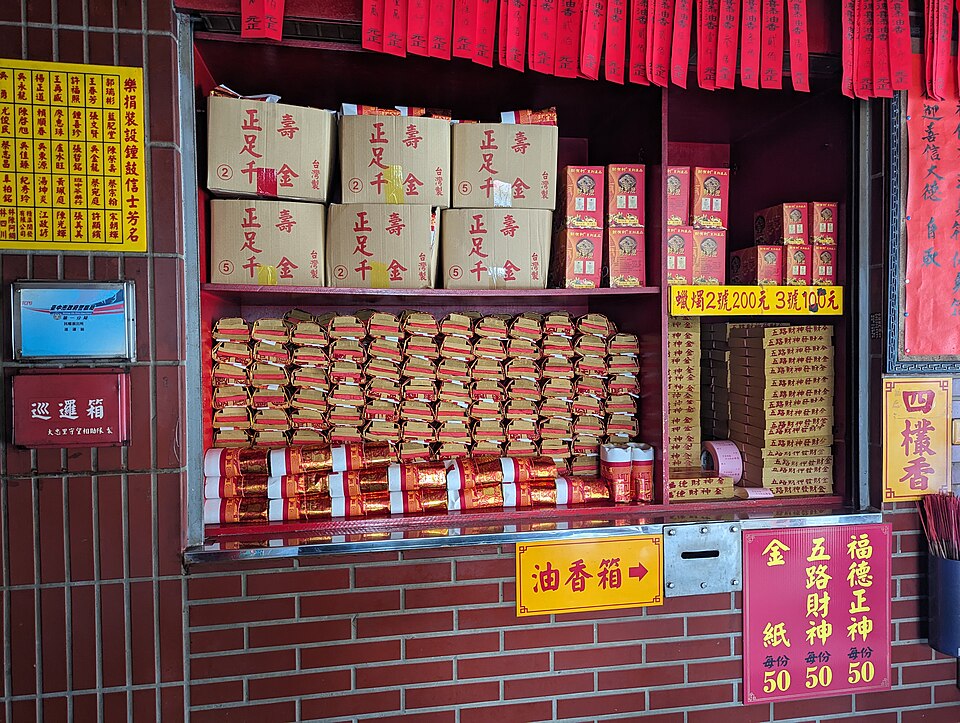
Image: Joss paper (金紙) stacked on shelves in a Taiwanese temple. Devotees exchange cash donations (香油錢) for joss paper and burn it to honor gods or ancestors. (Image Source: Boattoad, Wikimedia Commons)
It is in the election process for the committee chairs, who manage the institution, that temples demonstrate either resilience or susceptibility to corrupt leadership. Dr. Sher Chien-Yuan (佘健源), professor at National Sun Yat-sen University (國立中山大學) in Kaohsiung, classifies temples into two broad buckets: “new” and “old” temples. Old temples find their roots in Han communities that originally settled in various parts of Taiwan. New temples may have been constructed by internal migrants in Taiwan, or recently by businesspeople wishing to leave a physical representation of their legacies. Old temples often have highly restrictive eligibility criteria for membership. Charles Chang (張瑞麟), a committee member of Ji Dian Wu Miao (祀典武廟), a temple in Tainan that receives government funding due to its historical status, underscored to me that only direct descendants of the original families that founded the temple could serve as committee members. These committee members would elect the chair who manages the temple. There were 110 spots available in the committee, and an applicant would have to wait until an existing member passed away before they could join. His daughters had been waiting in line to join the committee for many years. [4]
Indeed, I interviewed committee members at multiple temples who described extended waiting periods for membership, sometimes stretching decades. One interviewee belonging to a prominent Mazu (媽祖) temple in Kaohsiung outlined an even stricter system. The temple had been built by three villages, and so direct descendants of the original inhabitants of each village were permitted to gather periodically and elect 21 representatives. The 21 representatives of each village would then elect 21 members among them to serve on the temple committee. Finally, the 21 committee members would choose the chair. [5] In theory, highly restrictive election systems such as these would hamper the ability of corrupt or criminal actors to gain leadership over temples. One member of an old temple in Tainan told me the committee would pay careful attention to the backgrounds of applicants, and would not admit a member who had a suspect past. [6]
However, as Dr. Sher explained to me, certain “new” temples have been constructed more recently by internal migrant communities, such as those who arrived in Kaohsiung during its industrialization boom in the 1970s. These migrant communities were naturally more transient, and could not ground committee membership in historical ties to a particular area. Membership might be more open—or, in the case of new temples struggling to attract donations, welcoming to businesspeople able to provide resources to grow the assets of the temple. [7] One academic survey found that when choosing which temples to visit, Taiwanese worshippers are particularly sensitive to the perceived financial health of the institution: the better the financial health of the temple, the more visitors it receives and the greater the donation figures.
In this context, gang leaders—who almost always own legitimate businesses through which to disguise their wealth—can be seen as worthy investors in temples, capable of drawing more devotees through bigger processions or improved physical premises. In a remarkable set of structured interviews with gang members in Taiwan, a Ministry of Interior Criminal Investigation Bureau (刑事警察局) official, Yueh Ying-Chung (岳瀛宗), learned that some gangsters regard temples as businesses to be developed. Recounting the growth of one temple, a gangster stated, “It was originally just a small altar, but later, as the incense offerings grew, it gradually expanded. The donations from believers were substantial, and training the procession was also a matter of prestige, which helped increase income.” Indeed, the gangsters interviewed by Yueh were particularly drawn to the revenue-generating power of temples: “For temples of any size, annual donations from believers are often tens of millions, and some believers’ donations for fulfilling vows are even more lavish.”
Charles Chang, the committee member of Ji Dian Wu Miao in Tainan—a temple that does not have gang connections—told me that donations to his temple had reached NTD 50 million (USD 1.6 million) last year. [8]
Whether by founding new shrines, offering their financial clout to struggling temples, or simply buying existing ones (since the assets owned by a temple are transferrable), criminal actors are able to secure a greater degree of control over temples with weak internal management systems. Once in control of a given temple, a corrupt or criminal actor can seek to use its resources and convening power to foster alliances with politicians: for example, in order to win bidding processes for government contracts. Speaking of the usefulness of temples for gangs that run construction businesses and compete for government tenders, a gangster interviewed by Yueh Ying-Chung stated:
If the temple is big enough, and is very famous with a large following, high officials, even presidents will come to visit. This changes its image, and donations will be substantial. So it’s easier for these companies to introduce bids or change government procurement offers, business will be easier, and lower officials won’t come and cause trouble.
A criminal actor in charge of a temple could also use their position to enlarge religious exchanges with Daoist shrines in the PRC, activity that the Chinese Communist Party (CCP) has long promoted as part of its united front political warfare strategy directed at Taiwan. The Chinese Unification Promotion Party (中華統一促進黨), a sham political party in Taiwan founded by gang members, has—according to a Ministry of Interior senior official—purchased more than a dozen temples and is using them to promote a pro-unification agenda allegedly financed by the CCP.
Even for so-called “old” temples, the pull of enormous donation receipts has encouraged some corrupt actors to seek control over management. This is especially true for temples to Mazu, a sea goddess that has achieved enormous popular appeal due to several massive pilgrimages organized in Taiwan each year. The vice chair of the eminent Mazu temple in Kaohsiung told me that all around the island, elections for chairs of Mazu temples had been growing more competitive. Despite the extremely restricted membership process for his temple—allowing eligibility for descendants of just three villages—the vice chair confided that committee members had recently convened to vote out a chair who had been diverting donation revenues to friends acting as vendors to the temple. [9]
Since large temples employ part-time workers, source supplies such as joss paper (金紙) from sellers, and conduct frequent building maintenance and improvements, it was possible for the corrupt former chair to funnel revenues to cronies who had asked for a share of the temple’s vast donations. The committee voted the corrupt chair out only narrowly. This incident illustrates that temples with more robust internal governance systems are better equipped to resist unscrupulous management—but that even older and well-established temples in Taiwan can become the targets of corrupt control.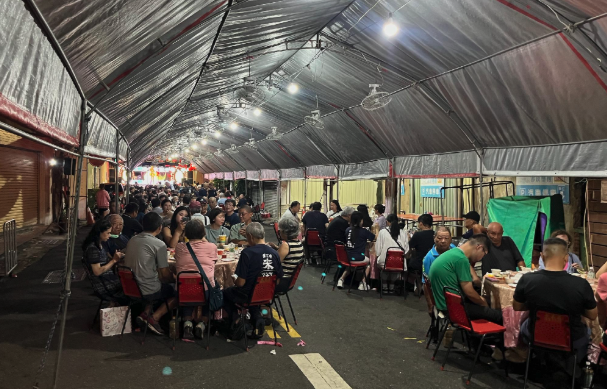
Image: A traditional Taiwanese street banquet (辦桌) in Tainan attended by the author. A number of politicians competing for local office attended this annual celebration, organized by a City God temple. (Image Source: Author’s photograph)
The Draw of the Political Power of Temples
How, in particular, can temples afford criminal actors political power? In Taiwan’s democratic era of competitive elections, the ability of temples to convene local residents has rendered them critical outreach targets for politicians. Some 60 percent of Taiwanese citizens observe some kind of deity worship. And since devotees to Daoist temples are typically concentrated among older populations, temples and the elaborate events that they hold afford politicians a chance to connect with reliable voters. As one election researcher at the National Chengchi University (國立政治大學) put it: “Everyone’s going to temples, if you don’t, you fall behind.” During the 2024 presidential election, the three major candidates made over 400 visits to temples (of which nearly 30 percent were Mazu temples).
The benefit to temples of high-level visits by politicians has been articulated by the gang members interviewed by Yueh of the Criminal Investigation Bureau: “Once a temple gains scale and reputation, politicians will flock to worship it, further elevating its religious status and fame.” But, what are the precise ways that a temple can help a particular candidate during an election?
There was once a time, in the early years of Taiwan’s democracy, that a temple might issue open support for a particular candidate. For example, in 2000, Jenn Lann Temple, one of the most prominent Mazu shrines in central Taiwan, held a divination that found that their Mazu preferred the candidate James Soong (宋楚瑜) for the presidency. However, temples have moved beyond this degree of overt support for a particular candidate, partly because the strategy is risky: in that case, Soong lost the election, leaving Jenn Lann Temple to engage with a president it had not supported.
Instead, Dr. Ku Ming-Chun (古明君), professor at Tsinghua University in Hsinchu, told me that temples’ support for candidates will be more “subtle.” When throwing elaborate processions, such as Jenn Lann Temple’s Dajia Mazu pilgrimage (大甲媽祖遶境) that draws millions of attendees each year, a temple will invite candidates from all parties. However, the temple management may afford a favorite candidate a more advantageous position in the proceedings, such as when the goddess statue originally departs her mother temple in front of heaving crowds. Ku noted that temples may also offer politicians honorary titles, such as an “advisor” (顧問), which the politician can flaunt in order to curry favor with a given area’s voters. [10]
Image: Temple volunteers distribute free bread to devotees during the Baishatun (白沙屯) Mazu pilgrimage in 2018 (Image Source: Wikimedia commons)
However, perhaps the most important resource that temples can lend politicians is the grassroots influence of the chairs themselves. Because temple chairs ostensibly command the activities of the temple, and in particular the charity that the temple distributes to local residents, chairs have cultivated deep wells of favor among local residents. In addition to gaudy events designed to entertain local populations, wealthy temples will distribute charity to devotees in the forms of cash-filled “red envelopes” (紅包), food staples such as rice, or scholarships for educational advancement.
The favor earned from this activity is no doubt part of the reason that temple chairs with known criminal backgrounds, such as Yen Ching-piao (顏清標), chair of Jenn Lann Temple, or even Wang Wen-tsung of Xuejia Ciji Temple, have been able to hold on to their chairmanship positions. As one former senior Ministry of Interior official told me, when elections roll around, these temple leaders have established such a strong position of local support that their personal political preferences can influence significant numbers of local voters to break for candidates. [11] Some temple chairs can even promise candidates specific numbers of votes when election time rolls around.
Yet for temple managers, the surest guarantee of political power is to run for office oneself, or to arrange for family members to run for positions of power. A number of temple chairs hold, or have held, political positions themselves. Examples include Yen Ching-piao (顏清標), who was a Kuomintang (國民黨)-aligned national legislator from 2002 to 2012; or Huang Cheng-kuo (黃承國), the chair of Zhinan Temple (指南宮) in Taipei, who was both a gangster and a member of the Central Standing Committee of the Democratic Progressive Party (民進黨). Still more temple chairs have supported family members entering elected politics: such as Tsai Yung-te (蔡咏鍀), chair of Beigang Chaotian Temple (北港朝天宮), who has allegedly channeled temple funds to a foundation run by his sister, who is a national legislator for the TPP. Even Wang Wen-tsung, the Xuejia Ciji Temple chair who served six months for arranging a shooting attack, can boast of a daughter presently running for city government in Tainan.
The main point: While most temples in Taiwan have likely resisted the influence of organized crime, some prominent temples are run by individuals with criminal records and alleged gang leadership roles. Temples enjoy extremely lax regulation in Taiwan, meaning that unscrupulous actors can potentially employ them to funnel worshippers’ donations to cronies, or as conduits for money laundering. Ultimately, internal governance systems determine how easily a temple can be corrupted, and the charity benefits that temples dispense to devotee communities affords temple chairs tremendous levels of political clout.
The author would like to thank Mina Chen and Karyn Kao for their help with the background research for this article.
[1] Author’s interview, July 2026.
[2] Author’s interview, July 2026.
[3] Author’s interview, July 2026.
[4] Author’s interview, July 2026.
[5] Author’s interview, July 2026.
[6] Author’s interview, July 2026.
[7] Author’s interview, July 2026.
[8] Author’s interview, July 2026.
[9] Author’s interview, July 2026.
[10] Author’s interview, July 2026.
[11] Author’s interview, July 2026.
Our vision is to raise awareness, deepen affinity, and create opportunities for strengthening the relationship between Taiwan and the international community
About the Author