What innovations from Ukraine should NATO implement? Is the North Atlantic Alliance capable of responding to the intensifying hybrid activities of the Russian Federation? If not, what must it do to change this? Members of the Ukraine-NATO Inter-Parliamentary Council sought to answer these and other questions.
In recent days, the Sejm of the Republic of Poland hosted a seminar of the Ukraine-NATO Inter-Parliamentary Council (UNIC) as part of the NATO Parliamentary Assembly. The main theme of the event, chaired by Joanna Kluzik-Rostkowska (Chairperson of the Delegation of the Sejm and Senate of the Republic of Poland to the NATO Parliamentary Assembly), was the lessons the Alliance can learn from the ongoing war in Ukraine. The meeting was dedicated not only to analysing conclusions from the war in Ukraine but also to defence innovations, combating hybrid threats, and the future of Euro-Atlantic security.
At the beginning of the event, it was stated that today’s escalation of aggressive actions by Russia results, among other things, from the fact that it is not achieving its intended military objectives on the front line. Data was cited indicating that, compared to July 2025, the number of Russian ballistic missile strikes on Ukraine has increased by as much as 80 per cent this July.
Assembly participants agreed that Russia remains a direct and strategic threat to Euro-Atlantic security. It was also repeatedly emphasised that Russian actions are supported by other authoritarian regimes, such as those in China, Iran, and North Korea.
Oleksandr Kornienko, First Deputy Chairman of the Verkhovna Rada of Ukraine, stated that today the most crucial and pressing problem for Ukraine remains air defence shortages. The Old Continent is expected to respond to these needs, although unfortunately, some Western European countries, despite the expiring service lives of PAC-2 and PAC-3 missiles, are currently unwilling to share them.
Minister Paweł Zalewski (Deputy Head of the Ministry of National Defence – MON) declared Poland’s continued support for Ukraine. He added that Warsaw is considering further equipment support, this time in the form of transferring another fourteen MiG-29 fighter jets to Ukraine. He also noted that the European Union is working on certain support measures. This includes work on its own solutions intended to be the equivalent of the currently critical Starlink system.
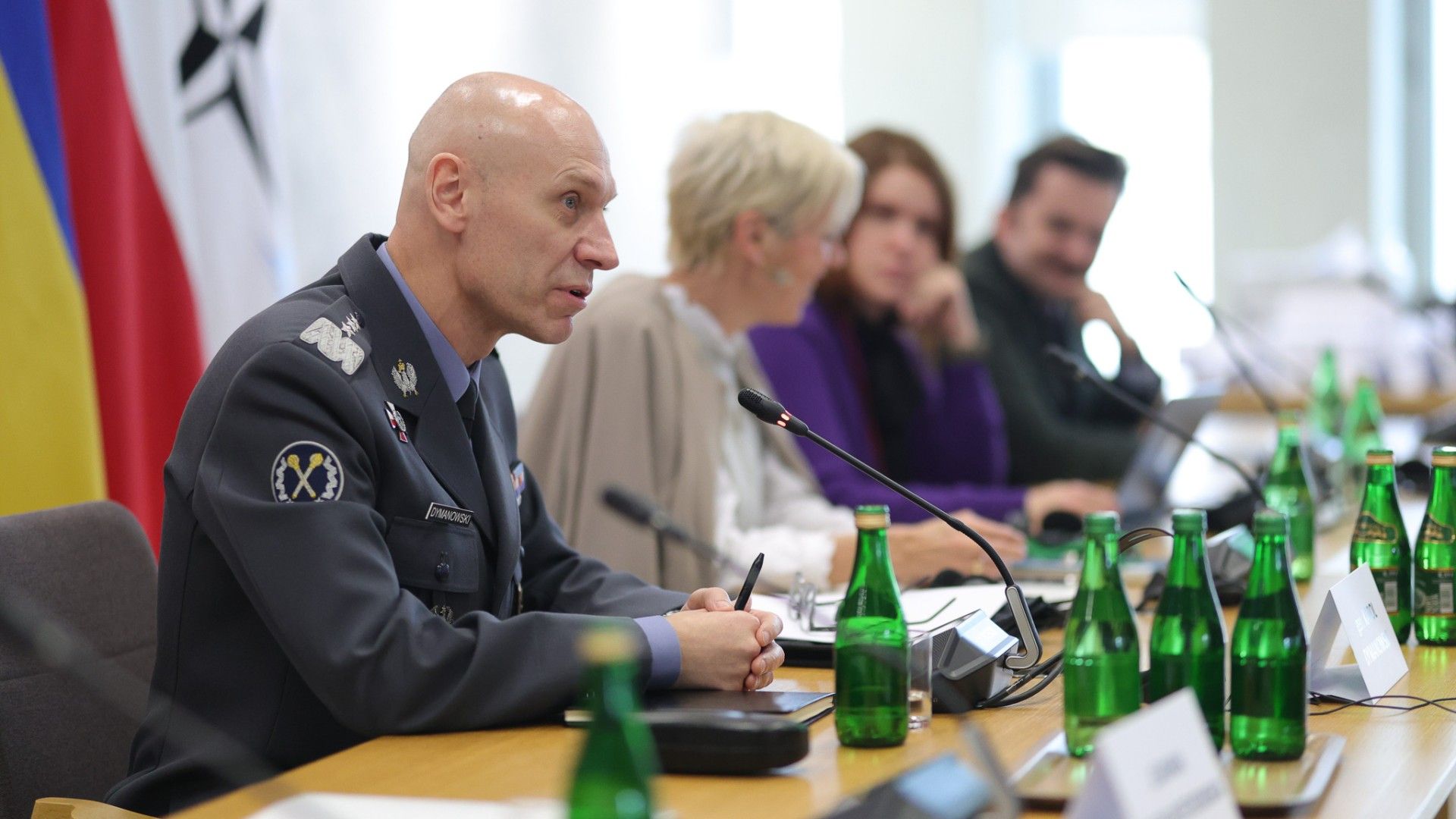
General Karol Dymanowski, First Deputy Chief of the General Staff of the Polish Armed Forces, drew attention to the difference in potential between NATO and the Russian Federation. The North Atlantic Alliance spends ten times more on security than the Russians. Even excluding the US, the European members of the Alliance alone spend three times more on armaments than Moscow. One must also not forget that the West has a significantly greater potential in terms of both population and economy.
As General Dymanowski stated, Russia is aware of its smaller conventional potential compared to NATO, which is why it invests in the so-called „grey zone”, allocating enormous resources to hybrid activities. In this way, it offsets the asymmetry of potentials and slows down decision-making processes within the Alliance.
Europe, despite its demonstrated potential, often remains defenceless against Russian hybrid actions. One problem is that disinformation reaches audiences up to six times faster than verified information, and societies show high susceptibility to manipulation.
Through the aforementioned disinformation activities, Russia managed to partially achieve its strategic goals, which are to sow chaos, create discord in Western societies, undermine trust in state institutions, and, in the long term, destroy Ukraine, institutions such as the European Union or NATO, and sever Euro-Atlantic ties.
One of the conclusions highlighted during the seminar was the need to strengthen strategic communication. UNIC Co-Chair Marko Mihkelson emphasised that constant public deliberation about whether Russia will attack NATO weakens the Alliance’s credibility: „If we speak this way, it means we do not believe in our own deterrence„” he said. Meanwhile, Brigadier General Rafał Kujawa admitted that Europe is currently too reactive, which leads autocratic states to perceive Western democracies as weak. In his view, a clear political message is essential to demonstrate the values we defend. An example of this is the (albeit delayed) reaction of Germany following the drone incident in Leipzig. Berlin not only stated that such Russian provocations would be met with even greater German support for Ukraine but also decided to close the consulate in Bonn. The German representatives present at the meeting also admitted that, in response to Russia’s actions, a decision was made to carry out a deep reform of the intelligence services, aimed at increasing intelligence competencies and powers.
In the panel dedicated to the fight against hybrid threats, it was stated that the Russians are implementing a doctrine of a new mode of warfare, which involves constantly testing the boundaries of the North Atlantic Alliance.
„Russia acts like a lawyer – it precisely analyses international treaties and looks for political and legal loopholes in them„” the audience heard. In the discussion regarding Russian actions below the threshold of Article 5 of the Washington Treaty, it was stated that it is worth considering a more effective NATO response to hybrid actions. A proposal was made to define a precise response threshold for such incidents within the Alliance.
Ukrainian parliamentary representatives drew attention to the progressive escalation of actions and their perfidy. It was noted that today a single drone can cause the shutdown of a large airport in Europe, generating enormous costs and paralysing a given country. A question was also raised about the future classification of specific actions. It was asked whether, if robots or autonomous drone swarms begin to cross NATO borders, the North Atlantic Alliance will still classify this as a „hybrid attack”. Another criticism from the Ukrainian side was the passivity of the West in many aspects. „Russia is conducting a campaign, and you are writing incident reports„” the participants heard.
A very important point of the meeting in Warsaw was drawing attention to the conclusions Western countries can draw from the war in Ukraine. It was repeatedly confirmed that one of Kyiv’s most important weapons today is the ability to adapt very quickly to changing conditions.
Speaking about Ukrainian innovations, the importance of the BRAVE-1 cluster was emphasised, allowing for the rapid implementation of innovations (from idea, through testing, to direct use on the front). Furthermore, several recent achievements were mentioned. These include the reduction of targeting and target designation time for artillery through the use of AI. It was also mentioned that the use of evacuation drones has allowed Ukraine to achieve a twofold increase in the number of rescued soldiers.
What can NATO learn from Ukraine? Above all, it was stated that 21st-century warfare requires the elimination of excessive bureaucracy in procurement and implementation processes.
About the Author