Bipartisan backlash over a proposed $1.8 billion “anti-weaponization” fund threatened to derail the bill.
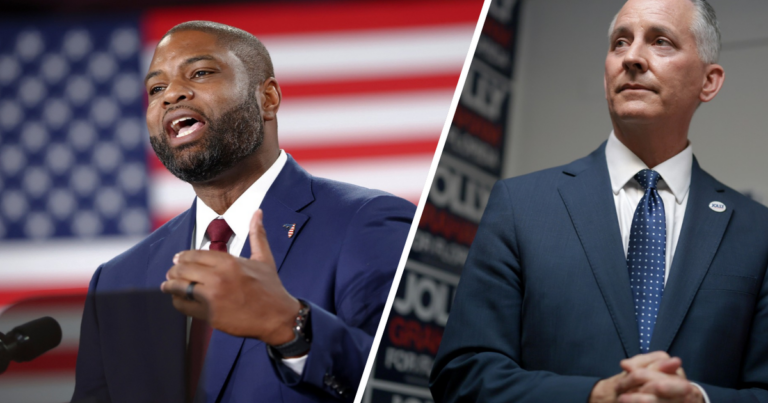
In recent weeks, Rep. Tom Kean Jr. launched a new “Hometown Heroes” program honoring first responders in his district. He’s said he’s joining the Congressional Crypto Caucus. And he announced he co-sponsored a bill to combat discrimination against Sikh Americans.
Looking at those social media posts, you’d have no idea that Kean, a 57-year-old New Jersey Republican, hasn’t voted or been seen in public for more than three months.
Read the full story here.
Two members of the advisory board for Stars and Stripes are suing the Defense Department over a memo that they say undermines the military newspaper’s long-standing editorial independence.
The lawsuit, filed this week in federal district court in Washington, asks the court to deem the March memo illegal and prohibit the Trump administration from moving forward with proposed changes. It was filed by advisory board members Susan Dardarian and William Church, two Pulitzer-Prize-winning journalists who say the Pentagon is trying to exert direct control over coverage in violation of its own regulations and the First Amendment.
“Unlawfully censoring ‘the soldiers’ paper’ is an insult to the dedicated members of the armed forces and an attack on the freedom of speech — a foundational constitutional principle for which those brave servicepeople dedicate their lives,” said Paul Wolfson, senior legal adviser at Democracy Forward, which is representing Dardarian and Church.
Pentagon spokesperson Sean Parnell, who is named as a defendant, said in a post on X that the lawsuit was “without merit” and that the department is “committed to a Stars and Stripes that is modern, mission-focused, and worthy of the servicemembers it serves.”
In January, Parnell had said the Pentagon planned to overhaul Stars and Stripes, which has reported on the U.S. military since 1861, refocusing it on “warfighting” instead of “woke distractions.” The publication’s ombudsman, Jacqueline Smith, who was fired by Parnell in April, said she believed it was because she opposed the changes.
Under Defense Secretary Pete Hegseth, the Pentagon has imposed new restrictions on media coverage, drawing protests from media outlets including NBC News. This week, journalists were banned from the Pentagon press office after the department designated it a classified space.
Acting Pentagon press secretary Joel Valdez rejected suggestions that it was an attempt to further limit media access, saying this was the “most transparent” Defense Department in history.
Even without the “anti-weaponization” fund, the Trump administration has the ability to give payouts to Jan. 6 rioters though an already existing mechanism: the Judgment Fund.
Acting Attorney General Todd Blanche told Congress this week that the Justice Department was “not moving forward” with the $1.776 billion “anti-weaponization” fund, after congressional Republicans balked over it.
Read the full story here.
The U.S. economy added a robust 172,000 jobs in May, a sign that the labor market remained resilient even despite a growing energy and inflation crisis triggered by the ongoing war with Iran.
According to the Bureau of Labor Statistics, the unemployment rate remained steady at 4.3%. Average hourly earnings rose 3.4% from a year ago, which puts wage growth below inflation. In April, inflation sharply jumped to a 3.8%, its highest level in three years, due to the surging price of gasoline and the resulting economic ripple effect.
Read the full story here.
For the Democratic Party, the road to Maine’s Senate primary is paved in dread.
All Graham Platner had to do was glide into Tuesday’s election to clinch the state’s Democratic Senate nomination, since Gov. Janet Mills abruptly suspended her campaign in late April. But with each passing day, the divisions inside the party have grown as some lawmakers and activists say they are increasingly alarmed over the breadth and depth of controversies and scandals facing the military veteran.
Graham Platner greets supporters at an event hosted by Sen. Bernie Sanders in Orono, Maine, last weekend. Robert F. Bukaty / AP file
Read the full story here.
The House passed bipartisan legislation last night that would provide new aid to Ukraine and impose sanctions against Russia, largely clashing with the Trump administration’s approach to the war.
The 226-195 vote included support from 18 Republicans, who joined all but one Democrat in approving the measure.
Read the full story here.
The jobs report for May, set to be released this morning, is expected to show that hiring has remained steady despite growing inflation and energy prices triggered by the ongoing war in Iran.
Economists polled by Dow Jones believe that the U.S. economy will have added 80,000 positions in May and that the unemployment rate will be unchanged, at a low 4.3%. Average hourly earnings, which fell below the rate of inflation in April, are expected to rise 0.3%. Wages are expected to rise 3.4% from a year ago.
Read the full story here.
Senators blocked a vote to start consideration of an extension of the authority under the Foreign Intelligence Surveillance Act to conduct warrantless surveillance of noncitizens outside the country — a controversial issue because of the potential for Americans’ communications to get swept up in the activity.
The effort to proceed to the measure failed after Senate Democrats raised concerns about Trump’s appointment of top housing official and close ally Bill Pulte as acting director of national intelligence. As director of the Federal Housing Finance Agency, Pulte had sought probes into several of Trump’s perceived political enemies.
A vote to proceed to the bill failed in a 47-52 vote with Sen. John Fetterman, D-Pa., being the only Democrat to vote to proceed to the bill. Republican Sens. Josh Hawley of Missouri, John Kennedy of Louisiana, Mike Lee of Utah, Rand Paul of Kentucky, Eric Schmitt of Missouri, Rick Scott of Florida and Tommy Tuberville of Alabama voted against proceeding to the measure.
The Senate passed legislation this morning to fund Trump’s immigration enforcement agencies after intense bipartisan backlash over a $1.8 billion “anti-weaponization” fund threatened to derail the bill.
Republicans managed to push through the $70 billion legislation, which would fund Immigration and Customs Enforcement and the Border Patrol through the end of Trump’s term, on a 52-47 vote after weeks of delays.
Read the full story here.
NBC News
About the Author