Key developments on November 2.:
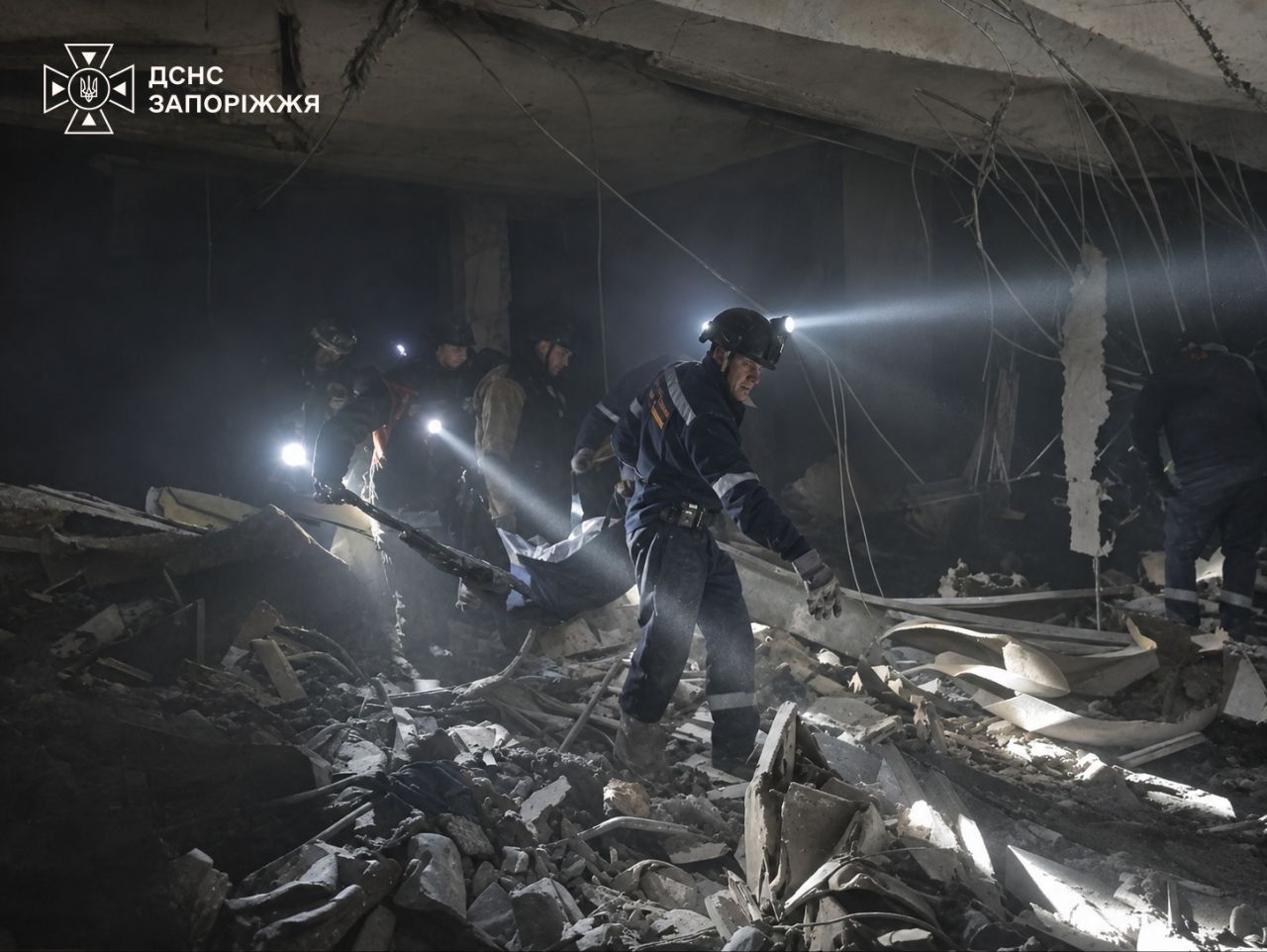
Russian strikes on a school used as a humanitarian aid distribution center in Komyshuvakha, Zaporizhzhia Oblast, killed at least 24 people, including two rescue workers and four police officers, on Nov. 2, Ukraine's State Emergency Service (DSNS) reported.
Five others were injured, including two rescue workers, according to DSNS.
President Volodymyr Zelensky said Russian forces launched several aerial bomb attacks on the settlement throughout the morning, initially striking a school where humanitarian aid was regularly distributed to local residents.
Following the initial strike, Russian forces dropped another nine aerial bombs on a shelter where people were taking refuge, Zelensky said.
He called it an "exceptionally horrific strike," saying it was proof Russia did not want to de-escalate the situation.
"Russian forces could not have been unaware that local residents who remained in Komyshuvakha received humanitarian aid there every week," Zelensky said.
Among those killed were two rescue workers, Denys Konovalenko and Oleksii Sushchevskyi, both 44, DSNS said.
According to the DSNS, rescue workers and police officers had arrived at the scene when the threat of another Russian strike emerged. The rescuers took shelter, but Russian forces carried out further strikes on the same site.
The attack destroyed a gymnasium, an outbuilding, and a fire truck, while also damaging the school building.
Konovalenko had served in Ukraine's civil protection service for nearly 12 years, while Sushchevskyi had worked in fire and rescue units in Zaporizhzhia since 2013. Both had received state awards for their service. They are survived by their wives and four children between the two families, according to the DSNS.
Komyshuvakha is located about 20 kilometers from the front line and has been considered a front-line settlement since November 2025 amid repeated Russian guided aerial bomb attacks, according to the Zaporizhzhia Investigation Center.
Russia frequently uses guided aerial bombs, known as KABs, to attack front-line areas. Fitted with wing kits, these bombs can travel tens of kilometers, allowing Russian aircraft to strike targets from a distance while staying outside the range of air defense systems.
Air raid alerts forced shopping centers across Ukraine to suspend operations for almost one-third of their scheduled opening hours in October 2026, setting a new record, as Russia escalates its attacks on the country.
The alerts accounted for 32.5% of their operating time, up 1.7% from September and almost three times the share recorded a year earlier, according to the Ukrainian Council of Shopping Centers (UCSC).
The figures cover shopping centers' standard operating hours, from 10:00 a.m. to 9:00 p.m. local time. In October 2025, air raid alerts accounted for 12.2% of this time.
Red-level alerts accounted for 36.7% of the total duration of air raid alerts in October, compared with 39.1% in September.
The disruptions are an additional drag on Ukraine's already hobbled wartime economy. Frequent Russian attacks force businesses to halt operations more often and for longer, causing losses.
On Sep. 3, the Ukrainian government introduced a two-tier air raid alert system to distinguish between different levels of aerial threat. A yellow alert indicates a drone threat, while a red alert signals a missile, combined missile-and-drone or large-scale drone attack.
Under the new rules, businesses can continue operating during yellow alerts if suitable shelters are available, but must suspend operations and move staff and visitors to shelters during red alerts.
The security situation deteriorated most significantly in Dnipropetrovsk Oblast, as well as in several western and central parts of the country, including Khmelnytskyi, Rivne, Volyn, Vinnytsia and Zhytomyr oblasts.
The five regions with the highest share of operating hours affected by air raid alerts remained unchanged: Donetsk, Zaporizhzhia, Sumy, Chernihiv, and Kharkiv oblasts.
By contrast, the UCSC recorded improvements in Cherkasy, Poltava, Odesa and Kherson oblasts, as well as in Kyiv.
The western oblasts of Lviv, Ivano-Frankivsk and Chernivtsi remained the least affected, with air raid alerts accounting for less than 3% of shopping centers' scheduled opening hours in October.
Nationwide, shopping center lost an average of 9.8 working days in October 2026 because of air raid alerts.
Since Russia launched its full-scale invasion of Ukraine in February 2022, the average cumulative downtime has reached 186.3 working days per shopping center, according to the UCSC.
Russia has modified and enlarged its Gerbera decoy drone, turning it into a lightweight, long-range one-way attack drone, Ukraine's military intelligence agency (HUR) said.
According to a technical breakdown published by HUR, the new version, called the Gerbera-2, has a range of 1,200 kilometers and carries a 25-kilogram warhead. The original Gerbera was designed as an inexpensive decoy to overwhelm and confuse Ukrainian air defenses.
The Gerbera-2 has a wingspan of 3 meters and a fuselage length of 2.6 meters, as well as upgraded flight avionics and a larger fuel tank, HUR said.
Components manufactured in the U.S., China, Taiwan, Switzerland, Ireland, and the Netherlands were identified in the drone's construction, according to HUR's analysis of recovered wreckage.
The drone's increased range may indicate that Russia intends to use it for attacks beyond Ukraine, HUR said.
"The increased operational range of the drone due to the large fuel tank indicates that its area of application may extend beyond the territory of Ukraine. It was the Gerbera-2 with a warhead that was discovered in mid-September on the Baltic coast of Poland," HUR said in its analysis.
The drone also features a rear-facing camera designed to detect approaching Ukrainian drone interceptors, which Ukraine uses to defend against Russian attack drones.
Russia has sharply increased its use of drones in recent months, including jet-powered models capable of reaching speeds of up to 600 kilometers per hour and flying at higher altitudes, making them harder for Ukrainian air defenses to intercept.
Yurii Ihnat, head of the Air Force's communications department, said on national television on Nov. 2 that Russian forces launched more than 4,000 jet-powered drones and 4,740 propeller-driven drones at Ukraine in October.
Ukraine's military intelligence agency (HUR) confirmed that a Russian Sukhoi Su-57 fifth-generation fighter jet was damaged by an engine fire at Akhtubinsk airfield in Russia's Astrakhan Oblast on Oct. 29.
HUR suggested that the fire may have resulted from deteriorating jet fuel quality linked to Ukrainian long-range drone strikes on Russian oil refineries, according to a Nov. 2 social media statement.
In August, the agency reported that Russia was becoming increasingly dependent on aviation fuel imports as Ukrainian strikes disrupted domestic jet fuel production.
The Su-57 is Russia's most advanced and expensive fighter jet. Estimates of its cost range from $35 million, according to a 2019 report by Russian outlet Kommersant, to around $150 million for the export variant, according to HUR.
The Russian government describes the aircraft as an advanced, supermaneuverable fifth-generation fighter with stealth capabilities, designed to rival Western models such as the U.S.-made F-35 and F-22.
Despite its advanced capabilities, the Su-57 has seen limited use during Russia's full-scale invasion of Ukraine.
Russia's small fleet of Su-57s has suffered several setbacks in 2026.
In April, a Ukrainian drone strike hit two aircraft of the type, according to Robert Brovdi, commander of Ukraine's Unmanned Systems Forces.
In July, another Su-57 reportedly crashed or was shot down in a friendly-fire incident during a training flight near Moscow.
U.S. first lady Melania Trump said on Nov. 2 that nearly 800 people were evacuated from Russian-occupied Oleshky during a humanitarian operation, though neither Kyiv nor Moscow has disclosed its own figures.
"The mission was a success, delivering critical aid to the region and enabling the evacuation of nearly 800 people," Melania Trump said in a statement on X.
The exact number of people evacuated from Oleshky remains unclear, as neither Ukraine nor Russia has disclosed how many civilians crossed into territory under their control.
Ukraine's Ombudsman Dmytro Lubinets said at a press conference on Nov. 2 that Kyiv and Moscow could not officially disclose the number of people evacuated from Oleshky "under the terms of the prior agreement."
"I really don't want this to turn into a competition over 'who has fled to which country in greater numbers.' That doesn't promote objectivity," Lubinets said.
"You've seen some news reports from non-Ukrainian journalists. I think you can draw your own conclusions without the release of official figures."
Lubinets added that Ukraine's Ombudsman's Office hopes to expand the mechanism to facilitate the return of people from other Russian-occupied territories.
The ceasefire, brokered with the help of Melania Trump to facilitate the evacuation of civilians, lasted from 3 a.m. on Oct. 27 until 11 p.m. on Nov. 1. Neither Ukraine nor Russia reported any violations of the ceasefire during that period.
Lubinets said on Oct. 31 that 25 buses with a combined capacity of 750 passengers were prepared for the evacuation, though he did not say whether they would all be filled.
The humanitarian crisis in Oleshky, which has been under Russian occupation since 2022, worsened in mid-2026. Residents were deliberately deprived of food and water by Russian occupying forces and faced drone attacks when attempting to leave the town.
Under international humanitarian law, Russia is obligated to protect civilians living in territories under its occupation.
Russia used the humanitarian ceasefire in Oleshky to rotate soldiers, improve fighting positions, expand anti-drone netting on key logistics routes, and resupply soldiers with ammunition, Ukraine's General Staff said on Nov. 2.
The statement came after a temporary ceasefire in Kherson Oblast, agreed between Russia and Ukraine to allow for the evacuation of residents from Russian-occupied Oleshky.
"During the regime of silence, the rotation of Russian units, strengthening of positions, expansion of anti-drone means on the roads and the increase in logistics, in particular the delivery of ammunition, were recorded," the General Staff said in a statement.
British outlet Sky News also reported Russian soldiers using the ceasefire as cover for military operations, broadcasting Ukrainian drone footage showing Russian forces using heavy armored and logistics vehicles to reinforce positions and reposition soldiers.
None of this was related to the humanitarian mission, Ukrainian soldiers of the 34th Separate Marine Brigade, interviewed by Sky News, claimed.
Meanwhile, Ukraine's Ombudsman Dmytro Lubinets said at a Nov. 2 press conference that the Russian military equipment seen moving during the ceasefire in Oleshky in footage published by Sky News was being used for demining under Ukrainian supervision.
Lubinets said the equipment shown in the footage was marked with red crosses and used for demining operations.
The ombudsman added that the agreement prohibited both sides from bringing in or moving military equipment during the ceasefire.
The parties had initially agreed to verify compliance every two hours and periodically make the results public, Lubinets said.
"This military equipment was used for demining under the strict supervision of the Ukrainian side. After the demining, this military equipment returned to where it had been," Lubinets said.
"I won't venture to make any assessments. I'm talking about what happened under my control. The video can be interpreted in different ways," the ombudsman added.
Russia has a history of using humanitarian ceasefires as cover for a renewed increase in offensive operations, one Ukrainian military source told the Kyiv Independent.
"As part of the ceasefire introduced for the humanitarian operation in Oleshky, units of the Ukrainian Defense Forces ensured compliance with the regime of silence and acted exclusively within the framework of the agreements reached," the General Staff claimed.
The ceasefire, brokered with the help of U.S. first lady Melania Trump to facilitate the evacuation of civilians, lasted from 3 a.m. on Oct. 27 until 11 p.m. on Nov. 1. Neither Ukraine nor Russia reported any violations of the ceasefire during that period.
Ukraine's Ombudsman Dmytro Lubinets said 25 buses with a total capacity of 750 passengers had been prepared for the evacuation. Melania Trump said on Nov. 2 that nearly 800 people were evacuated during the humanitarian operation.
Residents were given the option of choosing whether to evacuate to Ukraine or Russia, but the exact number of people who left for each country remains unclear.
According to Lubinets, he and Russian Human Rights Commissioner Yana Lantratova are exploring ways to continue similar humanitarian efforts.
Oleshky has been under Russian occupation since the early days of Russia's full-scale invasion. Located across the Dnipro River from Kherson, the city has been effectively blockaded by Russian forces, which have prevented humanitarian aid from reaching residents.
We are the news team of the Kyiv Independent. We are here to make sure our readers get quick, essential updates about the events in Ukraine. Feel free to contact us via email with feedback and news alerts.
This story exists because readers chose to back it. Behind it is a newsroom that will not look away — and a community of people who make that possible. It's thanks to 35,000 members that our reporting stays free for everyone to read, and we can continue our reporting. Will you be one of them?
About the Author