It's the final day of campaigning in the US midterms, where voters will decide which party controls Congress for the rest of Donald Trump's presidency – see how these elections could reshape US politics
A row has erupted in the Democratic Party after Michigan congresswoman Haley Stevens, who missed out on the party's Senate nomination in the state to Abdul El-Sayed, endorsed Republican rival Mike Rogers
Trump's Republican party currently controls both chambers of Congress – the Senate and the House of Representatives. Democrats are hoping to flip enough seats to win a majority
The Democrats have high expectations heading into these pivotal elections, our North America correspondent Anthony Zurcher writes – but are the polls accurate?
What's up for grabs? All 435 seats in the House; 35 of the 100 seats in the Senate; and some state-level politicians, including governors – read our basic guide
This video can not be played
Edited by Nathan Williams and Jamie Whitehead Joe Coughlan
Live reporter
Mackinac Bridge links the upper and lower peninsulas of Michigan
The Michigan contest – where a row has erupted after a Democrat's endorsement of the Republican candidate – is one of the most closely-watched and bitter contests of the midterms.
Situated in the Upper Midwest of the US, the state includes the nation's longest freshwater coastline and borders four of the region's five Great Lakes.
The state is known for its Motown roots, with the its former capital of Detroit being recognised as one of the birthplaces of the modern automotive industry.
It has an estimated population of 10.1 million as of July 2025, according to the US Census Bureau, while job growth has slowed to a crawl in recent months and the state has one of the highest unemployment rates in the country.
The previous set of midterms in 2022 saw the Democrats winning the governor race in Michigan, while seven Democrats were elected to the House – the lower chamber of the US Congress – compared to six Republicans.
Meanwhile, the 2020 presidential election saw Joe Biden winning 2.8 million votes to Trump's tally of just under 2.65 million, while the 2024 race saw Trump winning 2.8 million votes to Kamala Harris's 2.74 million.
The University of Florida's Election Lab is keeping track of those who have voted early ahead of tomorrow's midterm elections.
Figures today show that 54.5 million people have already voted. Of those votes, 30 million people went in person, while 24 million returned their mail ballots.
The majority of those taking part in early voting were over 41. The 41-65 age group accounted for 37.6% of votes, while over 65s represented 43.1% of early votes.
US President Donald Trump says he would "become Mr Veto" if the Democrats take control of Congress.
In an interview with Fox News on Sunday, Trump said he would veto legislation initially and then begin negotiating compromises.
"This wouldn't be the first time. You'll have a president and you won't have the House or the Senate. They'll be sending stuff up, you veto it and eventually after a month or two of getting all vetoed… they come over and they make a deal".
But the president remains hopeful about his party's chances in the midterms, adding: "Hopefully we don't have to worry about that." Anthony Zurcher
North America correspondent
The Democratic Party has high expectations as it heads into these pivotal US midterm elections.
A historically unpopular Republican president, an American public unhappy with the rising costs of food and bills, and months of favourable polls point to a good night for them on Tuesday.
But are the polls accurate?
Recent US political history is littered with examples where public opinion polls, even ones just days before an election, were off the mark.
Trump outperformed predictions on his way to White House victories in 2016 and 2024.
According to Clifford Young, president of Ipsos Public Affairs, which conducts political and market research surveys, polling has become difficult in recent years because it's harder to reach Americans as they abandon their land lines and screen their calls.
And many of those who pollsters do contact have become less willing to participate. Sarah Smith
North America editor
Donald Trump has repeatedly urged voters to behave as though his name is on the ballot in the midterm elections. He hopes that, and his prolific campaigning will persuade his supporters to turn out and vote.
Many of his Maga loyalists tend to vote in presidential elections and not bother with midterms.
But by making himself the centre of the Republican party’s campaign, President Trump is also risking driving voters who don’t like him and his polices to polling stations to vote against his candidates.
Polls suggest a surge in support for Democrats and major losses for Republicans. But polls have underestimated Trump’s support in the past so they may not be correct this year.
"If we don't win the midterms, they’re going to blame me," Trump said at a rally in Tennessee last month.
He might be right. We will soon find out.  Sakshi Venkatraman
US reporter
The political party that controls Congress has the power to shape the laws of the US – laws that affect Americans from coast to coast.
Currently, Trump's Republican Party has power in the White House and both chambers of Congress – the House and the Senate. Their majority is slim, but it means they have the power to bring their preferred laws to the floor and have them signed off by the president.
The Democratic Party opposition wants to change that.
Throughout the Michigan race, El-Sayed's strong criticism of Israel has been a source of tension within the Democrat Party.
A recent flashpoint involved an advert that came from an outside liberal group. The advert linked rising prices in the US with American support for Israel. Stevens called on El-Sayed to condemn it. El-Sayed said he did not agree with the advert's contents and said he had nothing to do with its contents, which was welcomed by Stevens.
The Michigan contest more broadly is one of the most closely-watched and bitter contests of the midterms.
El-Sayed, who would be the first Muslim person ever elected to the US Senate, has faced a variety of attacks from Rogers and Trump.
The president has invoked 9/11 and called him a "jihadist" without citing any evidence, prompting a backlash and accusations of Islamophobia.
US Senate Democrat Chuck Schumer called Stevens' move "despicable"
Many Democrats are stunned after Michigan congresswoman Haley Stevens, who lost out on the party's Senate nomination to Abdul El-Sayed, endorsed his Republican rival Mike Rogers
Top Senate Democrat Chuck Schumer called Stevens' endorsement "a despicable betrayal". Many of her staff reportedly resigned immediately after her announcement.
Michigan Democratic Party chair Curtis Hertel wrote on X that Stevens is "not a current member of the Michigan Democratic Party, nor will she be in the future".
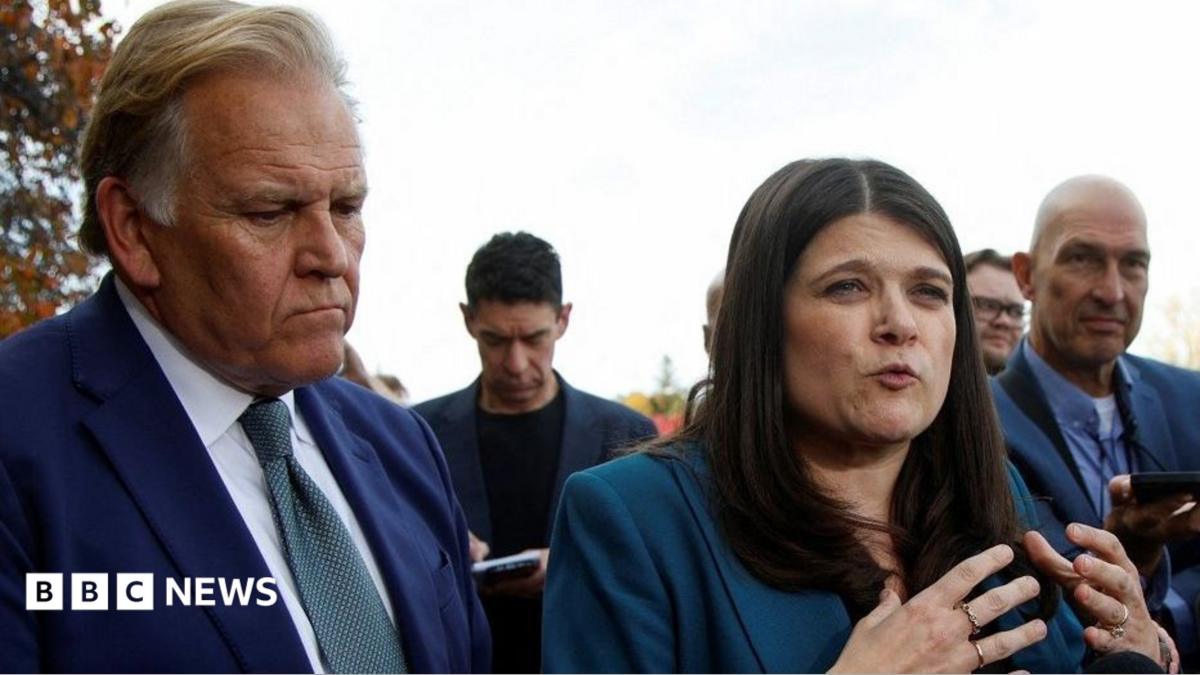
Republican Mike Rogers said Stevens showed "immense courage" in joining his campaign. He earlier said: "I would be honoured to earn support from Democrats across Michigan who believe in saving Michigan."
US President Donald Trump called her "very brave" at a campaign rally in Iowa, adding that she "said what few people were willing to say" and that he would love her to join the Republican Party.
Abdul El-Sayed told reporters he was focused on the problems Michiganders are facing when asked about Stevens' endorsement.
Haley Stevens appeared alongside Republican US Senate candidate for Michigan, Mike Rogers
Hours after Haley Stevens said she would back Republican Mike Rogers in the Michigan Senate race, she told CNN: "I woke up this morning clear-eyed, fresh and focused on what was in my heart, and that's that."
She had previously offered her endorsement to Abdul El-Sayed after conceding defeat to him during a closely-fought primary contest in August.
In her CNN interview, Stevens did not provide her specific rationale, saying: "I changed my mind. (El-Sayed) said, 'Hey, I don't need your endorsement.' That's fine. Why the anger? Why the frustration?"
Stevens insisted that "nothing with me changed". She added that she was now "rock solid" in her choice to back Rogers, although insisted: "I still love my party a whole lot."
Fellow Democrats who condemned the Stevens endorsement were also critical of her interview performance. It was described as "painful" by Debbie Dingell, who, like Stevens, currently represents Michigan in the House of Representatives.Sakshi Venkatraman
US reporter
Tomorrow the US will hold a slate of important elections that could change the direction of the country – and define the final two years of Donald Trump’s presidency.
These are called the midterms. Why? Because they fall in the middle of the president’s term.
While the president is not up for election in the midterms, they are largely a referendum on him and his political party. Under Trump, that’s the Republicans, who control both the White House and Congress, a two-chamber body that writes American laws.
Voters will be choosing those lawmakers tomorrow.
The Democrats, Trump’s opposition, want to take back control. Republicans, of course, want to keep it.
How the midterms play out will shape the country’s laws during a time when cost of living is high, the US is at war and Trump’s time in office is ticking down.
Michigan is one of a handful of battleground contests that will ultimately decide control of the Senate.
The seat is currently held by a retiring Democrat and the last time a Republican was elected to this Senate seat was in 1994. But in presidential elections, it is one of the crucial swing states – Michigan voted for Joe Biden in 2020 but Donald Trump in 2024.
Mike Rogers welcomed Stevens' endorsement and said it showed "courage" during brief remarks with reporters.
President Donald Trump echoed that sentiment during a campaign rally in Iowa, calling her "very brave".
"I don't know Haley. I've never met Haley. But Haley said what few people were willing to say," Trump said. "I'd love her to join the Republican Party actually."
Many of Stevens' staff reportedly resigned immediately after her announcement.
This Flourish post cannot be displayed in your browser. Please enable Javascript or try a different browser.
This Flourish post cannot be displayed in your browser. Please enable Javascript or try a different browser.
This video can not be played
How a Democrat in Michigan rocked the party days before the US midterms
A row has erupted in the Democratic Party after Michigan congresswoman Haley Stevens, who lost out on the party's Senate nomination in the state to Abdul El-Sayed, endorsed Republican rival Mike Rogers
Stevens made a surprise appearance alongside Rogers on Sunday.
"I don't belong in Abdul's campaign," she said in a video posted to X shortly after that appearance. "Who we are as Michiganders is not hate and is not what we are getting out from our Democratic nominee right now."
"That's why I am endorsing Mike Rogers," Stevens said.
The move stunned many of Stevens' fellow Democrats who condemned her decision to switch her support just two days before the election, with one calling it a "despicable betrayal".
The Michigan Senate race is considered by analysts to be one of the tightest in Tuesday's midterm elections. It is one of a handful of battleground contests that will ultimately decide control of the Senate. Grace Eliza Goodwin
US reporter
Here in the US, we're just one day out from a consequential election where control over Congress hangs in the balance.
Can Republicans hold on to their majorities in the House and Senate, or will Democrats wrest back power?
It’s a critical question for US President Donald Trump who has been campaigning in support of Republican candidates around the country. Losing his party’s majority in Congress would weaken his ability to fulfil his agenda and disrupt the remaining two years of his presidency.
We're watching key battleground states that could tip the scales in the Senate, including Texas, Maine, Michigan, Alaska, Ohio, Kansas and Iowa, where we'll have teams reporting on location this week.
American voters will also be deciding who they want to run their cities and states as well as a number of ballot measures on voter identification, property taxes, abortion access and more.
We'll keep you updated with everything you need to know, and why it matters.
Copyright © 2026 BBC. The BBC is not responsible for the content of external sites. Read about our approach to external linking.
About the Author