Follow Stars and Stripes
Follow Stars and Stripes Europe
Follow Stars and Stripes Pacific
Europe
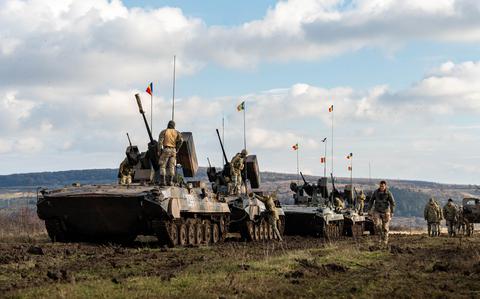
Romanian infantry fighting vehicles pause as their crews carry out inspections during a NATO training exercise near the alliance’s eastern flank in late 2025. A new Atlantic Council report says NATO needs to become more adept at responding to Russia’s campaign of gray-zone warfare, which falls short of actions typically considered an attack. (NATO)
By JOHN VANDIVER
STARS AND STRIPES
Published 2 hours ago
NATO’s military buildup hasn’t stopped Moscow from attacking the alliance in the shadows, exposing a deterrence gap that won’t close until the Kremlin begins paying a price for its provocations, a new analysis argues.
Despite years of strengthening the eastern flank, the 32-country bloc has seen scant success in discouraging Russian sabotage, cyberattacks and drone incursions, according to an Atlantic Council report released this week.
Allies “must persuade the Kremlin that hostile action will carry predictable, material costs and leave no doubt that NATO will respond to military provocations,” analyst Agnia Grigas wrote.
The report, titled “The Deterrence Gap: How can NATO Protect its Front Line from Russia?” urges allies to take a more confrontational approach to Russia’s “gray zone” activities, which have been on the rise as tensions ratchet up.
Besides being focused on the traditional mission of defending against a conventional attack on NATO turf, allies should establish a menu of options that can quickly be put into action in the event of other Russian provocations, the report argues.
Those could include targeted sanctions; restrictions on Russian and Belarusian travel, trade and transit; large-scale diplomatic expulsions and cyberoperations, the report said.
The aim would be to impose immediate penalties on attacks that fall short of outright war or triggering NATO’s Article 5 collective defense clause.
“Future drone incursions, attempted assassinations, sabotage, or comparable attacks on allied territory should prompt more than condemnation,” Grigas wrote. “Responses should be proportionate, coordinated, and preagreed.”
Portuguese soldiers take position aboard their infantry fighting vehicle during a NATO training exercise near the alliance’s eastern flank in late 2025. NATO faces a deterrence gap with Russia that won’t close until the Kremlin begins paying a price for its provocations, a new Atlantic Council report argues. (NATO)
NATO has faced growing criticism for responding too cautiously to Russian tactics, with European officials and security experts warning that the alliance’s reluctance to impose costs is emboldening Moscow.
“If we are hit by Russian hybrid attacks, our answers should be as painful as the attack,” Andrius Kubilius, European commissioner for defense, said at a Euronews defense convention in Brussels last week.
Kurt Volker, a former U.S. ambassador to NATO, made a similar argument.
“We’re left questioning where is the line that if Russia crosses it, we would respond,” he told Euronews in a separate interview.
NATO Secretary-General Mark Rutte has pushed back against such accusations.
“We have all the response options, sometimes visible, sometimes not. Not always public, not always tit for tat,” Rutte said at a news conference last week.
Still, Russia has intensified its campaign of sabotage, cyberattacks and drone incursions across Europe. Such actions include attacks on military infrastructure, disruptions at airports and operations targeting companies supplying weapons to Ukraine.
German intelligence officials warned that Moscow’s increasingly aggressive actions risk developing into open conflict.
Russia is now “waging a shadow war,” with the threat of attacks in Germany being “real and imminent,” Martin Jaeger, the head of Germany’s intelligence agency, said Monday during a parliamentary hearing in Berlin.
Danish military intelligence also warned of escalation of the Kremlin’s campaign in the coming months.
Such assessments coincide with the Atlantic Council report, which says Russia has grown bolder over time.
“Above all, these operations increasingly have a kinetic component and are persistent rather than episodic, forming a continuous pressure campaign that normalizes a higher level of risk for the Baltics, Poland, and Romania,” Grigas wrote.
While NATO grapples with how to deal with Russia’s hybrid moves, its ability to deal with a more conventional Russian attack has improved in recent years.
Defense budgets have steadily increased, especially in the aftermath of Russia’s 2022 full-scale invasion of Ukraine. Allied battlegroups on NATO’s eastern flank have expanded, and front-line allies have taken steps to fortify their positions.
For example, Poland is building a network of bunkers, barriers, sensors and potential minefields along its borders with Belarus and Russia’s Kaliningrad exclave. Similar efforts are taking place in Estonia, Latvia and Lithuania.
Last week, U.S. forces were awakened abruptly for a snap early-morning exercise in northeastern Poland designed to simulate a Russian invasion via the Suwalki corridor.
A patch of ground on the border of Poland and Lithuania, the corridor has long posed security worries for NATO.
The Atlantic Council report estimates Moscow maintains roughly 40,000 ground troops in the wider Baltic region, a number it says could be boosted to about 100,000 by a shift of forces from western Russia.
But deterring such conventional military formations is increasingly well-resourced, while countering persistent gray-zone pressure remains fragmented, the report said.
“If the current trajectory persists over the coming decade, Russia is likely to continue rebuilding conventional forces oriented toward the Baltic region and the Suwalki corridor while using drones, cyber operations, sabotage, and information warfare to probe NATO,” the report said.
NATO
John Vandiver covers U.S. military activities across Europe and Africa. Based in Stuttgart, Germany, he previously worked for newspapers in New Jersey, North Carolina and Maryland. He is a graduate of the University of Delaware.
PREVIOUS COVERAGE
Black Sea tension over attacks on commercial ships comes to NATO’s attention
Estonian infantry brigade sent closer to Russian border as NATO awaits new war plan
NATO Theory of Victory war plan aims to cripple invading Russian forces at border
Marines bring drones and sensors to NATO’s Baltic watch
NATO’s front line now stretches across Europe, top commander warns
Russian helicopter intrusion into Poland marks latest breach on NATO flank
STARS AND STRIPES VIDEOS
AROUND THE WEB
STRIPES TOP NEWS
Navy
Abraham Lincoln Carrier Strike Group receives military’s highest unit-level award for valor in battle
Europe
When military marriages end overseas, some spouses find there’s no easy way home
Asia-Pacific
No alcohol ban, but US troops on Okinawa face heightened oversight during 30-day curfew
Video Spotlight
Sign up to receive a daily email of today’s top military news stories from Stars and Stripes and top news outlets from around the world.
Sign Up Now
About the Author