news Alerts
There are no new alerts at this time
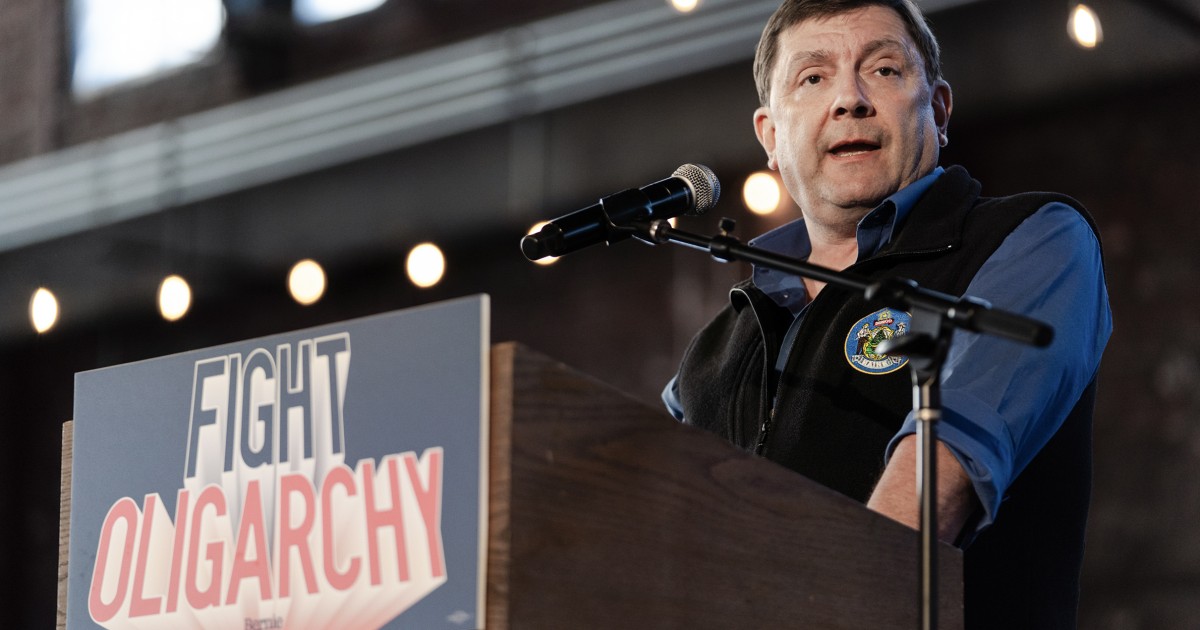
BANGOR, Maine — Former state Senate President Troy Jackson officially became Democrats’ Senate nominee in Maine, starting a 101-day sprint to Election Day in a nationally watched, must-win race for his party.
Subscribe to read this story ad-free
Get unlimited access to ad-free articles and exclusive content.
Hundreds of Democrats gathered in Bangor on Saturday morning for a state convention to pick their Senate nominee after the primary winner, Graham Platner, ended his campaign earlier this month after a sexual assault allegation, which he denied.
Jackson, a veteran legislator, was expected to win the nod after delegate candidates supporting him dominated at county meetings last weekend and all of his major opponents dropped out.
And Democrats are eager to move on to the general election.
“I officially call this convention to order — with a sigh of relief,” Maine Democratic Party Chair Charlie Dingman told the Democrats packed into a ballroom. Dingman announced later Saturday morning that Jackson had captured all but five of the 571 ballots cast at the convention, prompting roars from the crowd and chants of “Troy! Troy! Troy!”
The rapid series of events has shaken the Maine contest, where longtime Sen. Susan Collins, the only Republican representing a state President Donald Trump lost in 2024, is seeking a sixth term. Democrats are looking to net four seats and take control of the Senate this fall, and Maine represents one of their best opportunities to notch a win, at least on paper. If Democrats do not defeat Collins, they’ll have to pick up another seat in a state Trump carried by double digits.
Jackson previewed his case against the senator at Saturday’s convention.
“For nearly 30 years, Collins has told Maine that she is concerned,” Jackson said. “She was concerned while she rubber-stamped Trump’s Medicaid cuts and gutted our healthcare. She’s concerned when she cut taxes for corporations and the wealthy. Concerned when she confirmed justices who overturned Roe v. Wade, and really tragically, she was concerned when she gave ICE billions to terrorize our neighbors and murder people in the streets with no accountability.”
“But concern does not lower the costs of groceries or gas. Concern does not keep our monitoring wards of rural hospitals like down in Lincoln County open. Concern does not restore all the rights that she’s taken away,” Jackson continued.
“Maine does not need another six years of concern.” he added. “We need someone with courage. We need a fighter, and we need a senator who remembers exactly who sent them to Washington.”
The Collins campaign criticized Jackson’s candidacy as “low-energy” and the product of a closed process run by Democratic Party elites.
“Today, in a process concocted by the Maine Democratic Party establishment, a 24-year Augusta insider was appointed to run for the Senate by fewer than three-tenths of one percent of its primary voters,” Collins campaign spokesman Shawn Roderick said in a statement, adding: “Our campaign will continue to run on Senator Collins’ bipartisan record of delivering results for Maine and America, which will stand in stark contrast to Troy’s low-energy campaign and his partisan record of driving up costs, hurting our schools, and making life less affordable for families across the state.”
As his focus turns to Collins, Jackson must confront several daunting tasks, and with no time to spare.
He has to not only build a statewide campaign. He has to raise millions of dollars to compete on the airwaves.
Most of all, he has to convince huge numbers of Mainers who have repeatedly backed Collins for decades that it’s time for her to go.
Many Democrats backed Jackson’s bid because they saw him as the candidate with the best chance of defeating Collins in November.
Supporters of Jackson, a former logger and longtime legislator from Allagash, a tiny town at the northern tip of the state, believe he will have unique appeal to working-class voters and cut into Collins’ margins in rural Maine. It’s the first time Collins, from Aroostook County, will be facing an opponent who also hails from the same sprawling area.
“The working class has been left behind and forgotten about,” said Shelly Mountain, a former Aroostook County Democratic Committee chairwoman and a pro-Jackson delegate at the convention.
“He is definitely working class and always — has always,” she emphasized again, “been a champion for the working class.”
A Democratic strategist with experience in Maine races, granted anonymity to speak candidly about the race and Jackson’s potential challenges, noted that a Democratic statewide win against Collins involves narrowing a likely loss in the rural 2nd Congressional District to high single digits.
“Being from Aroostook County and having shown a pretty significant overperformance in his state Senate races, [Jackson] is well-suited to do that,” the strategist said, later adding: “Of course, Sen. Collins is not a pushover. She’s done very well over the state but also particularly the 2nd District.”
Other Democrats noted that Jackson mainly has to run up the score in traditionally Democratic strongholds of Portland and other cities.
“There’s a path without expanding the map,” said David Farmer, a Maine Democratic strategist. He noted that Collins’ 2020 opponent, former state House Speaker Sara Gideon, underperformed the Democratic presidential ticket in Portland and other blue areas, due in part to a third-party candidate.
Farmer was optimistic that this year, Democrats would stay united.
“The reactions to Trump, to the ICE killing in Biddeford, to high prices, to the war [with Iran] — that solidifies Democrats so they’re less likely to drift than in 2020,” Farmer said.
But the Democratic strategist noted that when Jackson ran in the party’s primary for governor earlier this year, he struggled in more affluent parts of the state where Collins has performed well, even as they have shifted away from the GOP in the Trump era.
“He’ll need to do better in the greater Portland suburbs,” the strategist said.
The 2020 election provides some clues about Jackson’s challenges ahead. That year, Collins won re-election nearly 9 points even as Joe Biden carried the state by the same margin.
Exit polls show that Collins overperformed with independents, moderates and women. Independents who voted for Biden by 24 points also voted for Collins by 3 points. Self-identified moderates swung 24 points for Biden, but they voted for Collins by 7 points.
Women, who have long been key to Collins’ victories, broke for Biden by 23 points, but they voted for Collins by 3 points. Collins overperformed among women who didn’t go to college and limited the margin of defeat among white women with college degrees, one of Democrats’ strongest constituencies.
Jackson’s most immediate challenge is fundraising. His campaign announced Wednesday that it had raised over $600,000 in roughly 72 hours, surpassing $1 million since launching his Senate run on July 8. Collins’ campaign had $11 million to spend as of June 30, and Republican groups are gearing up to spend millions more.
Asked if he has enough money to win the race, Jackson said with a laugh, “Well not now, but I hope to get it,” adding that he’ll have the resources to prevail “because we got the right message.”
Jackson is likely to get outside help, too, as Democratic groups that had abandoned Platner amid his scandals re-engage in the race.
Ahead of the convention, Sen. Kirsten Gillibrand, D-N.Y., the chair of the Democratic Senatorial Campaign Committee, signaled that Jackson could expect full support from the deep-pocketed party apparatus once he clinched the nomination.
“We’re excited for Maine,” Gillibrand said, adding that after state Democrats “finish their primary,” the DSCC will “support whoever wins.”
Jackson said Saturday that he has not spoken with any Democratic senators, and had not yet spoken with Senate Minority Leader Chuck Schumer, D-N.Y.
Republicans, meanwhile, are gearing up to unload attacks on Jackson, particularly over his long tenure in the state Legislature and his ties to Platner.
Senate Leadership Fund, a GOP super PAC, is launching a new six-figure ad campaign aimed at Jackson, starting with a digital ad launching on Saturday. The group has plans to spend more than $42 million on the race.
The ad highlights recent headlines on Jackson’s temper and heated confrontations with legislative colleagues, with a narrator saying, “A volatile personality, anger issues with women, verbal abuse. It’s not Graham Platner, it’s Troy Jackson. Jackson has a history of conflicts with women, bullying, even intimidation.”
“I disagree,” Jackson said when asked about the ad after the convention on Saturday.
“I am passionate about those issues. I mean, there’s just no doubt about it,” Jackson said, later adding: “Anyone that I may have argued with, that I might have went too far or got too passionate. I apologize to. But I don’t have a problem with anyone in the Legislature and the U.S. Senate.”
Jackson’s supporters were not concerned about those attacks.
“If I had been going through the same bulls— argument about stripping people’s coverage for their medications, I’d be throwing f—–g water bottles too,” said McGinley Jones, a 56-year-old small-business owner and convention delegate from Washington County, referring to an episode where Jackson reportedly threw a water bottle during a meeting on prescription drug legislation.
“I’m all for him getting passionate,” said Jim Gerritsen, an organic farmer representing Aroostook County at the convention, who has worked with Jackson on some pieces of legislation. “I’m all for him getting strong to fight for us because we know for sure that Susan Collins has never lifted a finger in her life to fight for the working class.”
Jackson and Platner were close allies and campaigned together, although Jackson quickly called on Platner to step aside following the sexual assault allegation.
Lance Dutson, a GOP strategist in Maine who worked on Collins’ past campaigns but is not involved in the race, suggested the contest resets without Platner, whose viral videos and impassioned critiques of the political and economic systems catapulted him to national fame.
With a “generic Democrat” as her opponent, Dutson predicted the contest would focus instead on their legislative records.
“People are going to be able to put his record up against Collins’ record. And there’s really no comparison between the two,” Dutson said, noting that Collins can point to “literally billions and billions of dollars” she has brought to Maine as a longtime member, and now chairwoman, of the powerful Senate Appropriations Committee.
Collins herself has already started to try and define Jackson as out of step with Mainers.
She told NBC News earlier this week that Jackson “seems to be firmly aligned with the democratic socialists,” and she recently told CNN that Jackson is a “Bernie bro,” referring to his support for Sen. Bernie Sanders, I-Vt., during the 2016 presidential primary.
Sanders, who endorsed both Jackson and Platner in their primaries, stayed out of the brief race to pick a new Senate nominee. But he praised Jackson this week as someone who “understands the problems of the working class in Maine and throughout this country.”
Dutson, the GOP consultant, acknowledged that Jackson could have some appeal in rural parts of the state given his roots in northern Maine, but said his policies were still too far left.
“If you’re from Aroostook County, Maine, but you’re standing onstage with Bernie Sanders, that’s just a massive disconnect,” Dutson said.
One reason Democrats are relieved is Jackson wins them back voters like Carol Eisenberg, a lawyer based in Maine, who supported Janet Mills in the primary and was leery of Platner after he won the nomination.
Jackson “has my full support,” she said. “I would never cast a ballot for Susan Collins. I just wasn’t sure if I would be able to cast one for Platner.”
Bridget Bowman is a national political reporter for NBC News.
Sahil Kapur is a senior national political reporter for NBC News.
© 2026 NBCUniversal Media, LLC
About the Author