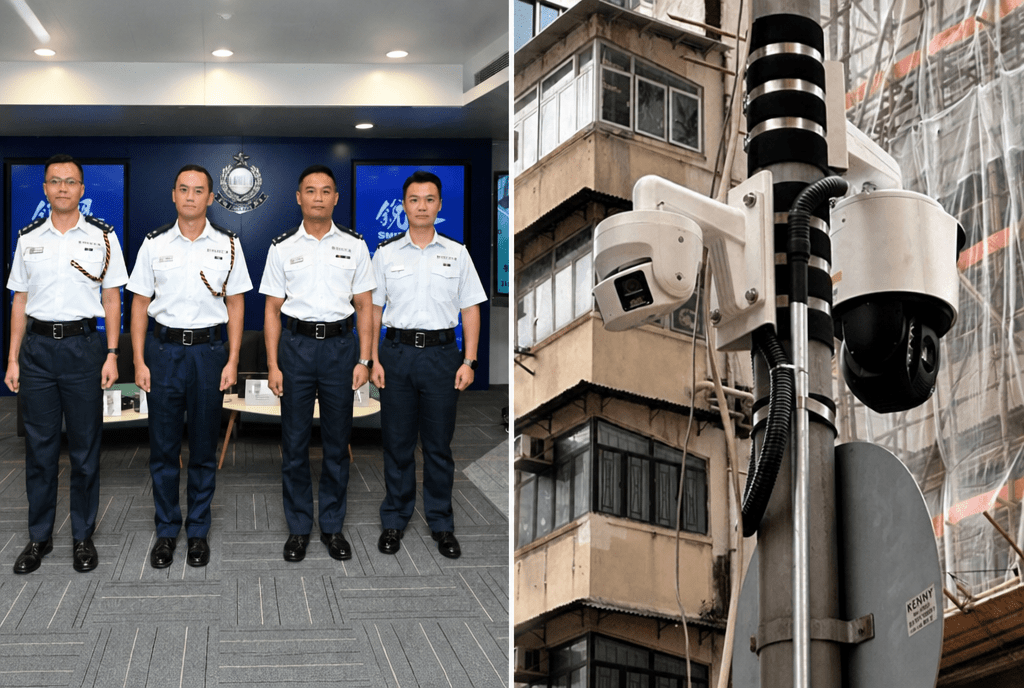
Hong Kong police will roll out artificial intelligence facial recognition across the force's Smart View closed-circuit television network within this month, aiming to accelerate criminal investigations and locate vulnerable missing persons, particularly elderly residents suffering from dementia.
Senior officers announced that the force is expanding surveillance infrastructure toward a target of approximately 60,000 cameras across strategic public and transit locations by 2028.
As part of the expansion, police are in discussions with major private commercial properties, with the first batch of private shopping malls expected to connect their camera feeds directly to the police surveillance grid as early as the end of this year.
Operations Bureau Senior Superintendent Leung Ming-leung stated that reviewing and cross-referencing video footage has traditionally required substantial manpower and investigative hours. Introducing facial recognition algorithms directly into the Smart View infrastructure will automate analysis, functioning as around-the-clock investigative support to identify suspects and locate missing individuals while freeing frontline officers for field duties.
Following the completion of the first phase, which established over 10,000 cameras at crime blackspots and high-traffic locations, police plan to add 20,000 cameras annually over the next few years.
The rollout will encompass public housing estates, boundary control points, transport hubs, tunnels, major expressways, and major sports and cultural venues such as Kai Tak Sports Park.
Police are also working with private commercial operators to integrate private mall camera feeds into the system, with at least 4 major shopping centers expected to take part in the initial phase before year-end.
The direct connection will enable officers to review feeds remotely from police offices during active inquiries, removing the need to dispatch investigators on site to complete manual record requests.
Authorities noted that malls are already legally required to display general closed-circuit television notices, and after consulting the Department of Justice and the Privacy Commissioner for Personal Data, officials decided not to mandate separate Smart View signage on individual cameras, though malls will be encouraged to post notices voluntarily to deter crime.
The facial recognition module will operate under two distinct modes depending on investigative needs. Under retrospective search protocols, officers who possess facial images of a suspect can enter biometric identifiers into the system to determine whether that individual appeared within specific camera locations or time windows.
Under real-time tracking protocols, intended primarily for vulnerable missing persons, police will input facial photographs obtained with family authorization, triggering instantaneous system alerts to frontline commanders whenever the missing person passes within camera range.
Operations Bureau Superintendent Raymond Cheng noted that because continuous facial recognition analysis requires heavy computational resources, the feature will not run simultaneously across every lens on the network.
Algorithms will be less frequently deployed on high-speed expressways, but technical capacity can be dynamically reallocated around the clock to specific cameras when specific cases warrant intensive monitoring.
Addressing privacy concerns, Leung emphasized that data collection is strictly confined to four statutory purposes, covering national security, crime prevention and detection, public safety, and public order.
Before officers can access footage, inquiries must satisfy an internal two-gate test that assesses whether accessing Smart View is necessary to solve the crime and ensures that the requested camera count and timeframe remain proportionate.
All installations are positioned strictly to capture public areas, supported by independent privacy impact assessments and ongoing regulatory consultations.
Standard surveillance video recordings are automatically erased within 30 days in compliance with personal data legislation, unless preservation is legally mandated or justified in the public interest.
However, because facial feature data files require minimal storage capacity and complex criminal cases may take months to surface, police confirmed that facial biometric data will be retained longer than the standard 30-day window, with sources indicating a retention period of around 180 days.
To defend against cybersecurity risks and external hacking, the force operates Smart View on a dedicated private optical fiber network, while mandatory firewall barriers isolate all external and commercial camera feeds before data enters police servers.
𝗗𝗼𝘄𝗻𝗹𝗼𝗮𝗱 𝗧𝗵𝗲 𝗦𝘁𝗮𝗻𝗱𝗮𝗿𝗱 𝗔𝗽𝗽 ↓
About the Author