Saturday Nov 07, 2026
Dailymirror
Sunday Times
Mirror Edu
Tamil Mirror
Lankadeepa
Middleast Lankadeepa
Ada
Deshaya
Life Online
Hi Online
Hitad
Timesjobs
E-Paper
Home delivery
Advertise with us
Print Ads
WNL Home
Saturday, 7 November 2026 00:00 – – {{hitsCtrl.values.hits}} 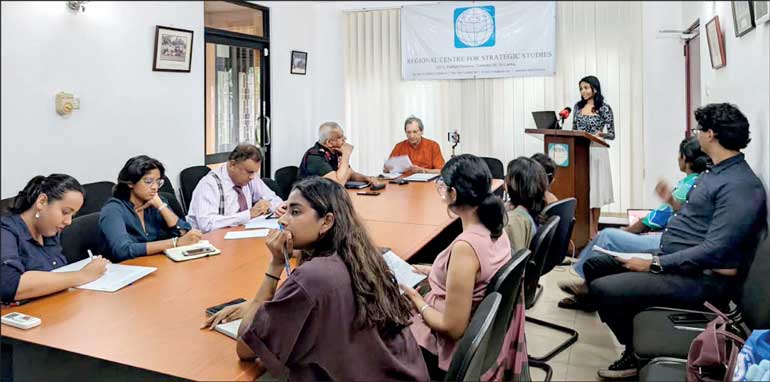
A Policy Study, authored by RCSS Researcher Thedini Herath, has found that the 2026 Middle East war did not create, but dramatically exposed how heavily South Asian states depend on a single region.
It noted that the war hit all five pillars of dependence at once: soaring oil prices raised fuel import bills and strained foreign reserves; the closure of the Strait of Hormuz disrupted the region’s key trade routes; the loss of jobs in the Gulf threatened the livelihoods of tens of millions of South Asian workers; Gulf financing tightened as sovereign wealth funds turned inward; and long-standing politico-strategic partnerships with countries on different sides of the conflict were tested.
The study called for reducing this over-concentration in order to build long-term resilience in the relationship.
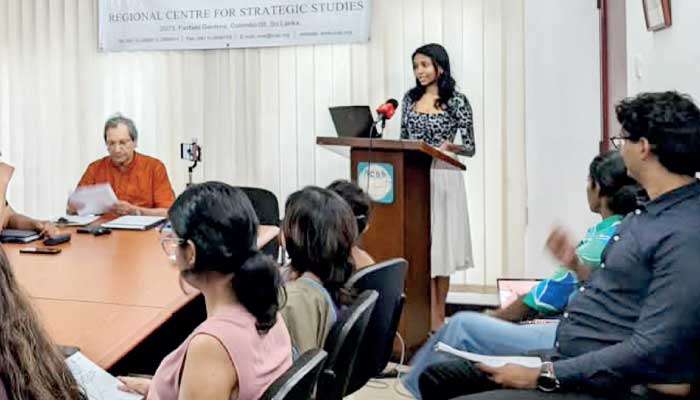
The study titled South Asia’s ‘Middle East Dependency Trap’: How the 2026 Iran War Exposed the Region’s Politico-Economic Vulnerabilities, was presented by the author at the RCSS-MIR joint webinar titled ‘Evolving South Asia–Middle East Relations: Opportunities for Cooperation in a Changing Geopolitical Landscape’, held on 29 October 2026, with a live audience at RCSS, Colombo, and participants joining virtually from the UAE and representatives from Sri Lanka’s diplomatic missions in the Middle East region and scholars across the region.
The co-chairs of the session welcomed the new partnership between the two institutions, established through a Memorandum of Understanding (MoU) signed in July 2026. MIR Director of Research Dr. Ahmed Abdel Alim celebrated the rapid movement from discussion to concrete action, observing that the war had created both challenges and opportunities for the two regions and shown how deeply interconnected they are. RCSS Executive Director Ambassador Ravinatha Ariyasinha, while noting that the collaboration extended the RCSS’s reach to the Middle East region, said the policy study also marked the RCSS’s return to theoretical work, offering a timely, in-depth look at South Asia as a whole in relation to the Middle East.
Viewing current developments through the prism of Robert Keohane and Joseph Nye’s concept of ‘complex interdependence’, Herath noted that the study shows that the imbalance in the relationship is a source of vulnerability. However, while Keohane and Nye focus mainly on economic and transnational ties, the study adds ‘politico-strategic partnerships’ as a distinct pillar of interdependence. In a further theoretical contribution, the study emphasises how the present war also points to an additional dimension of vulnerability that may need to be integrated into the interdependence framework.
While Keohane and Nye’s analysis saw military force as playing only a minor role, and as something the governments in an interdependent relationship might use, whether against each other or against outside powers, rather than treating strategic ties as a channel of interdependence in its own right, South Asia’s interdependence with the Middle East was disrupted by an extraneous force – in a war between the United States, Israel and Iran – in which none of the South Asian countries had any part.
During the open discussion that followed, the extent of the UAE’s contribution to South Asian economies and their resilience during the crisis was discussed, along with how expanded cooperation between the two institutions could play a vital role in these times. Responding, Herath noted that the study recognises these mutual benefits and appreciated the support provided. Turning to the protection of migrant workers, Herath pointed to the potential of existing forums, such as the Colombo Process, which brings together the region’s labour-sending states, and the Abu Dhabi Dialogue, which connects both the sending and receiving countries. She said these platforms could advance skills recognition, ethical recruitment and standard employment contracts, helping move workers out of the most precarious jobs and up the skills ladder.
It was also noted that while cooperation through multilateral fora between the two regions as a whole remains important, both South Asian and Middle Eastern countries must also work hard to safeguard their respective bilateral relationships, rather than letting them be absorbed into the larger regional relationship, so that the close bilateral relations built over decades are not lost. Asked whether South Asia’s dependence amounted to neo-colonialism, Herath noted that while colonial history helped create the early links, the current dependence was not imposed by a coloniser but was largely built through South Asia’s own choices, which is why the study describes the relationship as asymmetric interdependence. On the options open to small states, she described non-alignment as part of a wider hedging strategy, pointing to Sri Lanka’s own response during the current war: when the Iranian vessel IRIS Dena was sunk off its southern coast, Sri Lanka rescued and assisted the survivors, while also declining both a US request to land warplanes at Mattala and Iranian requests for naval goodwill visits.

Editorial :
+94 0112 479 356 , +94 0112 479 780
+94 0112 447 848
Technical :
+94 011 247 9437
[email protected]
[email protected]
Marketing :
+94 011 247 9540
+94 011 247 9873
Web Advertising Inquiry :
Dilan : +94 77 372 7288
Print Advertising :
Chameen Dayarathne,
Manager – Marketing,
: 076 928 5885 / 011 247 9597
: [email protected]
Mr Channa Jayasinghe,
General Manager: Sales & Marketing
: +94 777 880 155
: [email protected]
All the content on this website is copyright protected and can be reproduced only by giving the due courtesy to ‘ft.lk’ Copyright � 2004 Wijeya Newspapers Ltd.
About the Author