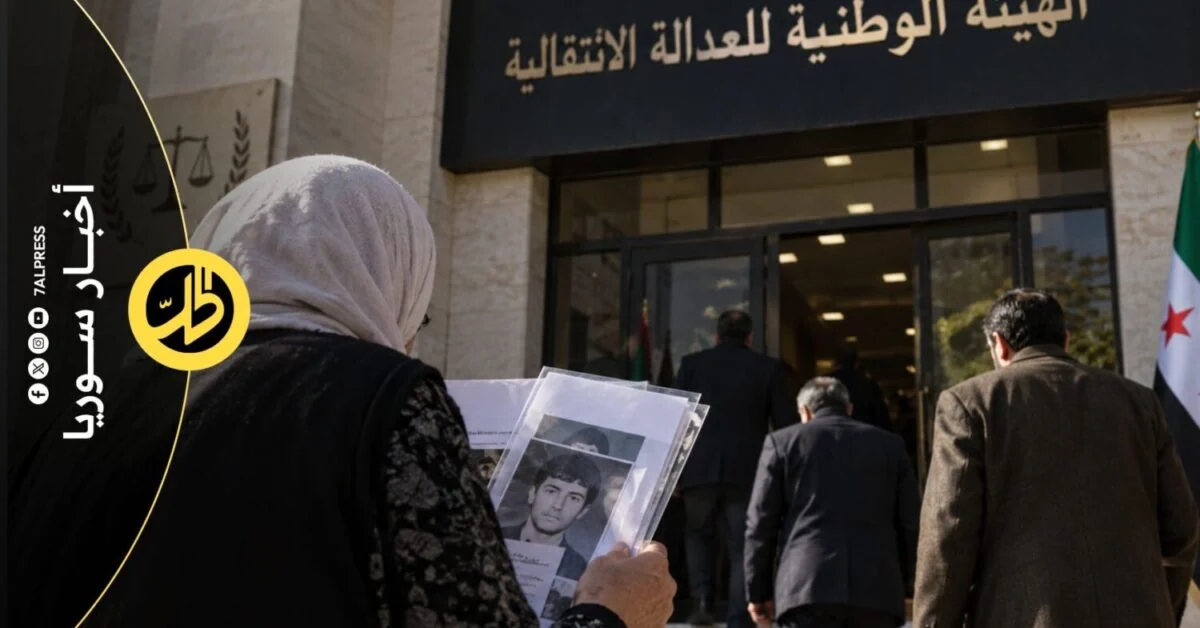
A human rights report released in October 2026 warns that Syria’s transitional justice process suffers from a widening gap between the institutional steps taken by transitional authorities and the lived reality of victims. The report says this disconnect persists amid limited resources, vague mandates, and the absence of effective mechanisms to ensure accountability for violations committed by multiple actors throughout the conflict.
The study, “Transitional Justice in Syria: Challenges of Transitioning from Ambition to Implementation on the Ground,” published jointly by the Ceasefire Centre for Civilian Rights and Syrians for Truth and Justice (STJ), notes that the mandate of the National Commission for Transitional Justice is currently restricted to crimes committed by the former regime up to December 8, 2024. As a result, victims of the Islamic State (ISIS), foreign forces and their affiliated militias, and non‑state armed factions fall outside its scope.
A Commission Constrained by Limited Resources and Ambiguous Mandates
Although the National Commission for Transitional Justice was established by presidential decree in May 2025 and conducted field consultations across 12 governorates, the report says its work remains hampered by institutional obstacles. These include shortages of resources, limited access to evidence, and an unclear division of responsibilities between the Commission and other state bodies, particularly the Ministry of Justice.
The report notes that some Commission members pay their own travel expenses to reach governorates, while public awareness of the Commission’s existence remains low, especially in rural areas and among minority communities. At the time of the research, the Commission had no permanent offices outside Damascus.
Still, the report acknowledges progress in preserving documentation related to former regime violations. It cites Deputy Interior Minister Abdul Qader Tahan, who said the ministry had preserved roughly 90 to 95 percent of its archive and established a specialized unit dedicated to safeguarding it.
The findings draw on field visits and interviews conducted between 2025 and May 2026 with more than 40 individuals from Damascus, Rural Damascus, Homs, Aleppo, the coastal region, Suweida, Deir ez‑Zor, and Qamishli, as well as Syrians in the diaspora.
Victims of the Coast and Suweida: Fears of Selective Justice
The report highlights victims’ concerns over the absence of accountability following the violence on the Syrian coast in March 2025 and the deadly events in Suweida in July of the same year. Interviewees expressed deep mistrust in the authorities’ ability to hold perpetrators accountable and voiced fears over ongoing sectarian attacks targeting Alawites.
The report also criticizes the lack of institutional pathways to hold other actors accountable, including Russian forces, Iranian‑backed militias, Turkish forces and aligned factions, and the US‑led International Coalition. Victims of violations attributed to these entities, it says, lack any comprehensive framework for formal recognition or reparations.
The authors call for expanding transitional justice to include all victims, regardless of the perpetrator. They recommend incorporating war crimes, crimes against humanity, torture and enforced disappearance into the Syrian Penal Code; reforming the judiciary; guaranteeing judicial independence; protecting witnesses; and establishing mechanisms for property restitution and redress.
They also urge the publication of clear criteria governing financial settlements with figures linked to the former regime, stressing that such settlements must not confer criminal immunity. The report further recommends creating an international fund to support civilian compensation.
Financial Settlements: Transparency and Accountability Under Scrutiny
The report examines the financial settlement process overseen by the National Anti‑Ill‑Gotten Gains Commission, which handles cases involving figures associated with the former Assad government. The Commission was established under Presidential Decree No. 13 of 2025 alongside the transitional justice track.
A central concern, the report says, is that these settlements are processed through a body separate from the Transitional Justice Commission, raising questions about coordination between recovering illicitly obtained funds and ensuring accountability for crimes.
Abdul Basit Abdul Latif, head of the Transitional Justice Commission, affirmed that financial settlements do not grant amnesty, security guarantees or protection from prosecution to individuals who committed crimes against Syrians. He stressed that the Commission does not participate in these procedures. However, the report argues that such assurances are insufficient without greater transparency regarding settlement mechanisms and conditions.
The report warns that the absence of public criteria detailing how individuals are selected for settlements, the required payments, and the nature of disclosures demanded from them risks eroding victims’ trust in the transitional justice process. Recovering funds alone does not answer questions of accountability, nor does it guarantee truth‑seeking or prosecution.
The authors stress the need to publish clear standards for financial settlements and ensure that beneficiaries receive no criminal immunity, keeping alleged crimes subject to investigation and judicial review. Without such safeguards, they warn, settlements risk becoming a purely financial track detached from justice—one in which funds are recovered while victims remain uncertain about how perpetrators will be held accountable.
This article was translated and edited by The Syrian Observer. The Syrian Observer has not verified the content of this story. Responsibility for the information and views set out in this article lies entirely with the author.
About the Author