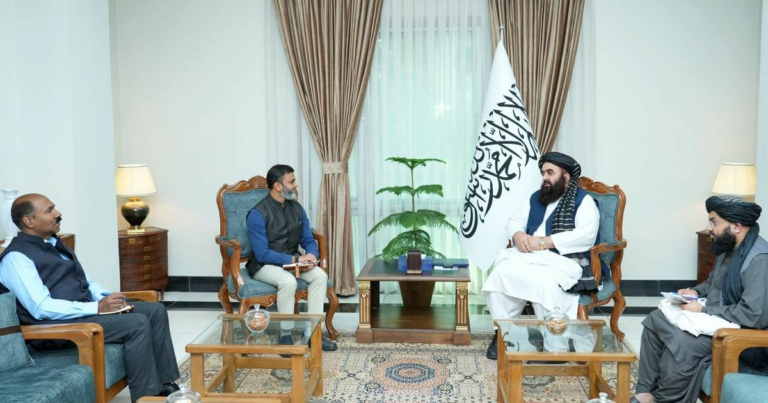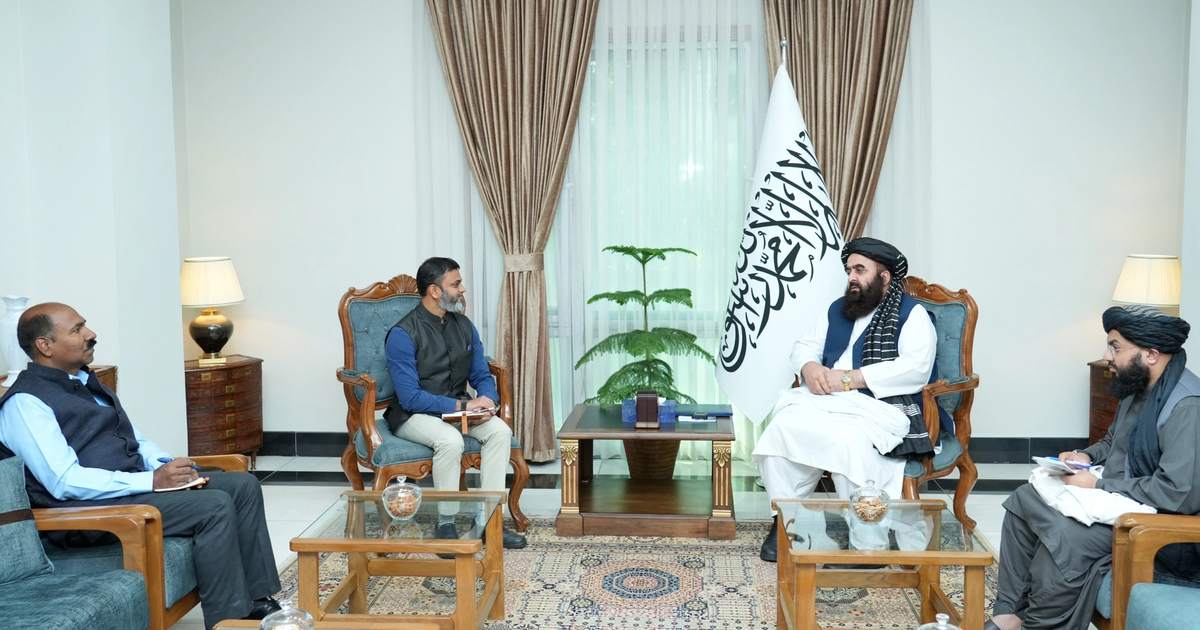
The Taliban Foreign Ministry says Amir Khan Muttaqi met Indian chargé d’affaires Yatin Patel in Kabul to discuss expanding bilateral ties, trade and political, economic and humanitarian cooperation.
In a statement on Wednesday, 14 October, the Taliban Foreign Ministry said Muttaqi stressed the importance of relations with India during the meeting.
The Taliban foreign minister said trade between Afghanistan and India was increasing and called for stronger links and cooperation between the two countries and their private sectors to maximise their respective potential.
The ministry quoted India’s chargé d’affaires as saying New Delhi wanted to engage with the Taliban administration and expand relations with Afghanistan in the political, economic and humanitarian fields.
Taliban officials have previously called for expanded economic relations with India and for New Delhi to resume and complete unfinished projects in Afghanistan during meetings with the Indian chargé d’affaires.
Over the past two decades, India has played a significant role in Afghanistan’s reconstruction through projects in infrastructure, education, healthcare and development.
Following the Taliban’s return to power in August 2021, many Indian development projects were suspended or faced restrictions.
In recent years, however, New Delhi has pursued greater engagement with the Taliban and resumed some humanitarian assistance and development cooperation with Afghanistan.
Iranian MP Mohammad Mehdi Shahriari says Tehran may make 100 hectares of land at Chabahar port available to Afghanistan for two to five years for imports and transit activities.
Shahriari is a member of the Iranian parliament’s National Security and Foreign Policy Commission.
He said Afghanistan has no access to international waters and that the land could be made available to the Afghan side to import goods through Chabahar port and transport them through Iranian territory.
He stressed that any such arrangement would preserve Iran’s territorial sovereignty and would not amount to transferring Iranian territory.
Iranian Foreign Ministry spokesman Esmaeil Baghaei recently stressed that transferring Iranian territory to another country was not possible and said claims to that effect were the result of a misunderstanding.
He said the issue under discussion concerned possible ways of helping landlocked countries gain access to ports and international waters and that no formal proposal existed to transfer Iranian land or territory to Afghanistan.
Baghaei also said discussions about transferring sovereignty or handing over part of Iranian territory to Afghanistan had no factual basis, adding that Tehran was only considering ways to facilitate Afghan trade and investment in Chabahar.
Shahriari’s remarks have once again brought the issue of Afghanistan’s presence and investment at Chabahar port to the centre of political debate in Iran.
The issue had previously sparked controversy. On 9 October, Iranian MP Mohsen Zangeneh, who travelled to Kabul as part of a parliamentary delegation, said around 10 hectares of land at Chabahar port and more than 100 hectares in the port’s free zone had been designated for Afghan investment.
His remarks drew widespread reaction in Iranian media and on social networks, with some interpreting them as suggesting that part of Iranian territory would be handed over to Afghanistan.
Zangeneh later walked back his initial comments, explaining that he had not meant a transfer of ownership or sovereignty over Iranian territory.
He said the proposal was instead intended to provide facilities for Afghan investment and to develop transit infrastructure, including a dry port, in Chabahar.
Chabahar port has in recent years become one of Afghanistan’s most important routes to international waters.
Its importance has grown particularly amid increasing border and trade tensions between the Taliban and Pakistan, while Taliban officials have repeatedly stressed expanding the use of the route for trade and the transit of goods.
Taliban spokesperson Zabihullah Mujahid says Afghanistan is offsetting losses from closed Pakistani border crossings by using alternative routes and expanding trade with Central Asian countries.
Before the crossings were closed, annual trade between Afghanistan and Pakistan was estimated at around $2.35 billion.
Mujahid told state television on Tuesday that Afghanistan’s import and export needs were now being met through Iran and Central Asian countries.
Following border clashes between the Taliban and Pakistan in October 2025, the main crossings between the two countries, including Torkham and Spin Boldak, were closed, forcing Afghan traders to move goods through alternative routes.
According to a World Bank report, 48 per cent of Afghanistan’s imports in August this year arrived through Central Asian routes and 46 per cent through Iran, while Pakistan’s share fell to almost zero.
Figures from the Taliban’s Ministry of Industry and Commerce show that Afghanistan’s trade with the five Central Asian countries reached $2.62 billion in 2025, up 45 per cent from the previous year.
During that period, Afghanistan’s imports from Uzbekistan, Turkmenistan, Tajikistan, Kazakhstan and Kyrgyzstan rose by 43 per cent, while exports to those countries increased by 77 per cent. However, part of this growth occurred before the closure of the Pakistani border.
According to the Taliban’s Ministry of Industry and Commerce, Afghanistan’s trade with Central Asia reached $1.278 billion in the first five months of 2026, including $1.204 billion in imports and $74 million in exports.
By contrast, the value of Afghan exports to other countries through the Wagah crossing and Pakistani ports fell from $454 million in the 2025 financial year to $7 million in the 2026 financial year.
Before the border closures, direct trade between Afghanistan and Pakistan was estimated at at least $6.45 million a day, equivalent to around $2.35 billion a year.
The World Bank says the continued closure of Pakistan’s crossings has reduced Afghanistan’s food exports and almost halted coal exports.
Textile exports, however, have increased, with some shipments being transported to China through Central Asia.
Taliban Foreign Minister Amir Khan Muttaqi thanked Qatar on Tuesday for its efforts to expand the Taliban’s relations with other countries during a meeting with Qatari Ambassador to Kabul Mirdef Al-Qashouti.
According to the Taliban Foreign Ministry, the two discussed relations between the Taliban and Qatar and ways to broaden the group’s engagement with the international community.
Muttaqi described the Taliban’s relations with countries around the world as expanding.
The ministry said in a brief statement that the meeting included comprehensive discussions on bilateral relations between Afghanistan and Qatar, particularly Qatar’s facilitation and efforts to strengthen the Islamic Emirate of Afghanistan’s relations with the international community.
The statement added that the foreign minister described the Islamic Emirate of Afghanistan’s relations with the international community as expanding and said Qatar’s efforts in this regard were worthy of appreciation.
According to the Taliban Foreign Ministry, the Qatari ambassador also stressed that his country would continue working to expand these relations and described the progress made so far as encouraging.
Qatar has for years served as one of the Taliban’s most important channels of communication with the United States and Western countries and hosts the group’s political office in Doha.
The office facilitated negotiations between the Taliban and the United States, which led to the Doha agreement and the withdrawal of US forces from Afghanistan. As those forces withdrew, Ashraf Ghani’s government collapsed and the Taliban returned to power.
Qatar maintained its relations with the Taliban following the group’s return to power and has become one of its most important intermediaries with the international community.
According to the Taliban, Qatar’s prime minister is the only senior foreign official to have met Taliban leader Hibatullah Akhundzada in Kandahar.
Qatar has also played a role in diplomatic efforts concerning Afghanistan in recent years. It has hosted talks between the Taliban and Pakistan and assisted with meetings related to engagement between the Taliban and the United Nations.
Despite these ties, Qatar has not recognised the Taliban government.
Russia is the first country to have formally recognised the Taliban government. Several other countries have maintained relations and engagement with the Taliban without formally recognising its government.
The Afghanistan Chamber of Commerce and Investment has announced that five trade contracts worth $55 million were signed during a visit to Kazakhstan by a delegation representing 10 Afghan companies. The agreements cover the supply of flour, wheat and other agricultural products.
According to the Afghanistan Chamber of Commerce and Investment, the delegation travelled to Kazakhstan on 8 October to participate in the international event “Agricultural Season After Harvest 2026”.
An exhibition of agricultural machinery and products, along with direct business meetings between traders from the two countries, was also held on the sidelines of the event.
The chamber said that of the total contracts signed, agreements worth $40 million were for the supply of wheat and other agricultural products, while contracts worth $15 million were for flour.
According to a statement issued by the chamber, the delegation included importers and agricultural traders from Herat, Kabul, Kandahar and Balkh provinces.
The delegation was led by Wahidullah Azizi, a member of the board of directors of the Afghanistan Chamber of Commerce and Investment and head of its Food Committee.
The Taliban had previously announced the signing of trade contracts worth $20 million between traders from Herat and Kazakhstan.
According to international trade data from the World Bank and the United Nations, Kazakhstan and Uzbekistan are among Afghanistan’s main suppliers of wheat flour.
In 2024, Uzbekistan ranked first in terms of the value of flour exports to Afghanistan. However, Kazakhstan exported a greater quantity of flour to Afghanistan than Uzbekistan.
Kazakhstan’s exports to Afghanistan are 70 times greater than its imports from the country.
During the first five months of 2026, Kazakhstan exported approximately 589,000 tonnes of wheat flour to Afghanistan, worth $162.9 million.
Trade between Afghanistan and Kazakhstan reached $545.2 million in 2024 before declining slightly to $541.8 million in 2025.
According to figures released by Kazakhstan, the country exported approximately $519 million worth of goods to Afghanistan in 2025, while its imports from Afghanistan totalled $22.8 million.
During the first seven months of 2026, bilateral trade reached $581.1 million, comprising $572.9 million in Kazakh exports to Afghanistan and $8.2 million in imports from Afghanistan.
Flour, wheat and vegetable oil were among Kazakhstan’s main exports to Afghanistan during this period, with export values of $215.6 million, $122 million and $51.1 million respectively.
Taliban governors from seven provinces including Kandahar, Balkh, Herat, Kunduz, Nangarhar, Paktia and Kabul have held a meeting in the Afghan capital city.
Participants discussed a range of issues, including the implementation of decrees issued by the Taliban leader, border affairs, efforts to combat drug trafficking and improvements to the security situation.
The Taliban’s Interior Ministry announced on Tuesday, 13 October, that a regular coordination meeting of governors from the country’s seven zones had been held in Kabul.
According to a ministry statement, participants reviewed reports from previous meetings of governors across the seven zones and discussed matters relating to the Taliban leader’s decrees, border management, combating drug trafficking, improving security management, mining operations and creating employment opportunities.
The meeting comes after Taliban governors in the country’s northern, southern, eastern and western zones held separate meetings in recent days to discuss various issues, particularly the security situation.
An increase in armed attacks against the Taliban in different parts of Afghanistan, from the north and east to the west and south, has become a major concern for the group in recent months.
Repeated meetings involving governors and senior security officials indicate that managing the security situation and countering the expanding activities of armed opposition groups have become central issues in the Taliban’s recent discussions.
Expansion Of Armed Resistance
Concerns about the growing activities of armed groups opposing the Taliban intensified after the Afghanistan Freedom Front launched a series of attacks against Taliban positions in Nuristan and Kunar provinces, claiming to have captured several Taliban outposts.
Several more explosions have occurred in Badakhshan over the past ten days. Attacks against the Taliban have also been reported in Panjshir and Ghor provinces over the past two days.
The Afghanistan Freedom Front, National Resistance Front of Afghanistan, United Front of Afghanistan, Republican Front, the Green Unit affiliated with Amrullah Saleh, and the Sepahi Mihan Front are among the known armed opposition groups currently carrying out attacks against the Taliban.
Reports of attacks against the Taliban have emerged from various parts of the country in recent days.
The continued attacks, together with concerns about the expansion of armed opposition activities, have increased security pressures on the Taliban.
Meanwhile, the Taliban have been holding public meetings and urging residents to cooperate with their authorities in an effort to strengthen local support for maintaining security.
About the Author